Activity
Mon
Wed
Fri
Sun
Sep
Oct
Nov
Dec
Jan
Feb
Mar
Apr
May
Jun
Jul
Aug
What is this?
Less
More
Clief Notes
45.9k members • Free
AI First Designer School
1.8k members • $129
12 contributions to Clief Notes

21d •
One ICM System or One Per Customer?
A question for those using ICM to provide software or consulting services: When you work with multiple customers, does one ICM system support all of them, with separate customer configurations, requirements, data, and outputs? Or do you create and maintain a separate ICM structure for each customer or software product? I’ve been thinking about this through the way I create my own products. I reuse many of the same standards, checks, scripts, and production methods, but different product types may still need different schemas and workflows. A devotional is not built exactly like a prayer card set, even though they share part of the same underlying system. I’m curious whether software providers (or consultants) approach this similarly. Do you maintain a common core and adapt it for each customer, keep every customer implementation completely separate, or use some combination of the two? I’m still learning how others structure this, so I would genuinely appreciate hearing what has worked for you—and where separation becomes important.

1 like • 21d
Great question, something i've been trying to tackle, my current approach (as far as I've built it out) is that I have jsp-workspace (my ux agency) and inside I have departments that contain pipelines such as design, finance, research, research for example has pipelines for competitor research, object mapping, sitescrapper for discovery.. all of these have outputs. This is where it gets tricky right, I dont want a mix of output for different clients in the one pipeline output folder.. so do I create multiple folders in each output folder for each client.. feels messy, also I would have to move all these manually to have them all in one place. So I've run a test that seemed to work as small scale. where I have the outputs right to a client project folder that lives out side the pipeline, in general this client project folder contains, a context.md that explains the project, I have a project activity/history log that gets updated post meetings. So the outputs get added to the client folder, in a folder named after the pipeline they were created by. I would love to know how far i've strayed from the ICM approach, and if there's a better way. Attached an image of where I currently am with the build.
0 likes • 17d
@Carla Bosteder only Claude, put i’ve also fed it jakes paper and I have an icm workspace where kind of sense check what Im doing with claude against the paper
Jul 10 •
I built my first product with Claude this week.
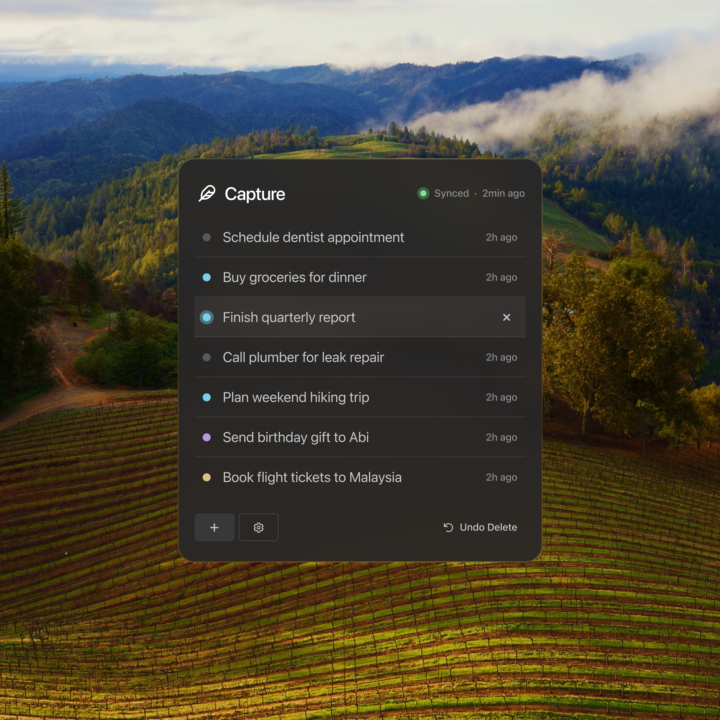
I've been playing around with Claude for a while, optimising workflows, supercharging a recent discovery sprint. But this week I actually shipped something. A simple idea capture tool for Mac. I used to use Things 3, and whilst the app structure never quite worked for me, I loved the quick capture feature. Keyboard shortcut, text input, thought saved. I've tried everything since: Apple Shortcuts to Reminders, Quick Notes, third-party apps. Nothing matched how I actually work. So I built my own. It's written in Swift, a language I've never touched before. I've been following development best practices as far as I remember them, pushing to a GitHub repo, branching for new features. Notes save as JSON that my ICM workspace can action, The whole thing was built with Claude. I haven't thought about anything else all weekend.
Scope creep is real. It now has optional task types, a menu bar drop down with sync status, a live list of recent captures, inline editing, tagging. I drafted the initial design in Figma, then went back and forth between VS Code and Figma, designing where I needed to, tweaking code where I needed to. As a designer, syntax was always the wall between having an idea and building it. But working in a real codebase, you're closer to the actual product. It allows a level of finesse you can't achieve in Figma. Refining a micro interaction, adjusting an animation timing, polishing subtle UI details. I am very excited to make progress with my ICM workspace build out, lots of product ideas to be built!
1 like • Jul 11
@Ralf Mbfy Legend - good to know
1 like • Jul 16
@Patrice Roatan Quebecois The initial intention for the capture tool is purely capturing an idea quickly, its stores it as JSON in a folder on my machine (which syncs to github - so I can access it on my other machine). As of now, Claude doesn't automatically action any of the ideas, but that is where I would like to get it to. You bring up some real challenges for me to address during the build, not just the happy path, but all the error and validation needed to make this work well for the user. I am hoping that if I give my ICM workspace enough context and guardrails, certain workflows could become mostly automated, but there will always be particular stages where it will need a human in the loop. Some small features I introduced to help funnel the idea to the right place, is tagging which allows me to tag something, like a project for example, and there's also task type for further context.

Mar 15 •
🏁 Foundations 3.1 Check-In
You just watched the full 23-minute folder architecture walkthrough. Vote below, then drop your use case in the comments. What are you building this system around?
Poll
1014 members have voted
0 likes • Jul 12
@Carla Bosteder 😂 You are forgiven! My current pre AI process would be to present the finding and recommendations to the client, get sign off then crack on with the design planning phase, starting with lofis, where we focus on rough layout, rough content, and hierarchy. then on visual design conceptualisation, bringing in the brand, colours typography, interactions, and prototyping, then dev hand off/collab. But now with AI involved in the process I think time spent on some of these can be condensed, but still working out where would be best, and what still needs the human touch! I do see the ability to be able to take something from the design phase to full build with out a developer is now on the cards, Very keen to bring that in to the offer.
1 like • Jul 13
@Carla Bosteder Most of the discovery stuff, I'm excited about automating the object mapping, its an information architecture activity where you work out the things that make up the system, it help everyone on the project get on the same page, in what each object is, what it does, how it relates to other objects, I have a pretty well defined process for this which is prime for automation. In addition to that, I have used AI to do competitor research, content inventory, UX audits so it will just be a case of formalising the SOP for a pipeline, and then chaining them together. I think once the visual design is done, automating the transition to development would be next.
Mar 15 •
🏁 Foundations 2.4 Check-In
You just learned the book, movie, video game framework. Vote below, then tell us in the comments: name one thing in your work that you now realize is on the wrong layer.
Poll
790 members have voted
0 likes • Jul 12
@Carla Bosteder Yes I plan to get building some of my own products! Trying to get my head fully into the ICM workspace first. What are you working on?
1 like • Jul 13
@Carla Bosteder That's the only issue, there are too many ideas to work on! but looks like you are diving in head first, I just gave your ICM simulator a go, very good - I love an interactive tool for learning!
Jul 10 •
New to ICM? Get hands on learning experience here
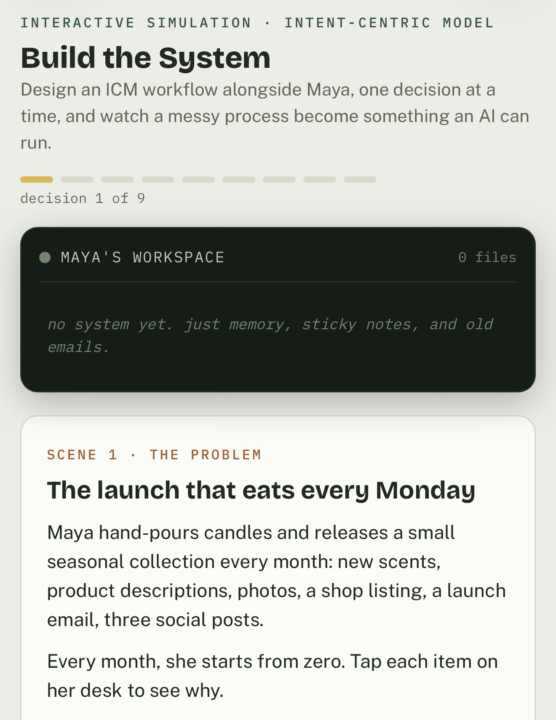
Step-by-step interactive guide from idea to output. Design an ICM workflow alongside Maya, one decision at a time, and watch a messy process become something an AI can run again and again. Right now, Maya has to try to remember what needs to be done and where each piece of information is kept. She needs a better solution. https://claude.ai/public/artifacts/7c9618f4-8324-4048-902c-cbcf77c9c102 Let’s build one with her. 😀
3 likes • Jul 13
This interactive tool is a great way to understand the basics of a pipeline without building your own!
1-10 of 12

Active 4d ago
Joined Mar 26, 2026
Powered by