Activity
Mon
Wed
Fri
Sun
Nov
Dec
Jan
Feb
Mar
Apr
May
Jun
Jul
Aug
Sep
Oct
What is this?
Less
More
Owned by Ian
Having fun with math and science
Skoolers
152.5k
Free
29 contributions to Dad Science

16d •
(Im)Possible Shape?
Can you draw this shape without lifting your pencil off the page or crossing any lines? Hint - Yes, it is possible. You just have to pick the right starting point and path. Can you see why some starting points won't work? Some intersections have 3 lines coming together, some of four. Is there some rules you can see regarding the number of lines that are coming together at any point?
1
0

16d •
Flip the Triangle
Arrange ten coins in a triangle as shown in the picture. Can you flip the triangle upside down by moving only three coins?
1
0

16d •
The Rolling Coin Puzzle
Take two coins heads face up, quarters work well because they have ridges. Hold one coin fixed so it doesn't move and roll the other coin halfway round the fixed coin so that it's on the other side. Try not to let them slip. Which way do you think the rolled head will be facing? Try to figure it out without trying it first and check your answer by doing it. Did you get it right? If so, congrats, it's a tricky problem. If you got it wrong can you figure out what's going on?
1
0

Jun 12 •
Kirigami Parachute
One of my favorite things is when art and science intersect to create something new and unique. Scientists recently discovered that the three thousand year old art of paper cutting called Kirigami can be used to create a better parachute. I've included a template that you can print out on a piece of construction paper to create your own. The template is just one way to make one and is provided to familiarize you with the basic parts. Here's a link to the original video of the scientists that came up with this https://youtu.be/6rrDW6YIbXI
0 likes • Aug 29
@Gabriel Llanas that's awesome, thanks for sharing!
Jun 26 •
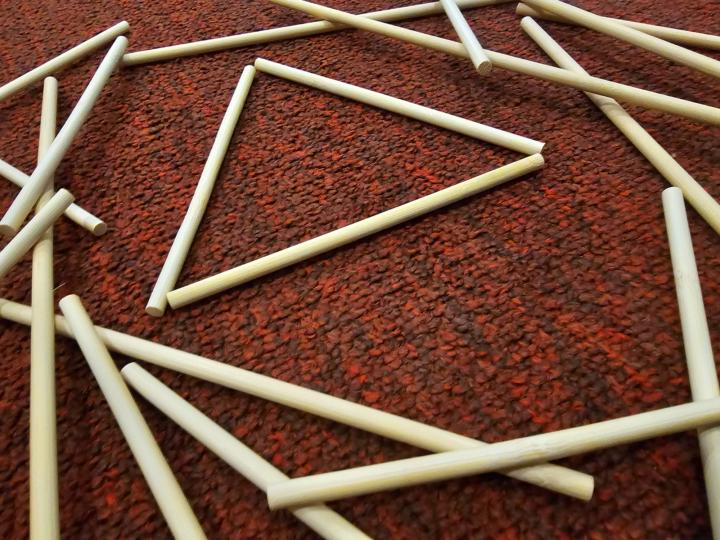
Can random sticks make a triangle?
If you had a pile of sticks (lines) of random length could you always make a triangle out of three of them? If not, can you figure out a rule for whether they can or not? What about making a four-sided figure from four sticks? Do the same rules apply? Scroll down for a hint. Solution at the bottom. - - - - - - - - - - - - - - - - - - - - - - - - Hint: No, you can't take any three random sticks and make a triangle or four-sided figure out of them. There is a specific relationship between their lengths that must be true. Scroll down for the answer. - - - - - - - - - - - - - - - - - - - - - - - - - - - - Answer: For a triangle, the combined length of the two shorter sticks must be longer than the length of the longest one. To put it on more mathematical language is 0 < a < b < c then a + b > c to make a triangle. This is called the Triangle Inequality. For a four-sided figure the answer is similar, the sum of the three shortest sides must be bigger than the longest side.
1
0
1-10 of 29

@ian-llanas-7935
I'm a dad with degrees in physics and mathematics. At times I've been an educator, artist, maker, builder, but always curious
Active 10d ago
Joined Feb 13, 2026