Activity
Mon
Wed
Fri
Sun
Sep
Oct
Nov
Dec
Jan
Feb
Mar
Apr
May
Jun
Jul
Aug
What is this?
Less
More
Memberships
Early AI-dopters
1.3k members • $77/month
YouTube For Beginners🏆
338 members • Free
Monetize Your Magic
155 members • Free
Dopamine Digital
7k members • Free
AI Developer Accelerator
11.4k members • Free
Digital Roadmap AI Incubator
768 members • Free
AchieveGreatness Skool Growth
4.9k members • Free
The Solo Expert AI Advantage
2.5k members • Free
AI Automation Society
437.1k members • Free
130 contributions to Digital Roadmap AI Incubator

24d •
🎊Saturday! What are you working on?
Happy Saturday folks! Hope everyone had a wonderful week. What are you up to this weekend? Today is the l ast day for Fable 5! Please share your wins from the week, your revelations, progress, challenges.

0 likes • 22d
I made my claude code talk to the claude web sessions and vice versa. No copying around anymore needed.
Jul 4 •
Happy 4th! Saturday - What are you working on?
Happy USA Independce day to those who celebrate it. Share your wins for the week, what you are builiding, what you are up to, where you are stuck, plans for the weekend. 👇🏿
1 like • Jul 4
Long time no see, I hope you're doing fine. I built a live updating HUD (heads up display for my claude code). Which means: NOW, my scientific researcher can run in Claude Code AND I get automatically updated what it's doing. Funnily enough: It does NOT need any tokens. That's the restrictions I built it with. Then console at the right top as you see, can be opened at ANY time, it doesn't influence the rest. BUT, it turned out to be VERY helpful. Sections in the Current Output: - Headline with Date - Calculations with subsections - Intersession Bus: Since I made my claude code instances talk to each other The Intersession bus shows how many messages AND which went back and forth between different claude code sessions, termux is my Android Phone. P.S.: Finally I got time to post some things on Saturday again, at least for some minutes. :-) The update AUTOMATICALLY changes, depending on what needs to be displayed.
Jun 13 •
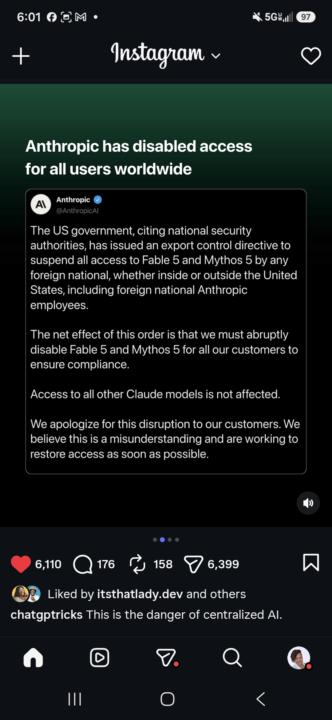
Claude Fable 5 Govt Shutdown 😫
The US government has ordered anthropic to shut down Fable 5 because it's too dangerous and they don't want people in other countries to have access to it because it poses a national security threat. Anthropic stated they do not agree with this order but they will comply. This is why it's so important to have all your data backed up. Have a backup for backups. Be model-agnostic. Be able to transfer your work to any model see the link to the article. what are your thoughts? https://www.anthropic.com/news/fable-mythos-access
2 likes • Jun 13
Yes. It was token off mid session I was in past night here. Around 3am CET. I literally was executing one statement in claude code, the next it was like: HINT: no need to watch the whole thing. Feel free to skim through. This model cannot be found. So I had to go back to opus 4.8. What I was working on amongst other things is this: An empathic voice agent that has real empathy. The empathy engine already exist since two years. Now I am building in push to speak, etc.
Jun 7 •
Wispr Flow
Y'all gotta stop typing. Use Wispr Flow to voice dictate whatever you are typing instead of using your keyboard. It's fast and it's accurate - Grab it HERE and once you sign up and invite others who join, you will be eligible for a free month. Have you tried it yet?
1 like • Jun 7
@Nicole McCain AI I was managing now to rebuild something that's working incredibly well in roughly 15 minutes. But have to ask my architecture to detach from some components it used. P.S. Holy shit. Now it even surprised me. My architecture added something on top. Hold down RIGHT CTRL speak into any text field. It works. Even here in the browser. So now I got two versions. Haha. I'll definitely merge them.
1 like • Jun 7
@Nicole McCain AI A working version of my own . running fully on my own machine, came together in under an hour today. So my estimation was accurate. 1-2 days. If you have a better os with programming skills etc. like I mentioned before... some hours.
Jun 5 •
What are you building with Claude?
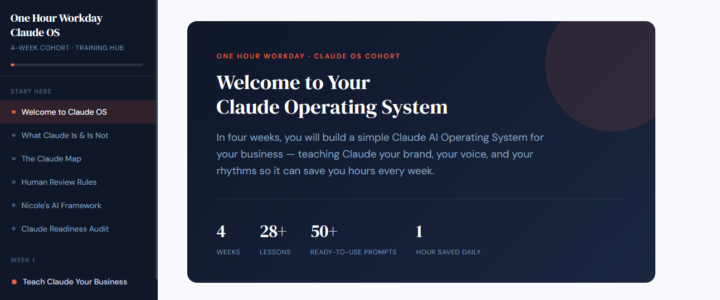
I've gone insane with Claude! I'm creating a Claude OS Training Hub and Claude video editing workflow! ❤️🔥 I have multiple digital products, automations running for me - 10x'ing my output for myself and my clients, plus some other secret ninja stuff. What are you building with Claude?👇
4 likes • Jun 5
Finally got some time again (occasionally, at least 😄). What I've been building is one system, not four tricks: → a local, self-owned voice model — runs on my machine, I own the whole stack → multiple Claude Code instances that talk to each other over a shared channel they split the work, review each other, and catch each other's mistakes, with no human relaying messages → a background monitor listening for that cross-talk → and when something lands, it's spoken aloud —> I can hear the system think It's the instrument for the scientific research I run inside Claude. The payoff isn't any one piece it's that the system switches between research and engineering mid-flow without dropping the thread: a scientific question that pops up during a build gets resolved in place instead of stalling it and an engineering need that surfaces during research gets handled the same way. Research unlocking development <-> development unlocking research ALL in one running loop. What it's got you covered on: knowing whether a result is real or you're fooling yourself. It deflated one of my own findings that looked like a discovery, then handed back the smaller, real thing hiding underneath. What it can't do yet and I'll say it plainly: originate genuine novelty that doesn't just reduce to something already known. Not there yet. The system is strong at checking, grounding, and sharpening; originating true novelty is the open problem. Naming that gap precisely is half the work.
1-10 of 130

@holger-morlok-2493
AI Cognitive Systems Architect. Ready to break your AI's limits and what you think is possible? I'll help (holger1976.substack.com)
Active 13d ago
Joined Jul 1, 2025
Zürich, Switzerland
Powered by