Activity
Mon
Wed
Fri
Sun
Aug
Sep
Oct
Nov
Dec
Jan
Feb
Mar
Apr
May
Jun
Jul
What is this?
Less
More
Memberships
Automatízalo
8.1k members • Free
AI Automation Society
419.4k members • Free
AI Automation Agency Hub
328k members • Free
AIlink Free
9.7k members • Free
12 contributions to AI Automation Society

Feb '25 •
Telegram Follow up if the customer doesn't respond.
I need to follow up with a customer if they don't respond. Here's the scenario: - I send a message to the client. - If the client does not respond within a specific timeframe (e.g., 1 hour, 1 day), I want to send a reminder. - The reminder message should be context-aware, meaning it should reference the previous conversation and deliver a message that fits the ongoing dialogue.

1 like • Feb '25
from oficial page of n8n How to build a Telegram AI bot with n8n – Step-by-step tutorial
0 likes • Feb '25
Haha, fair enough! 😄 I figured some ideas might be off the mark, but hey, that’s how brainstorming works, right? Let me throw a few more ideas your way. Haven’t tested them, but I guess they might work: 🤔 1. Engaging Multiple Clients Individually Okay, so if the Window Memory Node doesn’t quite fit here, maybe a Key/Value Memory Node could do the job? I mean, it sounds like it could store user-specific data like chat_id, conversation history, and even interaction timestamps.Alternatively, you might use a Google Sheets Node as a lightweight database, or go a bit more advanced with a PostgreSQL Node if you want something more scalable. ⏰ 2. Scheduling Follow-up Messages Every 2 Days at 8:30 AM So, if the Cron Node isn't the vibe, maybe the Schedule Trigger Node could work? I think you can set it up to trigger actions at specific times.Another guess: you could use a Wait Node combined with a Loop Node to create a more dynamic reminder system that only runs if certain conditions are met (like no response detected within a certain time window). 📬 3. Getting Notified When Clients Respond Besides Webhooks and Google Sheets, what about using the Telegram Send Message Node to DM yourself directly in a separate chat?Alternatively, you could integrate it with Slack if you prefer, or even set up a Gmail Node to shoot yourself an email whenever someone replies. I'm guessing this flexibility might help if you want notifications outside of Telegram. 🛑 4. Turning Off the Bot Once the Client Re-engages Okay, this one made me think a bit more. Instead of using a Switch Node alone, maybe combine it with a Function Node to track when the last response was received.You could write a small JavaScript snippet to check if there was activity in the past X days. If not, deactivate the Cron Node or any other scheduled workflow dynamically. Sounds like it could work! 🧠 Bonus Idea: Alternative to Window Memory Node - Redis Node: If performance matters, maybe caching conversation context in Redis could work. - File Node: For simpler cases, just saving context in a JSON file might be enough. - n8n Data Store Node: Haven’t tried it, but logically, it sounds like a native option for storing session-based memory.

💎
⭐
Feb '25 •
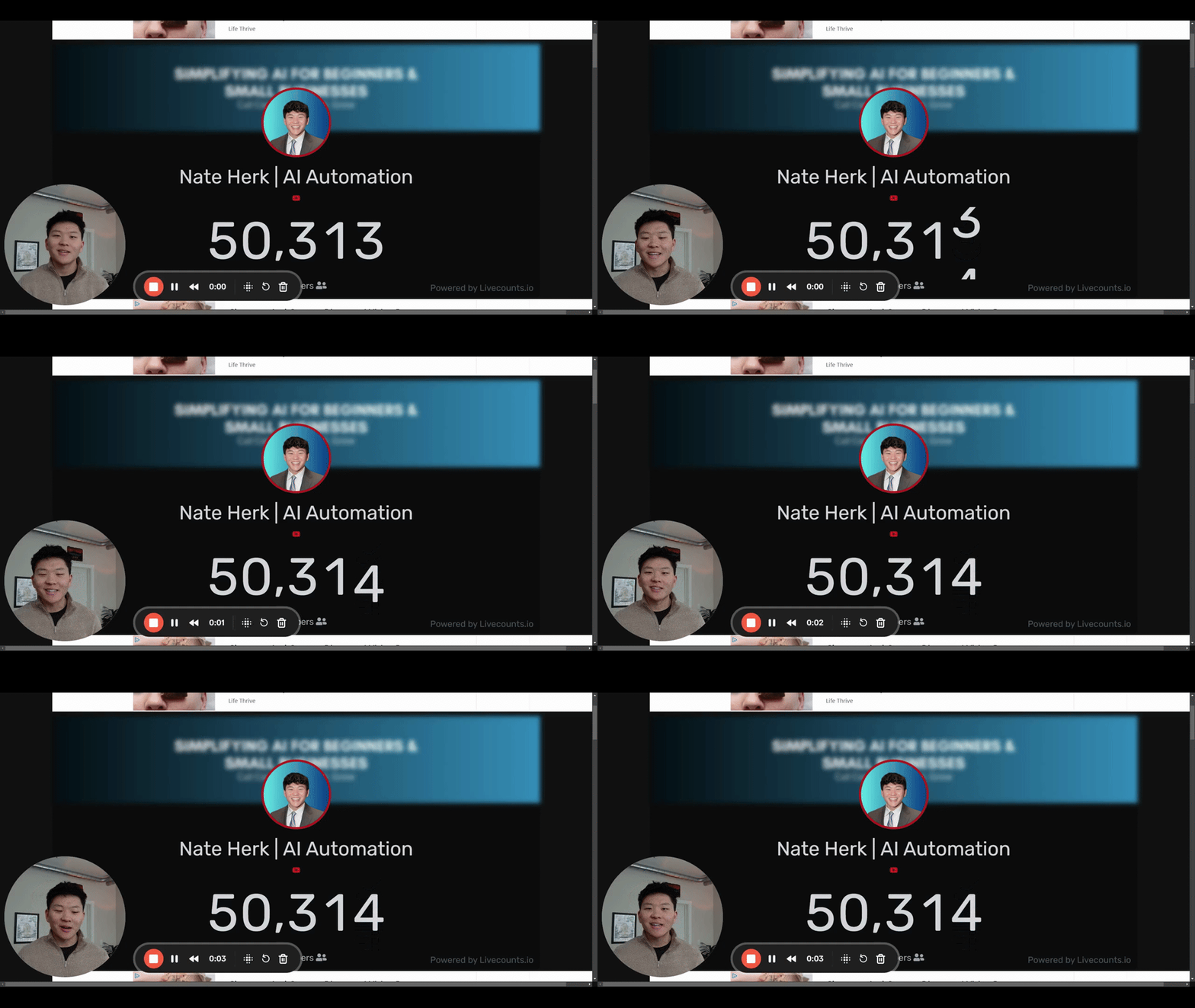
Thank You All - 50k YT Subscribers 💙
Been the best 5 months of my life so far... You guys make it all possible
3 likes • Feb '25
100 k on the way, we can help with that!
Feb '25 •
No hiring!!
That’s right—because we’re looking for partners, not employees. Be your own boss and come succeed with us! Think of this as a true partnership: your work is worth what you deserve, just like the person who brings in clients, convinces them to try our solutions, shares your ideas with others, or simply offers a helping hand. Everyone’s contribution counts. We’re based in Ibiza, and with the summer season fast approaching, we’re practically swamped. There are just three of us developers on this side, juggling both tried-and-true solutions and fresh, imaginative ideas that need more skilled hands to come to life. If you’re up for talking business, drop a message in the chat. Remember to follow the group rules—and welcome aboard, Captain!
0 likes • Feb '25
Perfect
0 likes • Feb '25

Feb '25 •
How Can a Student Like Me Monetize AI Automation Skills?
Hey everyone! I’m a student passionate about AI automation, currently diving into n8n + AI agents. I don’t have a business yet, but I want to learn how these skills can help businesses and how I can land a decent job in this space. I’d love some guidance: What’s the best way to get hands-on experience and build real-world projects? How can I monetize these skills or make myself valuable to companies? Would appreciate any advice from those who’ve been through this journey!
2 likes • Feb '25
Of course! Just to give you some additional ideas—right now, in places like Ibiza, where preparations for the tourism season (March-April to October) are already underway, hotels struggle greatly with staff shortages. AI-powered booking agents are a fantastic and scalable solution. The lack of personnel is a major issue in destinations like Ibiza, Menorca, Mallorca, and the Greek islands. Roles such as billing assistants and stock control managers are essential, yet most people have no idea about the tools available today. The same applies to all hospitality-related services. Feel free to chat with me—these are definitely applicable ideas. As for my own business models, I will share them in the appropriate space to respect the rules, as they are important. I'll be here if you’d like to discuss this further!
3 likes • Feb '25
Hi everyone! You can reach me at [email protected]. I intend to stay here and learn, as I’m still very new. From what I can see, @Nate Herk shares the same point of view as I do, along with the optimism and focus we really need. Remember: If you want to go fast, go alone. If you want to go far, go together.

Feb '25 •
Lost on how to deploy for a customer
This is theoretical because Im just starting out, but how is an n8n agent/workflow best deployed for a customer. So lets say I got 10 different customers and 50 different automations split amongst them. Im 'assuming' the best and only way is to have 10 different cloud accounts with a docker install of just each individuals workflow? This segments their data Protects their API keys (assuming using their own accounts) So customer A has their own cloud instance with a dockerized n8n install and say 5 workflows. Customer B has their own account and so and so on. If the customer wanted you to come back and edit or add new workflows you would log in to their cloud instance and edit. Have I got that right?
1 like • Feb '25
My response is that @Jessica Leighty Leighty has explained it very clearly—this is a perfect example of when self-hosting is a good idea. Otherwise, it really depends on the plan you have for the number of n8n automation flows (correct me if I’m misunderstanding).
1-10 of 12
@heriberto-daniel-camacho-fernandez-3465
Health care AI specialist. Ibiza.
Active 247d ago
Joined Feb 3, 2025
Powered by