Activity
Mon
Wed
Fri
Sun
Aug
Sep
Oct
Nov
Dec
Jan
Feb
Mar
Apr
May
Jun
What is this?
Less
More
Memberships
Boss Writer Academy
43 members • Free
12 contributions to Boss Writer Academy
23d •
New
My name is Robbie. I am a first time writer. I have finished my rough draft. I am in the begging stage of fixing my structure. I think the more I edit the more I love writing. I live in the states and my reason for writing is this; I want get published, make money, and eave a legacy for my neice and nephews. So hello to everyone.


0 likes • 4d
Welcome to our community, Robbie!

5d •
Writer’s Craft Challenge
This week's lesson is for the fiction writers, memoir writers, children’s book writers, and storytellers in the room. Watch this short lesson by Nalo Hopkinson: How to write descriptively — Nalo Hopkinson https://youtu.be/RSoRzTtwgP4?si=NyWGS4wiHxOMwXTq The main idea is powerful: Good writing does not only tell the reader what happened. It helps the reader enter the moment. As writers, we want readers to feel like they are inside the scene, not watching it from far away. That means we have to think about: What can the reader see? What can the reader hear? What can the reader feel? What can the reader smell? What small detail makes the moment feel real? Your Challenge Take one simple sentence from your story, chapter, memoir, or idea and make it more vivid. Start with something simple like: She walked into the room. Then rewrite it so we can feel the scene. For example: She stepped into the quiet room, the wooden floor creaking beneath her feet as the scent of old books and rain filled the air. Now try yours. Comment below with: 1. Your original sentence 2. Your revised sentence 3. One thing you noticed when you rewrote it Boss Writer Lesson: Description is not about adding more words. It is about choosing the right details so the reader feels present in the world you are building.
1 like • 4d
Amazing video Latoya! Thank you for sharing. Very imformative
May 18 •
Learn from Dr. Cheyenne’s Failure
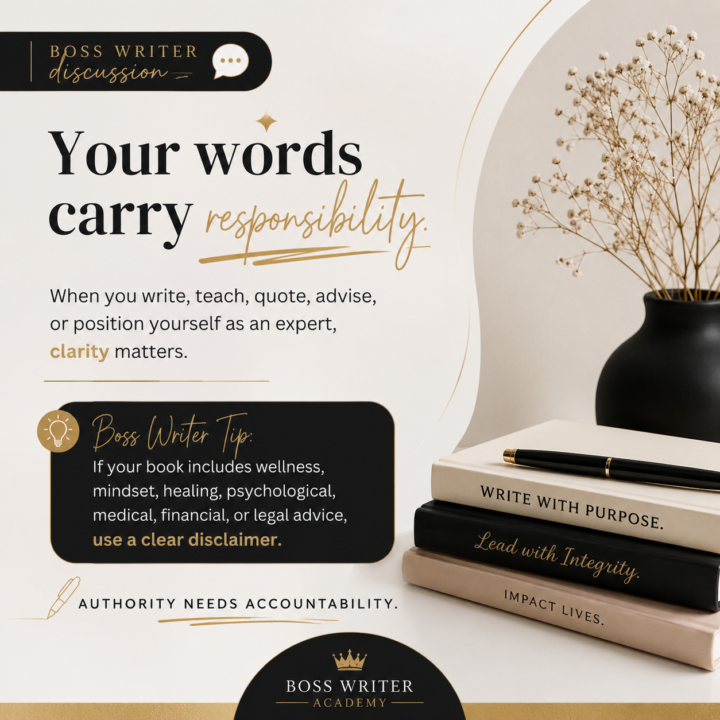
There is a conversation happening online right now around Dr. Cheyenne Bryant, credentials, public advice, and what responsibility looks like when someone is speaking from a place of authority. I don’t want us to focus on gossip. I want us to focus on the lesson. As authors, writers, coaches, speakers, and thought leaders, we have to understand that our words carry weight. When you write something publicly, publish it in a book, teach from a platform, or offer guidance that sounds psychological, medical, financial, spiritual, or legal, people may receive it as instruction. That means clarity matters. Credentials matter. Language matters. Disclaimers matter. Scope matters. A Boss Writer does not just ask, “Can I say this?” A Boss Writer also asks: Am I qualified to say this in this way?Could this be misunderstood as professional advice?Do I need to clarify my role, training, or limitations?Should I include a disclaimer in my book or content? Boss Writer Tip: If you are quoting, teaching, sharing advice, or writing about anything connected to mental health, trauma, healing, wellness, money, law, medicine, or psychology, and you are not licensed in that area, include a clear disclaimer. A disclaimer does not weaken your message. It protects your readers, your credibility, and your work. The lesson is this: Sometimes it is not just what we say.It is how we frame it, what authority we attach to it, and whether the reader understands the limits of what we are offering. Discussion:Where do you think authors should draw the line between sharing personal wisdom and offering professional advice? Comment your thoughts below.
1 like • May 18
@Robert Amilcar thank you Robert
May 13 •
BOOK PROMO LAB - TEST ONE!
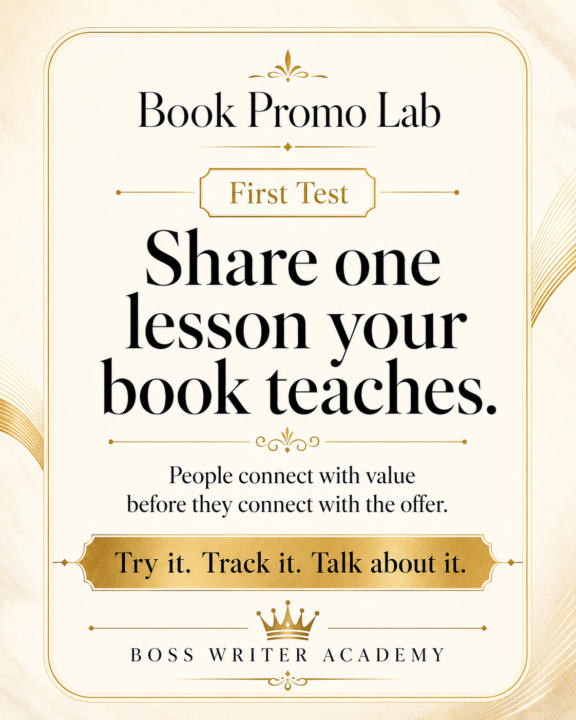
Let’s test a simple book promotion move. Instead of only saying, “Buy my book,” share one lesson your book teaches. People often connect with the value before they connect with the offer. Try one of these: My book teaches readers how to…One lesson from my book is…If you are struggling with ___, this part of my book will help you… This works because it gives people a reason to care before you ask them to buy. Your book is not just a product. It carries a message, a solution, a story, or a shift. Use this to build a social media graphic or a website post. Your task: Create one post this week sharing a lesson from your book. Comment : What is one lesson your book teaches? Or have you tried this before? Did it work? Post the social media or website link of where you have posted it in the chat so we can take a look. I am looking forward to this!!
1 like • May 14
Beautiful design! Very royal and golden!
May 6 •
Which book idea feels stronger to you?
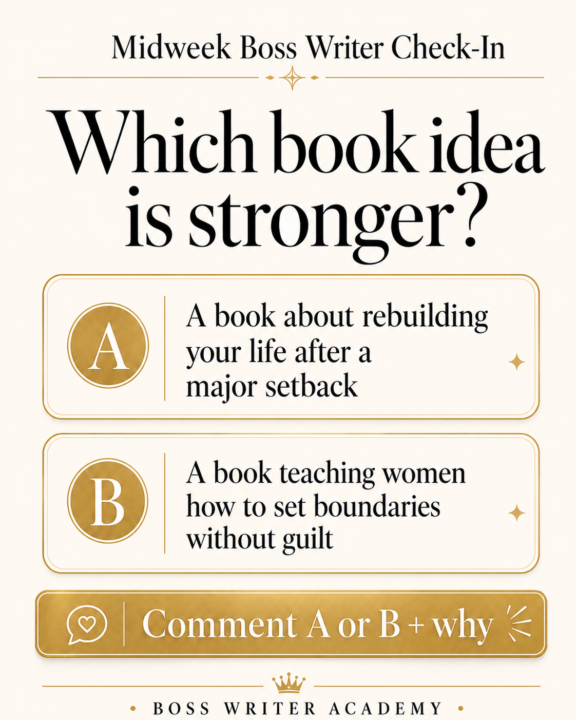
Midweek Boss Writer Check-In ✍🏾 Sometimes the strength of a book idea is not just in whether it sounds good. It is in whether it has direction, a clear audience, and the potential to meet a real need. So let’s talk about it. Which book idea feels stronger to you? A. A book about rebuilding your life after a major setback B. A book teaching women how to set boundaries without guilt There is no pressure to overthink it. Just choose the one you believe has stronger potential and tell us why. Comment A or B + why below. One of the lessons here is that sometimes it is worth reviewing our book ideas before and even while writing. What the market is saying, who our target audience is, and what problem the book is really solving can shift so much with more information. What looked like the right idea at first may need to be refined. And sometimes one small adjustment can make the concept much stronger. Let’s discuss. 👇🏾
1 like • May 6
B is better, because its bold, provocative, and gets straight to the point with confidence
1-10 of 12