Activity
Mon
Wed
Fri
Sun
Sep
Oct
Nov
Dec
Jan
Feb
Mar
Apr
May
Jun
Jul
What is this?
Less
More
Memberships
KetoforCancer
654 members • $9/m
Cancer Warriors
548 members • Free
10 contributions to Cancer Warriors
Jul '25 •
🧘♀️ Gratitude Journal
Gratitude might seem small… but it’s one of the most powerful tools we have — especially on the cancer journey. It doesn’t ignore the pain or fear. It helps us hold on to light even in the dark. Science backs it too: regularly practicing gratitude can lift mood, boost the immune system, reduce stress, and even support healing. Joy and gratitude are connected — and we all deserve more of both. So each week, we’ll have this thread as a gentle space to check in and share: 🙏 What’s one thing you’re grateful for this week? Big or small. Deep or simple. A moment of peace, a kind word, a good meal — it all counts. Drop yours in the comments below, and feel free to come back every week. Let’s build a habit of healing joy, together 💛
5 likes • Jul '25
I’m exceedingly grateful for just being told last Monday by my primary oncologist that even with having had a left brain tumor and three left lung tumors, I’m now in remission!
Feb '25 •
Combining Oxidative Stress With Metabolic Targeting
If you want to induce oxidative stress in cancer cells while simultaneously targeting multiple pathways, you can use a synergistic multi-pronged approach combining pro-oxidative, metabolic, and signaling pathway inhibitors. Here’s how you can do it: 1️⃣ Oxidative Stress Induction Cancer cells have increased reactive oxygen species (ROS) but also strong antioxidant defenses (like glutathione and NRF2 activation). You can disrupt this balance by: • IV Vitamin C (≥15-25g) generates hydrogen peroxide, selectively killing cancer cells. • Works best with low iron and low glucose conditions. • Artemisinin (Iron-dependent ROS generator) • Cancer cells with high iron intake are more vulnerable to artemisinin, which generates cytotoxic free radicals. • Fenbendazole / Mebendazole (Microtubule inhibitors + Redox disruption) • Disrupts mitochondrial function and causes oxidative stress. • Suppresses glutathione (GSH) levels, making ROS accumulation lethal. • Berberine (Mitochondrial uncoupler + AMPK activator) • Inhibits Complex I of the mitochondrial respiratory chain → increased ROS. • EGCG (Green Tea Extract) + Quercetin • EGCG inhibits NRF2 (reducing antioxidant defenses), while quercetin enhances chemosensitivity. 2️⃣ Metabolic Targeting (Starving the Cancer) Cancer relies on glycolysis, glutamine, and fatty acids for energy. You can block these pathways: • Glucose Restriction + Ketogenic Diet • Suppresses glycolysis (Warburg Effect), forcing cancer cells into oxidative stress. • Synergistic with metformin, DCA, and berberine. • Metformin (Mitochondrial Complex I Inhibitor + AMPK activator) • Lowers glucose availability. • Increases oxidative stress and blocks mTOR. • Dichloroacetate (DCA) (Pyruvate Dehydrogenase Kinase Inhibitor) • Forces cancer cells into mitochondrial respiration → increases ROS and apoptosis. • Glutamine Inhibition (Targeting Cancer’s “Backup Fuel”) • DON (6-Diazo-5-oxo-L-norleucine) or Ivermectin → Block glutamine metabolism.

2 likes • Feb '25
Good info. Thanks, always.
Sep '24 •
Reading List
Please comment below your favourite books about metabolic therapy/health. My recommendations: “Cancer as a Metabolic Disease: On the Origin, Management, and Prevention of Cancer” by Thomas N. Seyfried • This is a foundational text on the metabolic theory of cancer, proposing that cancer is primarily a metabolic disease rather than a genetic one. “Tripping over the Truth: How the Metabolic Theory of Cancer is Overturning One of Medicine’s Most Entrenched Paradigms” by Travis Christofferson • This book outlines how personalized nutrition, especially the ketogenic diet, can support metabolic therapies for cancer “Keto for Cancer: Ketogenic Metabolic Therapy as a Targeted Nutritional Strategy” by Miriam Kalamian • Focused on the ketogenic diet as a metabolic therapy for cancer, providing practical guidelines on how to implement it.
5 likes • Jan '25
Nasha Winters is also very with it!
4 likes • Feb '25
One of my docs, Philip Ovadia, M.D. is on an online deal with a lady named Mimi Morgan. Check it out. You can readily surf it up using both their names on videos. Excellent hourish conversation about nutrition and health. She literally got off of both Rheumatoid Arthritis and Parkinson’s with her carnivore mode.
Jan '25 •
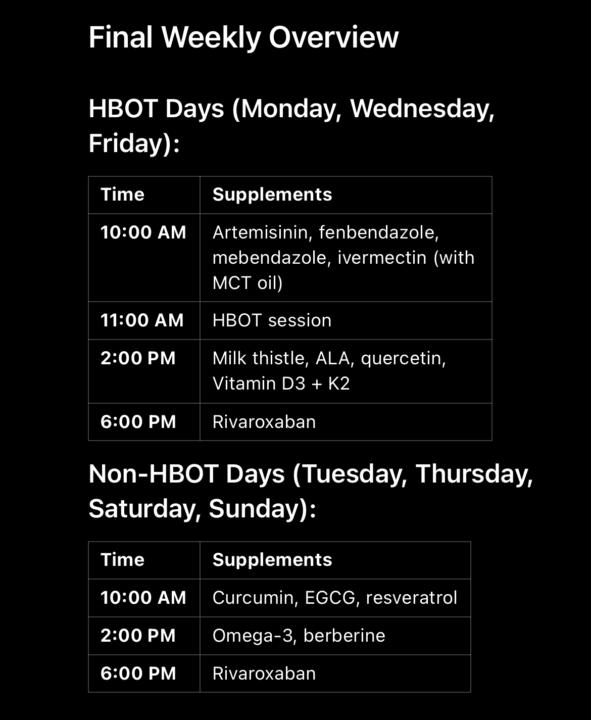
Pulsing 3x per week with these substances
Here’s what we plan to do. Let us know your thoughts in the comments below. Monday, Wednesday and Friday (just before HBOT) to be taken with MCT Oil: Curcumin, EGCG, Quercetin, Artemisinin, ALA, Resveratrol, CoQ10, Berberine, Fenbendazole Other daily supplements and off-labels include: Mebendazole, Ivermectin, Vitamin D3 + K2, Magnesium, Omega 3, Milk Thistle (And Zinc once per week) Also, IV Vitamin C once a month just after HBOT. Notes: My mum is on Immunotherapy (Keytruda) and taking blood thinners (Rivaroxaban). ChatGPT: While these supplements and medications have potential benefits, they can also interact with each other or with other treatments. Here’s an overview of possible interactions: 1. Curcumin (Turmeric) • Interactions: • EGCG: Both may enhance antioxidant effects, but there’s a slight risk of increased liver enzyme levels in sensitive individuals. • Quercetin: Synergistic effects; may boost anti-inflammatory and anticancer properties. • Berberine: May enhance effects on glucose metabolism but could also increase the risk of gastrointestinal side effects. • Artemisinin: Could interact due to shared effects on liver enzymes. 2. EGCG (Epigallocatechin Gallate) • Interactions: • Curcumin: Synergistic anti-inflammatory and anticancer properties. • Quercetin: Both are strong antioxidants and may boost anti-inflammatory effects. • ALA: Can add to antioxidant activity; monitor for potential nausea or upset stomach. • Resveratrol: Synergistic in reducing oxidative stress. • Fenbendazole: No known interactions, but EGCG affects liver enzymes, which could theoretically alter Fenbendazole metabolism. 3. Quercetin • Interactions: • Curcumin, EGCG, Resveratrol: Enhances bioavailability and synergistic antioxidant effects. • ALA: May increase antioxidant activity. • Berberine: May amplify anti-inflammatory and glucose-lowering effects. 4. Artemisinin • Interactions: • Curcumin: Could increase liver enzyme activity, altering the metabolism of both substances.
4 likes • Jan '25
Thanks, Seyma, Lemon, and Bernardo! My current Boswellia capsules are
5 likes • Jan '25
And my vitamin E is
Dec '24 •
Metabolic Therapy Plan for High-Grade and Metastatic Cervical Cancer
SOC (Standard of Care) alone has not been enough for us. We are now fully into Metabolic Therapy as a complementary treatment. This plan is based on the hybrid orthomolecular protocol tailored for my mum, who has high-grade, metastatic cervical cancer that has spread to the brain, bones, and lymph nodes. This protocol was developed based on the latest research, insights from our community, and personal experiences. Any suggestions would be appreciated to help further refine this plan. Please note: Always consult with healthcare professionals before implementing any changes. Case Overview - Condition: High-grade cervical cancer with brain, bone, and lymph node metastases. - History: Stroke and Pulmonary Embolism: June (on blood thinners since then). Chemotherapy and Immunotherapy: Completed 6 cycles by October. Imaging Results: NED (No Evidence of Disease) after 4 cycles on PET; 25% reduction in brain metastases. However, new brain metastases have appeared in December (likely due to the blood-brain barrier). Protocol Duration: 12 weeks (regardless of cancer type). Adjustments may be required based on glucose or glutamine-driven cancer types and sensitivity testing. Testing Recommendations To ensure the protocol is optimized, the following tests should be conducted: 1. RGCC: Genetic analysis of cancer cells for personalized treatment recommendations. 2. Imaging Tests: CSR (Chest Radiograph): Detects lung infections or abnormalities. 3. Blood Tests: CRP: Detects inflammation or infection. CBP: Screens for anemia, infections, and clotting issues. Vitamin D: Assesses bone health and calcium absorption. ESR: Monitors inflammation or autoimmune conditions. CBC: Diagnoses anemia, infections, or blood disorders. 4. Organ Function Tests: Kidney Function: Evaluates filtering capabilities. Liver Function: Assesses detoxification and metabolism. Lung Function: Diagnoses asthma, COPD, or fibrosis. 5. Clotting and Cardiac Markers: Fibrinogen: Evaluates clotting risk. D-dimer: Detects DVT or pulmonary embolism. Troponin: Screens for heart attack. 6. Gene Testing: Methylation deficiencies (e.g., MTHFR mutations).
3 likes • Jan '25
Good to meet you, neighbor Kimberly! We live on a cattle ranch in Wise County, ( www.barcbarranch.com ) an hour northwest of downtown Fort Worth where I go five days a week to run my almost 40 year old financial planning practice!
3 likes • Jan '25
We don’t tend to deal retail, but will have cows ready for sale in late spring/early summer. We don’t process them. We normally just take them back up to Decatur Livestock Market, where we got em a few hundred pounds lighter.
1-10 of 10
@guy-cumbie-9876
I'm Guy Cumbie, a 71 year old guy with Stage 4 melanoma. Tumors have been in left brain & left lung. And RN (radiation necrosis) in my left brain.
Active 7h ago
Joined Nov 20, 2024
Powered by