Activity
Mon
Wed
Fri
Sun
Sep
Oct
Nov
Dec
Jan
Feb
Mar
Apr
May
Jun
Jul
Aug
What is this?
Less
More
Owned by Geoff
SwiftStart AMZ community is for Amazon brand owners and small businesses like yours that are eager to scale their stores on Amazon.
Skoolers
162.7k members • Free
376 contributions to SwiftStart AMZ Mastermind

Jun 30 •
Amazon AI Images Update
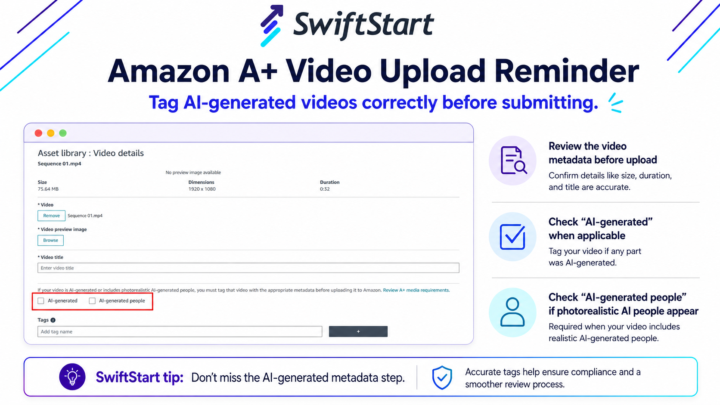
Amazon just introduced a small update that could become a big deal for brands. No announcement. No headline. Just a new checkbox inside A+ Content and Brand Story uploads. It asks whether your images were created with AI, and whether they include AI-generated people. At first glance, it looks insignificant. History suggests otherwise. Amazon has a pattern of introducing data fields long before they become mandatory. Product safety details, expiration dates, hazmat information, and country of origin all started as simple inputs before evolving into compliance requirements. This feels very similar. The brands that should pay the closest attention include: → Supplements → Skincare & beauty → Baby products → Pet brands → Any category where product benefits could be interpreted as health-related The concern isn't AI itself. The concern is what AI-generated images might communicate. A perfectly clear complexion. A healthier-looking pet. A happier, thriving baby. Even when no words are making the promise, the image can. Amazon's review teams don't just evaluate creative quality anymore. They also evaluate whether the visual implies a claim that your brand can support with evidence. That's where AI-generated lifestyle imagery creates additional risk. What should brands do today? → Keep a record of every AI-generated and AI-assisted image you publish. → Separate original photography from AI-created assets. → Review your visuals for implied claims, not just written claims. → Build a clear process for documenting creative sources. Not knowing which assets were created with AI won't be a strong defense if Amazon tightens its policies. This checkbox isn't just another form field. It may be Amazon laying the groundwork for what's coming next. The brands that prepare now will have a much easier time adapting if AI image disclosure becomes a formal compliance requirement. #amazonlistings
0
0
Jun 16 •
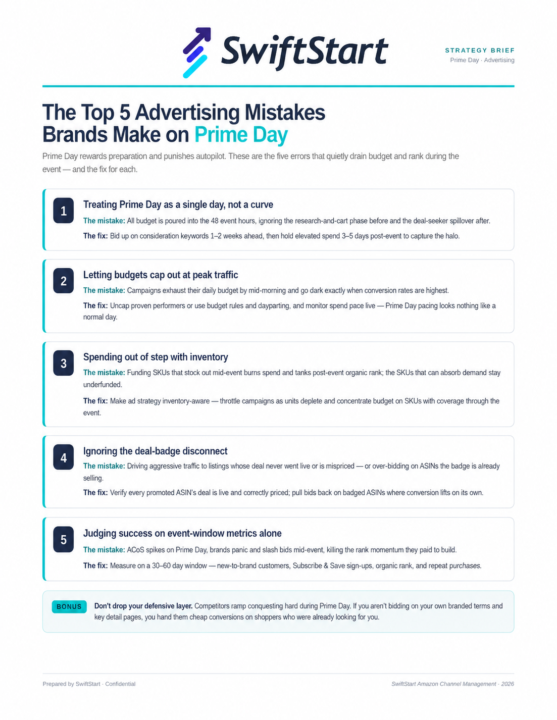
Most brands treat Prime Day as a 4-day sprint.
The ones who win treat it as a three-week campaign. Every year, we watch the same five advertising mistakes quietly drain budget — and drag down organic rank long after the deals end: → Treating the event as a single day, not a curve → Letting budgets cap out at peak traffic → Spending out of step with inventory → Ignoring the deal-badge disconnect → Judging success on event-window metrics alone None of the fixes are complicated. But they have to be in place before the traffic spikes — not scrambled together at hour 30 when your best SKU is already out of stock. We broke down all five (mistake + the fix for each) in the one-pager below. What's the costliest Prime Day mistake you've seen? Drop it in the comments.
0
0
Jun 11 •
📢 Heads up, Amazon Sellers! New Product Title Rules Start July 27, 2026
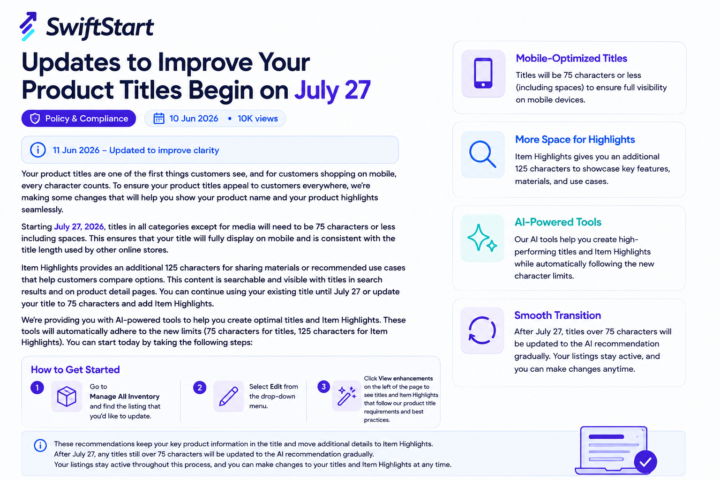
Amazon is updating how product titles work. Starting July 27, 2026, all product titles (except media) must be 75 characters or fewer, including spaces. This ensures your titles display perfectly on mobile and match other major online stores. Introducing Item Highlights: To make up for shorter titles, Amazon now offers 125 extra characters for materials, usage instructions, or key product details. These highlights are: ✅ Searchable ✅ Visible in search results ✅ Displayed on product detail pages What if you don’t update? Titles over 75 characters will gradually be replaced with AI-generated recommendations. Your listings remain live, but automated changes may not match your brand voice. Brand Owner Tip: You have 14 days to review, adjust, and approve AI suggestions before they go live. How to update now: Go to Manage All Inventory Select Edit from the menu Click View Enhancements to see AI-recommended titles and highlights 👉 Don’t wait—take control of your listings before the July 27 deadline! Are you updating your listings yet? Share your tips or questions below! 👇
0
0
Jun 10 •
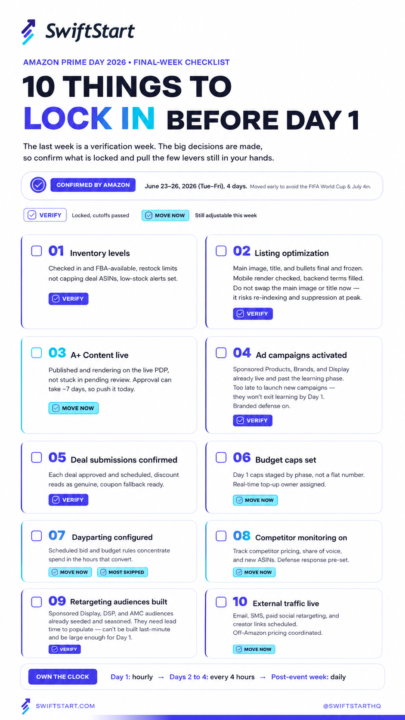
Prime Day isn’t won on Day 1.
Most of the major decisions have already been made. At this stage, success comes down to execution, verification, and making sure there are no preventable issues when traffic starts flooding in. Before Prime Day 2026 goes live, make sure these 10 essentials are locked in: ✅ Inventory is checked in and available through FBA ✅ Listings are fully optimized and finalized ✅ A+ Content is live and displaying correctly ✅ Advertising campaigns are active and out of the learning phase ✅ Deals and promotions are approved and scheduled ✅ Budget caps are planned and staged for each phase of the event ✅ Dayparting rules are configured to maximize efficiency ✅ Competitor monitoring is in place ✅ Retargeting audiences are built and ready to scale ✅ External traffic campaigns are scheduled and coordinated The final week is not the time for major changes. It’s the time to verify, stress-test, and ensure every moving part is ready for peak traffic. The brands that perform best during Prime Day are usually the ones that eliminate mistakes before the event begins. What’s the one item on this checklist that sellers most often overlook?
0
0
May 20 •
SwiftStart Low Inventory Fees Trick for 2026
Amazon just made one quiet update that could destroy margins for sellers who are not paying attention. Starting in 2026, Amazon’s low inventory level fees are no longer applied at the product level. They’re now charged at the FNSKU level. That means your main ASIN can look perfectly healthy, but if one size, variation, or color drops below 28 days of supply, Amazon will charge a fee on every unit sold for that SKU. And these fees are not small: • $0.32 to $2+ per unit depending on product size • Now expanded to bulky and large-item categories • Enough to turn a profitable SKU into a break-even product overnight This is where inventory strategy becomes profit strategy. Here’s what sellers should be doing right now: → Drip-feed inventory into FBA instead of overloading shipments → Use AWD (Amazon Warehousing & Distribution) for replenishment stock → Enable AWD auto-replenishment because those SKUs are fully exempt from low inventory fees → Audit your FBA dashboard at the SKU level, not just the parent ASIN level Most sellers will notice this change only after margins start shrinking. The smart operators will fix the supply flow before Q1 2026 hits. https://youtube.com/shorts/jkGViZY1TdM?feature=share
0
0
1-10 of 376
