Activity
Mon
Wed
Fri
Sun
Aug
Sep
Oct
Nov
Dec
Jan
Feb
Mar
Apr
May
Jun
What is this?
Less
More
Owned by Eliseo
📊 Better health = better performance = better physique. 🔥 2026 Is Your Year.
Memberships
Trifecta Training
9 members • Free
Specialty Coffee Community
2.9k members • Free
Better Sleep Skool
190 members • Free
17 contributions to Be Better Athletics

Feb 17 •
You don’t need to be in the gym for more than an hour
A lot of people think results come from spending hours in the gym. Truth is: results come from structure + consistency. As a lab scientist and someone who competes in races, I keep my training efficient and intentional—hypertrophy-focused work that compounds over time. In this video, I’m sharing the exact upper-body sessions I use to build strength and muscle while still training for performance under an hour.

1 like • Feb 19
@William Jividan thank you

Jan 29 •
If you want strength, load matter. For size, not so much.
We have learned over time that high reps + low weight = hypertrophy and low reps + heavy weight = strength This study challenges that A 2025 study followed 17 active men for 9 weeks. One group lifted heavy weights, and the other lifted much lighter weights. Both groups worked out their whole body three times a week during the study. What happened: • Muscle thickness increased across nearly all measured muscles in both groups • No meaningful differences in hypertrophy between high- and low-load training • Triceps hypertrophy occurred earlier and more consistently with high loads • 1-RM strength increased more in the high-load group While heavier weights may lead to improvements in strength performance, it looks like hypertrophy can be achieved through multiple rep ranges as long as the final set is taken close to failure. Recommendation: When resistance training, take final sets within 2 reps of failure. Use heavier loads if strength performance is the primary goal. Read the study here: Muscle Hypertrophy
1 like • Jan 31
@William Jividan haha. It’s always great confirmation when we see that science tell us
1 like • Jan 31
@William Jividan client testimonials will always triumph 🙌🏽
Jan 27 •
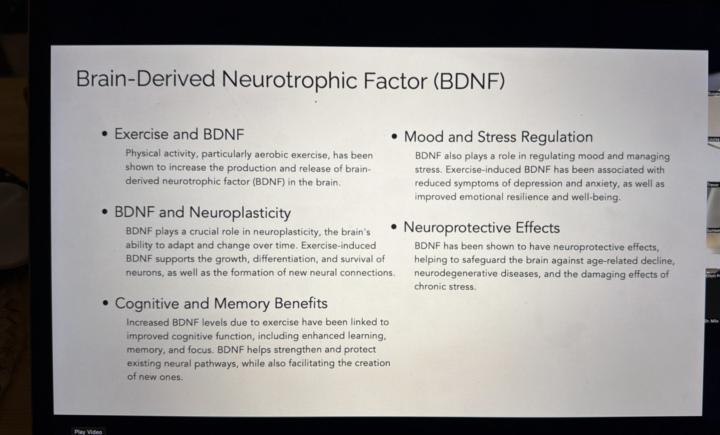
I was on a recent call with my team
and we covered how BDNF is so good for your brain! Its amazing to see how effective exercise can be and the benefits one receives. So if you ever "feel" slugggish or "not in the mood" keep reading, ingoring those thought can go away after just an exercise. The main topics we covered was BDNF. BDNF stands for Brain-Derived Neurotrophic Factor. The easiest way to think about it: BDNF helps your brain grow, adapt, and stay healthy. Exercise—especially aerobic movement like running, cycling, or fast walking—has been shown to increase BDNF in the brain. When you move your body: - Blood flow increases - Brain activity increases - BDNF gets released This is one reason exercise improves how you feel and how you think. BDNF plays a major role in neuroplasticity, which means: - Your brain can change - Your brain can adapt - Your brain can build new connections BDNF helps: - Strengthen existing connections - Keep neurons alive and healthy Higher BDNF levels are linked to: - Better memory - Faster learning - Improved focus BDNF also helps regulate: - Mood - Stress response - Emotional resilience 🧠 Simple Takeaway Exercise doesn’t just change your body. It changes your brain chemistry. When you move, your brain releases BDNF—and that helps you think clearer, feel better, and stay mentally resilient.
2
0
Jan 22 •
🧠 Exercise Isn't Motivation — It’s Comprehension
A well-known 2013 study by Bente Klarlund Pedersen changed how we understand exercise. (long post, worth reading) The big idea: Your muscles are not just for movement. They act like an organ that talks to the rest of your body. 🦵 Your Muscles Are an Organ (The Largest One) - Skeletal muscle is the largest organ in your body - We usually think of muscles only: - But that’s only part of the story. 🧪 Muscles Release Chemical Messengers When muscles contract, they release special proteins called myokines. Think of myokines as text messages sent from your muscles to other organs. These messages can travel to: - 🧠 Brain - 🍔 Fat tissue - 🍬 Pancreas - 🧬 Liver - 🦴 Bones 📡 What Are Myokines? Myokines = proteins released by working muscles They can: - Act locally in the muscle - Affect nearby tissues - Travel through the bloodstream to distant organs 🔁 Why Movement Matters (Not Just Motivation) Here’s the key point from the study: 👉 Many myokines are only released when muscles contract That means: - No contraction = no signal - No signal = fewer health benefits This is why exercise improves: - Energy levels - Blood sugar control - Fat metabolism - Brain health - Inflammation balance 🧠 The Takeaway Exercise works because: - Muscles communicate with your body - Movement triggers biological signals, not just willpower - Your workout is literally medicine created by muscle contraction 💬 Bottom line: Exercise isn’t about being motivated. It's about understanding what movement does inside your body. Here is the study
1 like • Jan 22
@William Jividan thank you 🫡 🙏🏽
1-10 of 17

@eliseo-garrido-7421
Let’s get better together with the Be Better Protocol
Active 60d ago
Joined Aug 24, 2025
Califronia