Activity
Mon
Wed
Fri
Sun
Aug
Sep
Oct
Nov
Dec
Jan
Feb
Mar
Apr
May
Jun
Jul
What is this?
Less
More
Owned by Denise
Sharing revelations, poems or words from God
Memberships
Skoolers
165.9k members • Free
286 contributions to Echoes From the Father’s Heart

12h •
When Praise Opens the Door
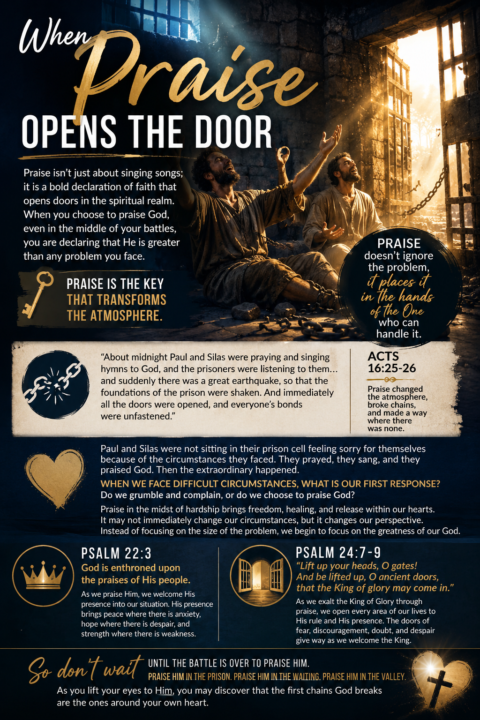
When Praise Opens the Door Praise isn’t just about singing songs; it is a bold declaration of faith that opens doors in the spiritual realm. When you choose to praise God, even in the middle of your battles, you are declaring that He is greater than any problem you face. The Bible is full of stories where praise changed the atmosphere, broke chains, and made a way where there seemed to be none. Sometimes we wait until we “feel like it” before we praise, but the truth is that praise is one of the keys God has given us to change the atmosphere. So today, lift your voice even if you don’t feel like it. Praise doesn’t ignore the problem; it places it into the hands of the One who is able to handle it. “About midnight Paul and Silas were praying and singing hymns to God, and the prisoners were listening to them… and suddenly there was a great earthquake, so that the foundations of the prison were shaken. And immediately all the doors were opened, and everyone’s bonds were unfastened.” Acts 16:25–26 Paul and Silas were not sitting in their prison cell feeling sorry for themselves because of the circumstances they faced. They prayed, they sang, and they praised God. Then the extraordinary happened. When we face difficult circumstances, what is our first response? Do we grumble and complain, or do we choose to praise God? Praise in the midst of hardship brings freedom, healing, and release within our hearts. It may not immediately change our circumstances, but it changes our perspective. Instead of focusing on the size of the problem, we begin to focus on the greatness of our God. Psalm 22:3 tells us that God is enthroned upon the praises of His people. As we praise Him, we welcome His presence into our situation. His presence brings peace where there is anxiety, hope where there is despair, and strength where there is weakness. Psalm 24:7–9 declares:” Lift up your heads, O gates! And be lifted up, O ancient doors, that the King of glory may come in.” Originally, these verses celebrated the victorious King entering Jerusalem. Yet they also paint a beautiful picture for us today. As we exalt the King of Glory through praise, we open every area of our lives to His rule and His presence. The doors of fear, discouragement, doubt, and despair give way as we welcome the King.
0
0
2d •
When the Enemy Taunts
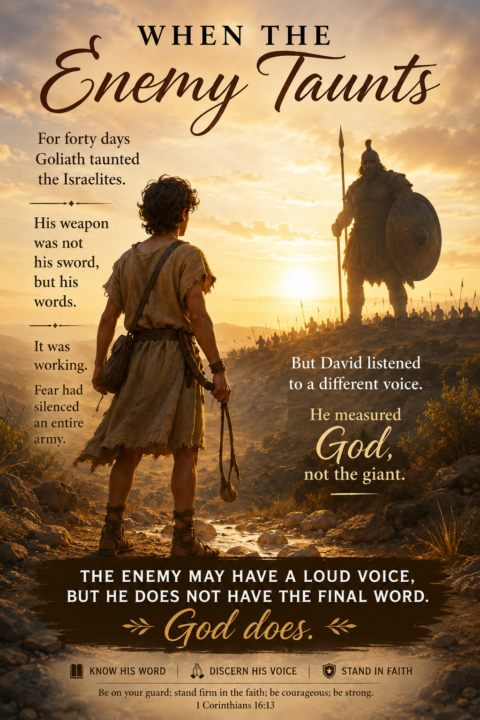
When the Enemy Taunts For forty days the Israelites stood listening to the taunts of Goliath. Day after day, morning and evening, the giant mocked them and challenged their God 1 Samuel 17:16. His greatest weapon was not his sword but his words. The purpose of the taunting was to create fear, wear down their confidence, and cause them to lose faith in the God who had brought them out of Egypt and given them victory so many times before. It was working. No one wanted to stand and fight. Fear had silenced an entire army. Then David arrived. What stands out to me is that David did not see the same battle everyone else saw. While the soldiers saw an unbeatable giant, David saw a man defying the living God. His focus was not on the size of the problem but on the greatness of God. David asked, “Who is this uncircumcised Philistine that he should defy the armies of the living God?” 1 Samuel 17:26. I have often wondered about what happened after David defeated Goliath. Goliath had proposed a battle of champion against champion. The implication was that the outcome would settle the conflict. Yet the moment David struck Goliath down, the Philistines fled and a full-scale battle broke out. Whether or not they ever intended to honour the challenge, one thing became clear: the enemy could not be trusted. That should not surprise us. From the beginning, Satan has been a deceiver. In the Garden of Eden he twisted God’s words. Jesus called him “a liar and the father of lies” John 8:44. He does not play by God’s standards because deception is his nature. How often do we hear his taunts today? “You’re not good enough.” “God has forgotten you.” “This situation will never change.” “Just give up.” Like Goliath, his aim is to intimidate us before the battle has even begun. So why was David different? I believe it was because he had already learned to trust God in the hidden places. While caring for his father’s sheep, he had seen God deliver him from the lion and the bear. Those private victories built a confidence that public battles could not shake. More importantly, David’s heart belonged to God. He knew God’s faithfulness through experience, not just through stories.
1
0
3d •
Strength for the Journey
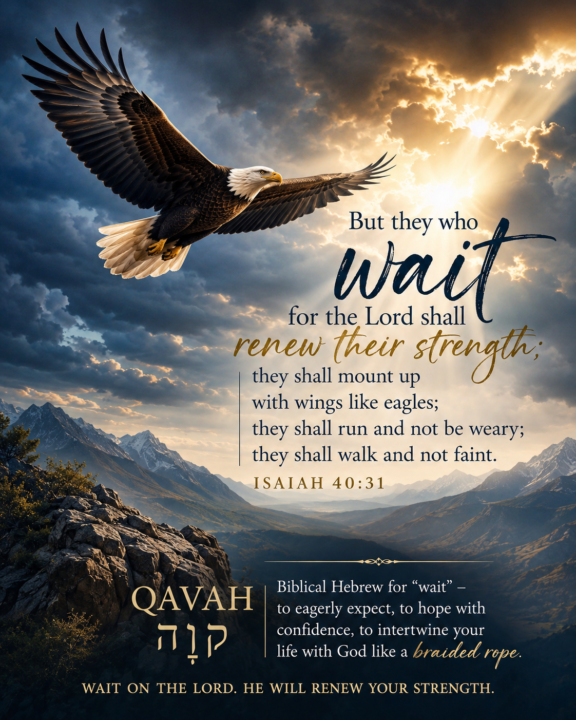
Strength for the Journey We all face battles, troubles, and seasons when we reach the end of our own ability to hold on. Our natural response is often to try to work everything out ourselves. We plan, we strive, we scheme, hoping that somehow we can carry the weight on our own. But when you feel like you simply cannot keep going, God’s Word gives us the key to continuing on. “But they who wait for the Lord shall renew their strength; they shall mount up with wings like eagles; they shall run and not be weary; they shall walk and not faint.” Isaiah 40:31 The key word in this verse is wait. In Biblical Hebrew, the word translated “wait” is qavah. It is far more than simply passing time. It carries the rich meaning of eagerly expecting, hoping with confidence, and even becoming intertwined with God like the strands of a braided rope. The picture is one of our weakness being woven together with His strength. We live in a world where almost everything is available at our fingertips. Waiting has become one of the hardest things for us to do. We pray, we ask, and when the answer is not immediate, we are tempted to become discouraged. Some even conclude that God has not heard them or that He is not there. But biblical waiting is not passive. It is choosing not to rush ahead of God. It is spending time in His presence. It is talking with Him, listening for His voice, allowing Him to shape our hearts while we trust His timing. As we wait on the Lord, He promises to renew our strength. He does not simply help us survive our circumstances, He enables us to rise above them. Like an eagle that catches the wind beneath its wings, we are lifted by His strength rather than our own. We find ourselves able to run without growing weary and to walk without fainting because He is carrying what we could never carry ourselves. God has not forgotten you. He knows the plans He has for you, plans for your good and not for your harm. He sees every circumstance you face. His invitation is simple, wait in His presence, listen for His voice, and allow your life to become intertwined with His. There you will discover a strength that is not your own, a peace that cannot be shaken, and the grace to keep moving forward one faithful step at a time.
0
0
4d •
Trust Beyond What We Can See
Trust Beyond What We Can See “Some trust in chariots and some in horses, but we trust in the name of the Lord our God.” Psalm 20:7 When the battle is at its fiercest, our natural tendency is to trust in what we can see, touch, and control. We look for visible solutions, influential people, financial security, or our own strength to rescue us. Throughout Scripture we repeatedly see God’s people tempted to place their confidence in earthly alliances. Kings looked to Egypt and other nations for protection instead of trusting the God who had delivered them time and time again. What seemed powerful in human eyes could never compare to the power of the Lord. God continually calls us to a different kind of trust. “Do not be afraid, for those who are with us are more than those who are with them.” Then Elisha prayed, “O Lord, please open his eyes that he may see.” So the Lord opened the eyes of the young man, and he saw that the mountain was full of horses and chariots of fire all around Elisha. 2 Kings 6:16–17 The servant could only see the enemy. Elisha saw heaven’s army. Nothing had changed in the natural. The enemy was still there. The city was still surrounded. The only difference was that God opened the servant’s eyes to the unseen reality. How often are we like that servant? We become overwhelmed by the circumstances in front of us because we cannot yet see what God is already doing around us. When our trust is in the Lord, we can rest even when everything appears impossible. Though the battle may look dire, God surrounds His people on every side. He is never caught by surprise, never outnumbered, and never defeated. Sometimes it is darkest just before the dawn, but darkness has never prevented God from bringing the morning. The victory has never depended on the size of the enemy. It has always depended on the greatness of our God. When we choose to trust Him, He teaches us to see beyond what our natural eyes can perceive. Faith begins to recognise what fear cannot see. We discover that the battle truly belongs to the Lord, and that He is already fighting on behalf of those who place their confidence in Him.
0
0

5d •
God has a plan
Jeremiah 29:11 is often quoted as a promise of immediate blessing, but its original setting tells a deeper story. These words were spoken to God’s people while they were living in exile. Their circumstances were difficult, and there would be no quick escape. Instead of offering an instant solution, God gave them something greater—a promise that His plan was still unfolding. God has a plan, not merely an immediate solution. His promise is not that the path will always be easy, but that His purposes are ultimately good. He is not finished with us. He is still writing our story. A plan unfolds as we journey. It is carefully thought through, requiring intention, wisdom, and purpose. In the same way, God’s plans reveal His love and care. He has never acted carelessly toward His children. Every step He allows, every season He leads us through, is woven into a story that reaches far beyond what we can currently see. What is even more remarkable is that His plans are not only about our story. They become part of someone else’s story as well. God is weaving countless lives together into one great work of redemption. Our moments of waiting, obedience, perseverance, and even suffering may become the very testimony that brings hope to another. As Romans 8:28 reminds us, God works all things together for the good of those who love Him and are called according to His purpose. That good is not always immediate comfort, but His greater purpose being accomplished in and through us. God’s plans are never frivolous or without meaning. They are filled with depth, wisdom, and eternal purpose. We may not always understand the mind of God or the road He chooses for us, but we can trust the heart of the One who is leading us. Faith is not having every answer. Faith is believing that the Author of our story knows exactly where He is taking us. Even when we cannot see the next chapter, we can trust the One who is writing it.
0
0

1-10 of 286

@denise-roberts-6177
Woman of God just wanting to share the things that God shows me
Active 12h ago
Joined Nov 17, 2025
Mackay Queensland Australia