Activity
Mon
Wed
Fri
Sun
Aug
Sep
Oct
Nov
Dec
Jan
Feb
Mar
Apr
May
Jun
Jul
What is this?
Less
More
Memberships
AI Story Crafters
191 members • Free
Summers Method - Rewire "You"
40 members • Free
DP
Digital Product Creators Club
767 members • Free
AI Pro Writers Studio
112 members • Free
AI Book Builders
185 members • Free
Story Hacker STARTER
7.6k members • $7
LTC Ashram
3.3k members • Free
20 contributions to Digital Product Creators Club

19d •
✨ New: Rewrite any part of your book with a single instruction
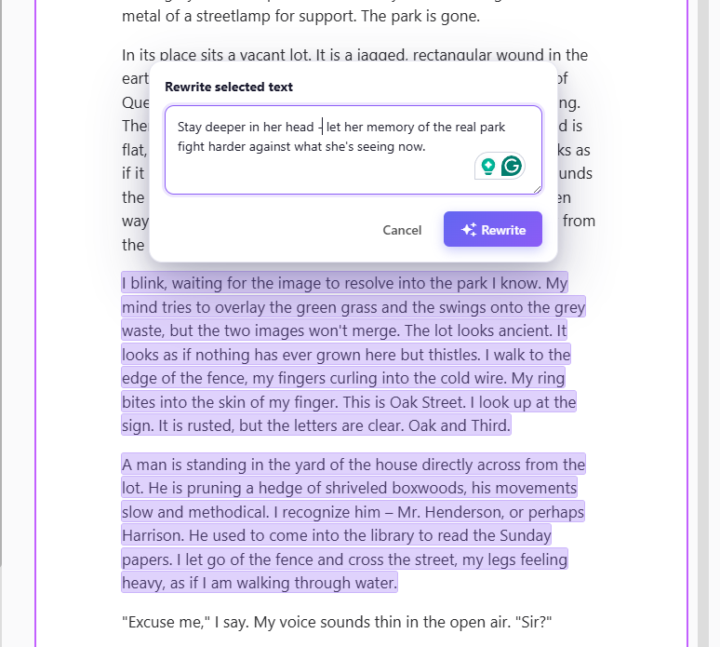
Hey everyone, I just shipped something I'm genuinely excited about, and I think it's going to change how you polish your books inside BookNova. Up until now, if you wanted to change a sentence or a scene, you either edited it by hand or regenerated the whole chapter. Today I'm giving you something far more surgical: you can now rewrite any specific piece of text just by selecting it and telling the AI what you want. Here's how it works: Highlight any sentence, line of dialogue, or paragraph in your chapter (just drag your mouse over it). A small Rewrite button pops up right above your selection. Click it, and a box slides open. The text you picked stays highlighted, so you always know exactly what's about to change. Type an instruction for how you want it rewritten — or leave it empty for a standard rewrite — and hit Rewrite. That's it. The AI rewrites only the part you selected, in your book's language, using the same model that wrote the chapter — so it blends right in with the prose around it. The real power is in the instruction box — this is where you direct the scene like a showrunner. A few examples of what you can actually type: "Give her dialogue a sharper, more sarcastic edge — she's hiding how scared she is." "Rewrite this fight so it's chaotic and close-quarters instead of clean and choreographed." "Add a beat of physical tension between them before he answers." "Make the villain's threat quieter and more menacing — no shouting." "Switch this from telling us he's grieving to showing it through small actions." "Slow this moment down and stretch the suspense right before the door opens." "Layer in sensory detail — what the tavern smells and sounds like." "Plant a subtle hint here that she's lying, without giving it away." "Deepen the POV so we're fully inside his head during the betrayal." You can get as specific as you like — name the character, the emotion, the stakes. The more precise your direction, the closer the result lands to the scene in your head.

4 likes • 18d
The possibilities are endless with this update. I've been taking the "final" output and going to another tool to analyze and complete rewrites. To do this in real-time and stay here is truly a major update.
24d •
A question about 'SAIL MODE' and the story's characters.
I have decided that SAIL MODE sails without a compass. I had developed a framework where the book's structure would be defined, but there is one problem - in the middle of the story, the AI offers such interesting plot twists that the ship begins to drift (very) far from its original course, and those compasses no longer serve any purpose. The same goes for the story's main characters. While sailing, you can bring in all kinds of different characters. So the initial character definitions no longer make much sense either. A question for you. How would you like to see 'SAIL MODE'? A both/and option does not work. It's either freestyle or strictly defined. Both options require completely different algorithms, which complicates the development process. That is why this needs to be firmly decided right now.
1 like • 24d
Sail mode
Jun 15 •
An update on Story Geography
I've just shipped an update I'm pretty happy with, and it's all about fixing geography in your books. Here's the problem I kept seeing: longer stories were losing track of where things actually are. Characters would drift out of their proper places - someone who's supposed to be away on a ship or a journey would suddenly turn up in a scene back home, with no explanation of how they got there. And the one that really bugged me: stories would jump between far-apart locations way too fast. A character could be deep in one corner of the world (or the galaxy) one night and back at the home base the next morning, basically teleporting. The system was good at tracking the timeline of a story, but it had no real sense of distance - so places would shift around in ways that just didn't add up. So I built a new geography layer to fix it. It works out up front where each location sits and how far apart the different regions are, then keeps that in mind across the whole book. From now on, new books should: - Keep characters in more precise, consistent locations instead of popping up where they shouldn't be; - Respect real distances and travel time, so characters can't teleport across the map (or across - space) without the time it'd actually take to get there; - Get checked automatically while the outline is being built, so these slips get caught and fixed before they ever reach you. - It all runs quietly in the background — no extra steps, no extra cost — on every new book you generate. I'll be straight with you: this is a real step up, but keeping a whole story consistent is genuinely hard, and I'll keep tightening it. At least, that's how it should work now - so if you still catch a character showing up somewhere they couldn't possibly be, please tell me. That kind of feedback is exactly what got this fixed in the first place. Happy writing 📖
3 likes • Jun 15
Really appreciate your continued review and upgrades, and your drive to make BN the best it can be. Helps make us better storytellers, too.
Jun 12 •
I just finished the biggest rebuild BookNova has ever had — and I want to tell you what actually changed. 📚⚙️
I'm a solo founder, so when I say I spent the last weeks deep inside the engine room, I mean every line of it. This wasn't a prompt tweak. I rebuilt the two systems that plan and write your books — the Story Threads Engine and the Chapters Engine — around one fundamental idea: Your story's facts now live as structured data, not just text. Until now, AI book generators (mine included) passed your story between generation steps as plain text — and every hand-off was a chance for details to mutate. A park named "Riverside" in chapter 1 became "Willow Park" by chapter 4. A character knew things she hadn't learned yet. A wound healed overnight. Timelines quietly ran backwards. What I rebuilt in the Story Threads Engine (the system that plans your outline and chapters): 🗓️ Story Calendar — every chapter now sits on a canonical story day. Time can't run backwards, injuries get realistic recovery time, and travel takes as long as travel takes. 🧠 Knowledge Map — the engine tracks WHO knows WHAT, and WHEN they learn it. A character can no longer react to a secret she hasn't discovered. Reveals land exactly in the chapter they were planned for. This is the machinery of real suspense — dramatic irony, gaslighting, slow-burn secrets — now enforced, not hoped for. ⛓️ Event Graph — the load-bearing plot events (the betrayal, the switch, the reveal) are stored with their dependencies. An event can't silently vanish from the book or happen before its setup. If the outline misses a key scene, the engine now KNOWS — and flags it. 🛡️ Code checks + AI repairs — the part I'm proudest of. Instead of asking AI to "please remember everything," fast deterministic code now scans every chapter plan against your story's canonical data — names, numbers, scheduled events, points of view. When it finds a violation, an AI editor surgically repairs that exact spot. Code detects, AI fixes. That inversion is the whole game. What I rebuilt in the Chapters Engine (everything around the actual prose — before AND after each chapter is written):
1 like • Jun 12
Completely amazing!
Jun 11 •
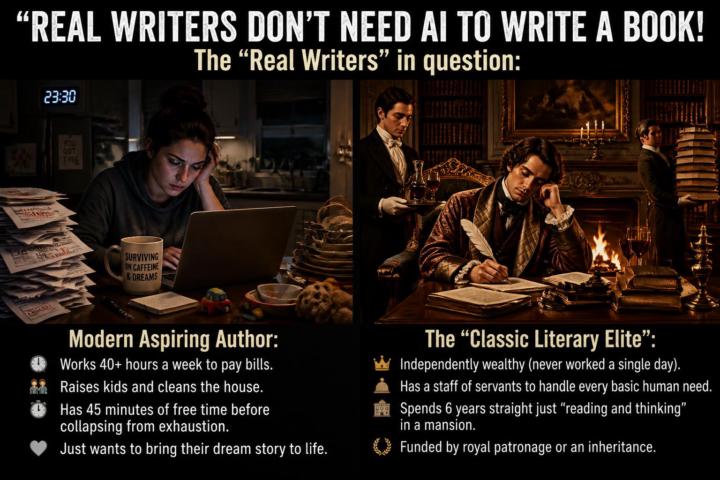
Why the Old 'Elitist Authors' Hate AI, and My Two Cents on the Subject
I recently came across a comment on our page that perfectly encapsulates the gatekeeping and elitism still running rampant in the literary world. It was so dismissive of modern creators that I felt the need to share it—and address it head-on. The comment read: "Homer didn't use AI. Dante didn't use AI. Geoffrey Chaucer didn't use AI. John Milton didn't use AI. William Shakespeare didn't use AI. Voltaire didn't use AI. Jane Austen didn't use AI. Charles Dickens didn't use AI. Herman Melville didn't use AI. Edgar Allen Poe didn't use AI. Ernest Hemingway didn't use AI. F. Scott Fitzgerald didn't use AI, and George Orwell didn't use AI. What did they have in common? Talent, good imaginations, and taking the time to learn their craft. REAL writers write. Would-bes-if-they-could-bes have to use AI." As the founder of BookNova, this punchline "REAL writers write. Would-bes-if-they-could-bes have to use AI"-struck a chord with me. It’s a classic narrative meant to shame people, but it completely falls apart the moment you look at actual history. Comparing a hard-working person in 2026 to this list of literary giants isn't just unfair—it’s historically inaccurate. Let’s look at what most of these "real writers" actually had in common besides talent: immense privilege, financial safety nets, and an army of invisible support. Let’s look at the facts: Dante, Milton, and Chaucer never knew what it felt like to balance a soul-crushing 40-hour work week just to pay rent. They came from wealthy families, held high-paying court positions, or were independently funded. Milton literally spent six years straight doing nothing but reading and writing at home because his wealthy father picked up the tab. Jane Austen belonged to the gentry. She never worked a day job and never had to scrub a floor; family servants handled the domestic labor so she could sit by the window and write. Voltaire became a multi-millionaire through clever investments and inheritance, eventually buying a massive estate where he could write whatever he pleased without a single worry about survival.
2 likes • Jun 11
Read an article the other day where the author likened using AI for writing was like wearing glasses for her brain. As others have said: just another tool to use.
1-10 of 20

@david-jones-5417
Years in the corporate world writing scripts, manuals, PR, help desk info, etc. Now it's time for me to use that experience in other ways for myself.
Active 5h ago
Joined Apr 25, 2026
ENFJ