Activity
Mon
Wed
Fri
Sun
Jul
Aug
Sep
Oct
Nov
Dec
Jan
Feb
Mar
Apr
May
Jun
What is this?
Less
More
Memberships
NeuroSpicy Freelancers
393 members • Free
The Independent Authors Guild
124 members • Free
Automate Business AI
6.1k members • Free
AEJuice
767 members • Free
AI Pro Writers Studio
94 members • Free
DP
Digital Product Creators Club
670 members • Free
Wordsmiths’ Guild
11 members • Free
Ideorix - AI Writing & Editing
156 members • $15/month
Story Hacker AI
1.6k members • $67/month
6 contributions to AI Pro Writers Studio

2d •
Question for the Lurkers....
you joined for a reason? What are we not doing here to get you to join in on the conversation? Happy to have you keep watching, I just feel like I'm not helping you if I don't know what your needs are? Give a shout, ask a question, throw out an idea. I'm noodling on ideas to get people more involved and see what you need that I/we can provide.


1 like • 3h
It can be overwhelming. Getting to the first step. All the information available.
1 like • 3h
@Michael Culp oh I understand that. Just talking about the others.
5d •
Workflow Wednesday
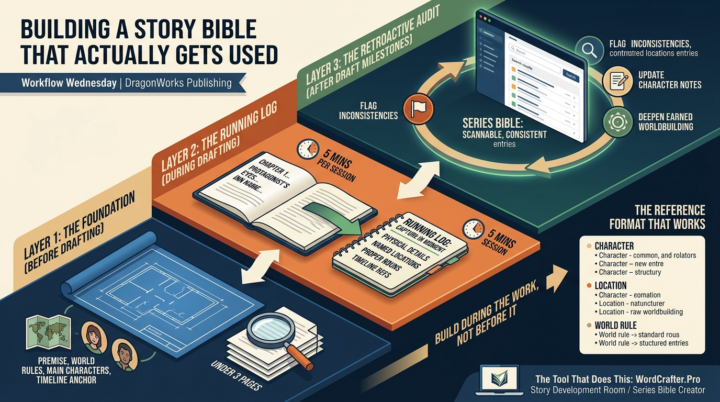
Building a Story Bible That Actually Gets Used Most story bibles are graveyards. You build them with good intentions. You name the continents. You map the magic system. You write three paragraphs about the royal succession. And then you open your draft and just... write from memory anyway, because pulling up the bible feels like a context switch that breaks the flow. Six chapters later you've given your protagonist two different eye colors and forgotten the name of the inn from chapter two. A story bible that doesn't get used isn't a bible. It's procrastination formatted nicely. Here's how to build one that actually works during the draft, not just before it. The Two Failure Modes Before the workflow, it helps to name what goes wrong. The Over-Built Bible. You spend three weeks building world lore before a single scene is drafted. The bible has texture and depth and almost zero relevance to the story you're about to tell, because you don't actually know what the story needs yet. By chapter four you're ignoring most of it. The Never-Updated Bible. You build a decent one up front, start drafting, and then never add to it as the story grows. Characters develop details in the draft that never get captured. Plot decisions accumulate. By book two you can't remember what color your protagonist's apartment was. The solution to both is the same: build the bible in layers, during the work, not before it. The Layered Build Layer 1: The Foundation (before drafting) Keep this short. Under three pages if you can manage it. You only need what you can't discover in the draft: The premise in one sentence. The world rules that constrain your plot (magic system limits, technology level, geography if it affects plot). Your main characters, one paragraph each: name, role, want, wound, voice note. The timeline anchor: what happened before chapter one that made chapter one necessary. That's it. Resist the urge to go further. The rest gets built as you need it. Layer 2: The Running Log (during drafting)
5 likes • 4d
I use notebooklm for the storybible. It's pretty solid.
5d •
Sigh... Rules change
Thanks to two warnings from a new user - Whose initials *might* be Sandra Rose I've raised the floor on Direct MEssaging to level 3. Glad to have you if you need help or want to help others here, and if your offer is of legitimate value to our users then cool post it for all. But please do not directly contact folks with offers. You must engage and move to level 3 to send DM's now.

6 likes • 5d
@Stacey Brooks oh I was thinking about others lol I am silly tho
3 likes • 5d
@Kenny Funk 🤣it just happened
6d •
Marketing...
I'm starting to really push on the marketing side with some updates and new pieces of the puzzle added in. Let me know what you need or are missing on the marketing side to sell your books. I'm going to make a push to get my own published and follow the same sequence I'm teaching here and start doing commentary on what I am doing and why. If you have a better idea, thought on my process or want to tell me what I'm doing is just wrong PLEASE do!! Marketing is both a science and an art. I worked IT for a major regional Ad agency for many years and know a lot but I am by no means an expert as everything changes and they were more centered on Radio, TV, and Newspaper advertising, not online. PLease leave your thoughts and needs below for now. I'm looking for the pain points that I may have missed so far

3 likes • 5d
If there was a focus more on that side of things. Just a basic go to on a baseline plan would be good. What do I need to do to build an audience that will read.
3 likes • 5d
@Michael Culp exactly this!
8 likes • 14d
It’s based on your activity
1-6 of 6

Active 3h ago
Joined Jun 11, 2026
Fayetteville, NC
Powered by