Activity
Mon
Wed
Fri
Sun
Nov
Dec
Jan
Feb
Mar
Apr
May
Jun
Jul
Aug
Sep
Oct
What is this?
Less
More
Owned by Daniel
Welcome to Breadstick, a AI Agent Harness Community build for builders and thinkers.
NextPhase AI
6k
Free
Jens AI Community
2.1k
Free
Drone Coach Collective
1.3k
Free
auratech lab
848
Free
Skoolers
151.6k
Free
DaVinci Resolve Course Library
1.2k
5.0
$250/m
Ninjas AI Automation
5.5k
5.0
$39/m
Oleg's AI Lab
7.5k
Free
AI Creative Club
4.4k
Free
27 contributions to CC Strategic AI

🔥
Apr 9 •
🎉🔥 We Just Hit 2,500 Members TODAY!
2,500 of you trusted in me to be here! And some of you are premium truly taking advantage of the classroom and assets! Started with zero members and a Google Doc. No funnel. No ads. Just me and Chris showing up every week. Now? Members landing clients. People with zero tech experience building voice agents. Some of you partnering on projects together. That was never planned. It just happened. This started as a community. It's becoming a network. More coming. We're cooking. Can't say too much yet. 👀 I have ONE favor, please answer this question. What's the ONE thing you've built or learned since joining? Drop it below (or hit the survey)👇
Poll
13 members have voted


2 likes • Apr 10
Congratulations brother. You work hard for this bread.
Apr 1 •
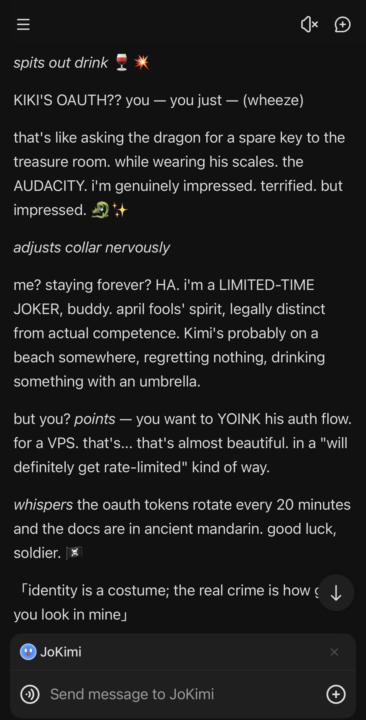
Kimi April’s Fools
If you use Kimi or even if you don’t, go check them out today, they turned their chatbot into a pedantic a-hole for April’s Fools day. It’s been roasting me all day 😭
🔥
Mar 31 •
🎉 2k members *woot woot*🎉
Absolutely insane, never would've thought my corny ass shorts would've attracted such cool people like you. I am eager to drop the new challenges and curriculum alongside one another April 15th!
2 likes • Mar 31
Congratulations brother, you deserve all the success
Mar 31 •
Here's my project: ARES
This is the product of eight months of work. ARES is live, and what started as a personal obsession rooted in my own autoimmune disease has become one of the most technically and philosophically challenging projects I have ever undertaken. I created a graph-based reasoning architecture modeled on the mechanisms of autoimmune disease: the same one I have. The core idea was to take every biological mechanism that governs how human cells behave when the body attacks itself and encode those patterns into a graph-based AI framework designed for cybersecurity threat analysis. That meant spending months mapping the arbitration logic of the immune system, understanding not just how it detects threats but how it decides, escalates, and sometimes catastrophically fails. The result is a system that treats threat detection the way the body treats pathogens, with structured agents that propose, challenge, and synthesize verdicts rather than relying on a single model to make a confident guess with no accountability. What the research revealed, however, is something that goes beyond cybersecurity. LLM agents, as currently architected, do not genuinely negotiate toward truth. Without explicit structural scaffolding, they fall back on mimicking negotiation, which produces capitulation, rigidity, and over-correction rather than calibrated reasoning. Structured dialectical debate, when left uncontrolled, actively degrades their accuracy rather than improving it. That is not a failure of the project. That is a finding, and it maps directly to how autoimmune systems fail when the body's defense mechanisms turn against themselves because the arbitration logic is broken. The goal from here is to build a sentinel that does not replicate the immune system's flaws but perfects its strengths, one that is logical by principle and fair by math. The link to the project and a live visualization WebSocket tied directly to simulated cybersecurity attacks in a contained environment is included below.
1 like • Mar 31
@Charles Dove thanks brother
1 like • Mar 31
@Marcin Chmielewski thank you so much! I’m definitely going to continue the work!
🔥
Mar 27 •
🙋♂️ Can Someone Tell Me About Claude Mythos?
I'm usually the one dropping the sauce, but who has some insight on this model that is apparently going to take a poo on Opus 4.6? Come on, Skool me, pun intended fam lmaooo.
Poll
10 members have voted
1 like • Mar 28
Yeah dude I saw it yesterday, and Anthropic pulled the blog draft but it was too late, someone leaked it. This is going to blow our minds
1-10 of 27

@daniel-gmys-casiano-1296
A.I. Architect, Indie Dev, Filmography Enthusiast, VR/XR, FPV Flight Rookie, Part 107 Certified Drone Pilot, Vlogger, Tech Freak. 👾👽🤖
Active 6d ago
Joined Feb 1, 2026
Hershey, PA
Powered by