Activity
Mon
Wed
Fri
Sun
Jun
Jul
Aug
Sep
Oct
Nov
Dec
Jan
Feb
Mar
Apr
May
What is this?
Less
More
Memberships
Pre-Vet Skool
16 members • Free
6 contributions to Pre-Vet Skool

11d •
🌶️ Happy Cinco de Mayo from Pre-Vet Skool!
For those who may not know — Cinco de Mayo is a Mexican-American holiday celebrated on May 5th, commemorating a historic Mexican military victory. In the U.S., it’s become a celebration of Mexican culture and heritage… and an excuse to eat really good food. 🇲🇽 Today we’re looking at one of Mexico’s most iconic ingredients through a science lens, because yes, even your hot sauce has biology in it. 😉 Did you know the compound that makes cayenne pepper spicy is actually used in medicine? It’s called capsaicin, and it works by binding to a specific protein in your body called a receptor. Think of receptors like locks, and capsaicin is the key. When capsaicin fits into this particular lock (called TRPV1), your body reads it as heat and pain. That burning sensation is not imaginary. Your nervous system genuinely thinks something hot is touching you. But here’s where it gets interesting. Use capsaicin repeatedly in the same spot, and eventually that receptor gets so overwhelmed it stops responding. No more signal. No more pain. Scientists figured out how to use that trick medically. 🔬 Here is what capsaicin actually does in the body: 🌶️ It can relieve pain — Creams and patches containing capsaicin are used in human medicine for conditions like arthritis and nerve pain. Veterinary compounding pharmacies make similar formulations for dogs and horses with chronic pain. The key is that repeated exposure quiets the pain signal rather than amplifying it. 🌶️ It affects blood flow — Capsaicin causes blood vessels to widen (called vasodilation) by triggering a chain reaction that increases nitric oxide, a molecule that relaxes the walls of blood vessels. More blood flow means better tissue healing. This is part of why cayenne has been used topically for sore muscles and cold extremities. 🌶️ It affects platelets — Platelets are the cells responsible for clotting your blood when you get a cut. Research shows capsaicin actually slows platelet clumping, similar to how aspirin works. This makes it a subject of interest in cardiovascular disease research.

2 likes • 11d
🌶️This is so interesting! Fun fact: Water doesn’t actually help when your mouth is burning from spicy food, which I always thought was interesting. Capsaicin is oil-based, so water just spreads it around, while milk works better because it actually helps wash it away. It’s also cool that it’s not real heat. It’s just your nervous system being tricked.
12d •
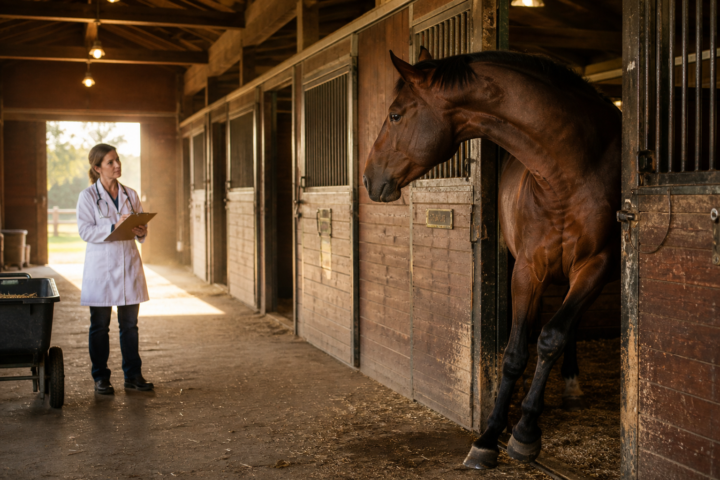
🐴 Case Study: Why Does Atlas Rock Like a Metronome?
Meet Atlas, a 7-year-old Warmblood gelding whose new owner calls because she is worried he might have a neurological problem. He sways rhythmically at his stall door every morning before breakfast, shifting his weight from one foreleg to the other like a pendulum, head and neck swinging side to side in perfect time. She asks if something is wrong with his brain or spine. You arrive at morning feeding time and watch Atlas for yourself. The swaying begins the moment the feed cart appears at the end of the aisle. It stops twenty minutes after he finishes eating. You perform a complete neurological exam. In-hand trot on a straight line, tight circles both directions, backing, tail pull. Atlas is perfect. Not a single stumble, no toe dragging, no proprioceptive deficit anywhere. This is weaving, a locomotor stereotypy. His basal ganglia have been permanently reorganized by years of social isolation and twice-daily grain feeding with minimal hay. The behavior is not neurological. It is behavioral. And it is irreversible. You counsel the owner honestly: increase turnout, add slow feeder hay nets, allow social contact. The frequency may improve. The behavior will not disappear. 💡 The takeaway: A horse that sways only at the stall door before feeding is not broken neurologically. It is telling you something went wrong long before you arrived. For more information on this condition see the classroom or follow the link below: https://www.skool.com/pre-vet-skool-9535/classroom/eada0165?md=e818bf20993643c49143555284796a86
2 likes • 11d
I really like this case on Atlas. I think this is a great example of how important it is to look beyond neurological causes and consider management factors. The fact that it’s irreversible really emphasizes how early conditions can have lasting effects on behavior.
Apr 13 •
Welcome to Pre-Vet Skool! 🐾
I’m so glad you’re here. Whether you just discovered your love for veterinary medicine or you’re putting the finishing touches on your application this cycle, you belong in this community. I’m Dr. Nisana, a Doctor of Veterinary Medicine. I built this space because I love working with students, but not the politics of universities. This is a place where you can: 🔬 Explore real clinical cases that make you think like a vet 📋 Get support on every part of the application process 💬 Ask me anything — no question is too small 🤝 Connect with other students who share your dream As a founding member, you can help me to create and shape the community and resources inside! A few things I want you to know: You don’t have to have it all figured out. You just have to show up. The students who get noticed by vet schools aren’t always the ones with the perfect GPA — they’re the ones who are intentional, prepared, and passionate. That’s exactly what we’re building here. Step 1: Introduce yourself below! Tell us where you are in your journey — are you just starting out, or are you deep in the application process? I’d love to get to know every one of you. So you are aware: I will be filling the classroom over time. Some resources I'm going to level-lock. So, this means you will need to "gain points" to unlock some resources. Step 2: GAIN POINTS- You gain points when another member likes one of your comments or posts! (1 like = 1 point) Level 1 - 0 points Level 2 - 5 points Level 3 - 20 points Level 4 - 65 points Level 5 - 155 points Level 6 - 515 points Level 7 - 2,015 points Level 8 - 8,015 points Level 9 - 33,015 points Please, please provide any feedback about what's working for you or not working for you in this community!
2 likes • 12d
Hello, my name is Cristal! I am an aspiring Small Animal Veterinarian. I have always loved animals and have fallen in love with shelter medicine over the past few years. I am working towards my Vet Tech license and I am working towards my Master's degree in Animal Health at the University of Delaware. I am excited to be part of such an amazing community!😊
14d •
Happy Sabbath! Sabbath Skool Animal Trivia
Happy Sabbath, Everyone! Welcome back to Sabbath Skool Animal Trivia! This week’s story features one of the most jaw-dropping moments in all of Scripture, and it involves an animal doing something that should be absolutely impossible. We’re still in the wilderness with the children of Israel! God needed to stop a prophet in his tracks, a man who was on his way to do something that would bring harm to His people. So the Lord opened the mouth of an unexpected messenger. Not an angel. Not a man. An animal. And this creature said something that stopped the prophet cold and opened his eyes to what he’d been blind to all along. Sound impossible? Well, with God, nothing is. And this moment wasn’t just dramatic, it was an act of mercy. The animal saw what the prophet couldn’t. Three times. This Week’s Question: What animal spoke to the prophet, and what was the prophet’s name? Read carefully, because why the animal spoke matters just as much as what it said! No Googling, this is Sabbath trivia, not a search contest! 😊 Hint: Start in Numbers 22, then notice how 2 Peter 2:16 references this same story centuries later. 🌟 Fun Extra: After naming the animal and prophet, share one interesting fact, scientific, behavioral, or biblical, about this animal! May your Sabbath be filled with rest, wonder, and the reminder that God can use anyone and anything to speak truth! 🙏
2 likes • 13d
The prophet was Balaam and the animal that spoke to him was a donkey. In the Bible donkeys are often used for transportation and carrying goods. While donkeys were used as working animals in the Bible, they were treated kindly and cared for, showing responsible treatment of working animals.
17d •
🐟 Case Study: Why Are Koi Dying Overnight?
Meet Sakura, a prized 6-year-old koi in a backyard pond in California. Her owner calls in a panic on a warm September morning. Five of his twelve koi are dead and three more are lying on the bottom gasping. The water temperature is 73°F. You arrive and notice something immediately. The surviving fish are coated in thick excessive mucus and their eyes look sunken rather than bright. You check the gills on a freshly dead fish and find white and gray mottled patches where healthy red tissue should be. The owner mentions he added five new koi from an online seller three weeks ago without quarantine. This is Koi Herpesvirus. At 73°F, the temperature is perfect for viral replication. The gills are being destroyed faster than the fish can breathe. There is no antiviral treatment. Your first move is not medication but a PCR swab of gill and kidney tissue, followed immediately by a call to state animal health authorities. KHV is an OIE-listed reportable disease. The quarantine failure three weeks ago made this inevitable. 💡 The takeaway: In fish medicine, a four week quarantine is not optional. It is the difference between one sick fish and a pond full of dead ones. For the full course on this disease, see the classroom or follow the link below: https://www.skool.com/pre-vet-skool-9535/classroom/289939ea?md=ad951c90ea3b4b87909dc49e6936a6d2

2 likes • 13d
This is so interesting! I love Koi fish.
1-6 of 6

@cristal-perdomo-4888
Graduate student in Animal Health at the University of Delaware with a focus on small animal health and clinical care
Active 11d ago
Joined Apr 19, 2026