Activity
Mon
Wed
Fri
Sun
Nov
Dec
Jan
Feb
Mar
Apr
May
Jun
Jul
Aug
Sep
Oct
What is this?
Less
More
The Atelier Sewing Hub
66
Free
Catherine's Sewing Room
1.4k
5.0
Free
17 contributions to The Atelier Sewing Hub

Sep 6 •
Where The Atelier Hub Started - Personal Post ☺️
Before there was an Atelier Hub, there was a bridal shop. Then three businesses. Then losing all of it. I opened Bridal Emporium in Leeds city centre in September 2014. Before that, a family of creatives, and an education across fashion, tailoring, millinery, historical costume, props, set design & much more. That range is exactly why this Hub is not organised around one discipline. Dressmaking, bridal, couture, tailoring, corsetry, millinery, historical costume, alterations, props... It is all one craft to me, and I built this space to reflect that. Bridal Emporium grew into three businesses, Bridal Emporium a physical shop selling and designing wedding gowns & alterations, Claire Amelia Couture a collection of designed & manufactured in UK bridal & evening wear, and Emporella an online wedding marketplace b2b and b2c. Whilst becoming a mother to 3 beautiful children, birthed in 4.5 years, and only having 5-6 weeks maternity leave between all 3. I remember the days where my children strapped to my chest, whilst pinning brides for their big day, napping on the cutting table, whizzing to business meetings with double prams, oh it was so liberating being with my babies but exhausting all at once. All businesses running through Covid, of which only one qualified for government support. After prior investment of my own profit growth of over £250k, but no active industry due to covid, I closed Bridal Emporium in 2023, I kept the other two going as long as I could, and by Easter 2024 the exhaustion caught up with me completely, bed ridden with severe side affects. I am still rebuilding my health, and accepting what was lost is ongoing work, not a one time thing. These are the dips in and out of the online world, I find myself living life with my family, present there and then, and not wanting to be online, but with mother earth. I built the fast paced, masculine businesses prior, this time feels different. The Atelier Hub is what came out the other side of that crazy, fun, lots learned, grief, stressful and many happy times mixed in all at once. Sewers who are past the beginner stage rarely have anywhere to go, and I built this because I needed exactly that and could not find it. Not a how to group, not a beginner space. A place where experienced sewers across every discipline gather, share what they know, and go deeper into the parts of the craft that beginner spaces skip past. Damn I remember the late night, oh shit, how do I do this, and nowhere to turn or anyone to ask.


1 like • Sep 11
Not being able to find experienced sewist groups -- or even those people in my town -- was what drew me to this space! I do understand the overachieving women must go to just to compete in the business world. I am well into my 70s, and I can tell you that all your experience will give you more confidence, less fear, and more growth options than if it never happened. Now -- it's time for what you want to do.
1 like • 27d
@Claire Amelia We do, indeed!

Sep 12 •
my latest creations
working on crochet christmas gifts, market prepping, and finished a commission today. the fingered glove pictured is the first fingered glove I've ever made

0 likes • Sep 16
The glove is beautiful! I love crochet. I did it when I was a teen in the 60s, but not since then. Your basket looks professional! I take it you've been doing this for a while to get this good.
0 likes • 29d
@Lindsay Huff That's impressive!
Jul 18 •
Vintage Wedding Dress Turned Into Modern Bodice
We're discussing bodices this season, so here we are, a live project I'm working on for a customer. The customer asked for her mum's wedding dress to be made into a top for her to wear any time as sadly her mum has passed now, it's bringing a memory back to life 🫶 one of my favourite types of projects. The vintage wedding dress had to be washed 3 times before I took it apart, then I could start the lace manipulation onto the bodice. The fabric souring was the hardest part of this project, to match it to the yellow/gold tone of the lace, and for the client to feel comfortable as she was very sensory to fabrics. Wanting a tight fit but feel soft.. Take a watch and if you have any questions, please drop them in the comments!

1 like • Jul 18
@Claire Amelia You did a great job for a first time!
Jul 14 •
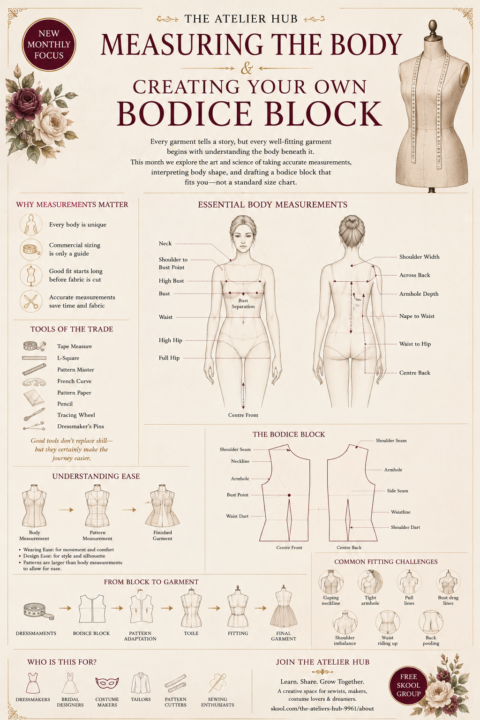
What's On - Measuring The Female Body & Making A Body Block
We're stepping into one of the most valuable skills any dressmaker, pattern cutter or garment maker can learn: understanding the body and creating a bodice block that truly fits. No matter what you love to sew—everyday clothing, bridal wear, historical costume, tailoring or couture—it all begins with a solid foundation. And that foundation isn't fabric or thread... it's understanding the person you're creating for. Throughout these sessions, we'll explore how to take accurate body measurements, interpret those measurements, and use them to draft a personalised bodice block. A bodice block (sometimes called a sloper) is a simple, close-fitting pattern that represents the unique proportions of the body. It isn't a finished design, but it is the starting point for countless garments. Once you have a well-fitting block, you can adapt it into dresses, blouses, jackets, bodices and so much more. Along the way, we'll be discussing topics such as: 📏 How to take accurate body measurements 📐 Understanding balance, posture and body shape 🪡 Drafting a personalised bodice block ✏️ Common fitting challenges and how to identify them 👗 Turning a basic block into your own garment designs ✨ Why commercial patterns don't fit everyone—and how to make them work for you One of the most rewarding parts of learning pattern cutting is that it changes the way you see clothing. Instead of simply following instructions, you begin to understand why a garment fits, how seams create shape, and where adjustments make the biggest difference. Whether you've been sewing for decades or you're just beginning your dressmaking journey, these skills will help you build confidence and create garments that fit better, feel better and reflect your own creativity. We'd love to hear from you! 📏 Have you ever drafted your own bodice block? 📏 Do you usually rely on commercial patterns, or have you experimented with pattern drafting? 📏 What's the biggest fitting challenge you've experienced when making clothes?
1 like • Jul 15
My two biggest issues are compensating for my old, rounded shoulders and narrow back. My pants issues are needing a longer crotch length in the back. I used to be able to make patterns without any adjustments (except for the pants), but no longer. I'm adept at blending patterns, taking in patterns and adding darts, etc. But I've never made a pattern from scratch. I'd love to have a simple, pull-over stretch knit top with a variety of necklines and sleeve lengths.
Jul 3 •
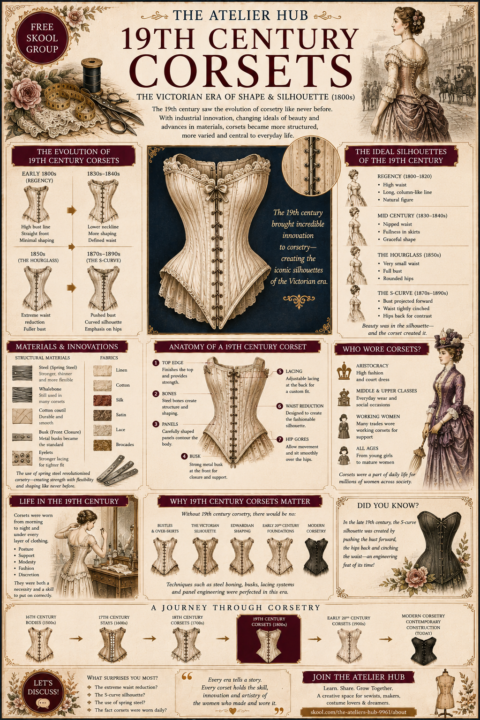
🪡 19th Century Corsets – Innovation, Craftsmanship & the Victorian Silhouette
As we continue our journey through the history of corsetry, we've reached perhaps the most recognisable era of them all the 19th century. When many people hear the word corset, this is often the image that comes to mind. Yet the Victorian corset was far from static. Throughout the 1800s, it evolved dramatically alongside fashion, technology and society itself. The century began with the elegant, high-waisted Regency silhouette, where corsets were relatively short and lightly structured. As fashions changed, so did the corset. By the mid-century, waistlines returned to their natural position, skirts became fuller, and corsets grew longer, offering increased shaping and support. One of the greatest developments of the Victorian era was the introduction of industrial manufacturing. Advances in metalworking transformed corsetry, introducing stronger steel busks and more reliable steel boning. These innovations allowed corsets to become both more supportive and more comfortable, while maintaining the fashionable silhouettes of the day. During this period, makers commonly worked with: 🪡 Cotton coutil and tightly woven cottons for strength 🪡 Linen and fine cotton linings 🪡 Flat and spiral steel boning 🪡 Steel busks for secure front closures 🪡 Hand-worked and later machine-set eyelets 🪡 Silk, satin, brocade and decorative trims for fashionable finishes The Victorian corset was also an extraordinary feat of pattern engineering. Carefully shaped panels, precise seam placement and graduated boning worked together to support the body while distributing tension evenly throughout the garment. It's important to remember that not every Victorian corset was designed for dramatic waist reduction. Everyday corsets were worn by women from many walks of life, providing support beneath clothing and helping garments fit as intended. Like modern bras or structured undergarments, they were practical foundation garments as much as they were fashionable ones. Many techniques used by modern corset makers continue to build upon Victorian innovations. From panel shaping and boning placement to busk installation and precision fitting, the craftsmanship of the 19th century still influences couture, bridal wear, historical costume and contemporary corsetry today.
1 like • Jul 4
@Claire Amelia I agree. Proper shaping of the garment is much more flattering. I've often done 2 fittings with and without spandex. I had one bride wear it. Everyone else said no.
1-10 of 17
@christy-steiger-5151
I've been sewing since I was 5. Last year, I closed my alterations business, and I'm looking forward to sewing just for myself and my family.
Active 5h ago
Joined Apr 21, 2026