Activity
Mon
Wed
Fri
Sun
Nov
Dec
Jan
Feb
Mar
Apr
May
Jun
Jul
Aug
Sep
What is this?
Less
More
CSCS Accelerator Community
236
Free
17 contributions to CSCS Accelerator Community

Jun 26 •
Retake 7/24/26
Hey. I’m Lou and I retake the exam July 24th. I w Scored half way in each topic. Any advice on what to do to refresh myself before the exam retake?

1 like • Jun 27
@Lou Howell, II, Recommend that as you study, step away from the material and teach it to someone. Talk it through like you were teach the concept to someone else. You're going to get stuck at different parts. Don't worry about it, that's your cue to what you need to review again. It's all repetition, not from a memorization perspective, but from a teaching perspective. I would walk the stairs at work (11 floors) on my breaks and I would explain (talk) to myself the distinction between the energy systems, how respiration works (especially as I got to floor #8), how the blood flows through the body and what it's doing/delivering to my muscles, etc. Give it a shot. After a little while, you'll catch yourself remembering all sorts of cool stuff about this beautiful world of training and adaptations.

Jun 18 •
Test Retake
A month or so ago, I had passed the practical portion of the CSCS, but failed the science portion by one point. I am retaking it next week! Any tips going into it? I have been watching all of the science related videos @Jacob Goodin has put out and practicing on Brainscape.
0 likes • Jun 27
Coach Miller, I recommend knowing the nutrition formulas cold. You have an advantage in having taken the test once already. Yes, look at it as an ADVANTAGE! Not to be taken lightly, but use that to support your confidence going in. You know what to expect! Recommend understanding key concepts like levers, how the muscles function, etc., well enough that you can teach them to the person down the street in the corner coffee shop. Good luck, you've got this!

Jun 19 •
New Quiz Feature: Daily Goal
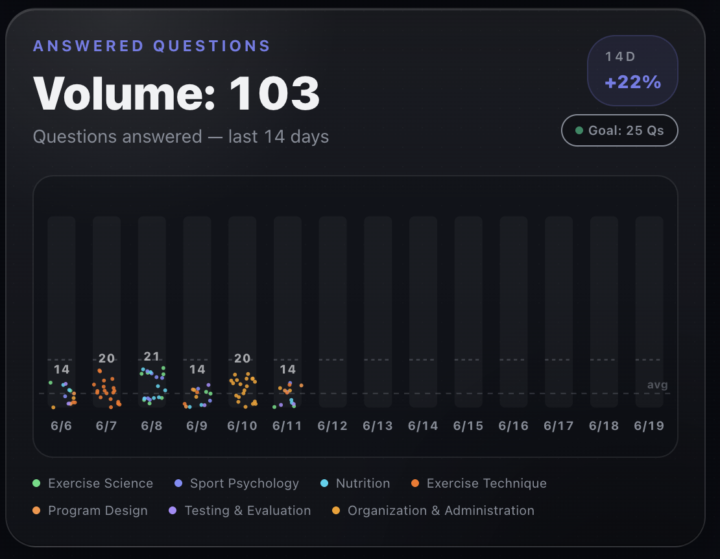
You can now set your daily question goal and watch as the green bars stack up while you put in the reps. Reminder: The CSCS Accelerator Quiz App is in beta. Thank you for those who are reporting bugs to me—it's very helpful! Reminder #2: Early access to the next cohort is open to all community members. Join now and get immediate access to quiz app: https://www.drjacobgoodin.com/
2 likes • Jun 19
😂 I'm sure you'd rather be on the track or in the gym. Appreciate you building this capability for us. A few more reps at the keyboard will get you an honorary degree in CompSci to add to your credentials!
Jun 18 •
The CSCS Accelerator Quiz App
It wasn't on my 2026 bingo card to add "App Developer" to my resume. But then Canvas crashed, and with that, we lost one of the most robust features of our CSCS Accelerator Course, one that I had put HUNDREDS of hours into curating. The Canvas Quiz platform was robust enough to handle question and answer randomization, immediate vs delayed feedback, multiple question banks, and many other useful learning features. And as hard as I've tried, I haven't found a better platform for our CSCS practice quizzes and practice exams. So I built my own. And CSCS Accelerator Course members get access to it. TODAY. Look for an email with the heading "Welcome to the CSCS Accelerator Quiz App." It contains a link that expires within 24 hours (Why does it expire? Because I couldn't figure out how to change that setting. If you miss it, just let me know). Once you sign up, start your practice! And please know that this is a web-based, beta version of the app. There are still features I'm working on, some formatting issues, and possibly some user interface issues. But by and large, it's ready to rock. If you are interested in joining the next cohort of the CSCS Accelerator Course before it fills up, you can find all the details here: https://www.drjacobgoodin.com/ The live sessions kick off August 3rd, but once you sign up you'll gain immediate access to the course, as well as the Accelerator Quiz App ahead of public release.

1 like • Jun 19
@Jacob Goodin, this is very cool 😎. What an awesome resource to help prepare for the exam or drop in to refresh foundational skills. On a Random test run, I got three out of ten questions wrong. I could immediately navigate to see a breakdown of where extra work was needed by DCO or Essentials chapter. Also handy to have so many ways to tailor the quizzes. The options are literally endless! This is going to be a great way to stay sharp. Thank you 🙏
Jun 8 •
CSCS Accelerator Course Updates:
Coaches! 😅😮💨 There have been a lot of major changes here in the last few weeks. Here are the pertinent updates: - All 151 recorded lecture videos have been posted in the Classroom 🙌🏽 - Video descriptions have been added, along with granular video chapter headings and summaries so you can skip straight to the topics you want to review - The infographics, study guides, and other downloads have been uploaded to a study tools module in the classroom. I still have a few infographics to add from the end of Cohort 3 - Speaking of Cohort 3, we closed it out a week ago and have already had coaches passing the exam 💪🏽 - I still have some work to do on migrating the following resources: downloadable lecture slides, extended resources and readings - The quiz platform in coding is coming along, but is not yet ready. I’ll give access as soon as it’s in beta. If you’re a free Skool member and are confused by any of this, it’s for the CSCS Accelerator Course members. I’ve listed links for you to check it out if you’d like to! I’m out of town for a few days for some family time but look forward to checking back here soon!
1 like • Jun 8
The lecture chapter headings and summaries are such a huge help! Very nice to be able to jump to specific topics where there are learning opportunities practically every minute of every lecture.
1-10 of 17

@christopher-smith-5668
CSCS, retired Army, moving swiftly into my Third Career in fitness, health, and wellness.
Active 8d ago
Joined Feb 23, 2026
Powered by