Activity
Mon
Wed
Fri
Sun
Oct
Nov
Dec
Jan
Feb
Mar
Apr
May
Jun
Jul
Aug
Sep
What is this?
Less
More
Owned by Christina
🔥 A Free Community For Entrepreneurs Ready To Build Differently 🔥 • • • 🗺️ Strategic Planning 🛠️ Real Tools 🧠Brain-Friendly⚡Sustainable Systems
HighLevel Quest
14.8k members • Free
HighLevel Huddle w/ Clay
3.6k members • Free
ADHD Reset Roadmap
5.5k members • Free
ADHD Nation
1.1k members • Free
AEO - Get Recommended by AI
1.8k members • Free
3X Freedom
1.8k members • Free
Skoolers
157.8k members • Free
Automated Marketer
5k members • Free
GoHighLevel w/ Robb Bailey
13.6k members • Free
267 contributions to 3X Freedom

Sep '25 •
The Boring Business Fundamentals You Shouldn't Skip...
Most of us that have been in business for a while already know these, but for anyone that's newer and just getting started, there's a few business fundamentals that aren't sexy, but are necessary that you should make sure you have... and some suggestions on where to start if you don't have them... DISCLAIMER: I am NOT an expert in things like business entities or other parts I'm sharing below, I just have a LOT of years of experience and seeking advice from professionals that I used to compile this list. If you are unsure, seek professional advice, and if you are a professional and I'm saying something wrong - please comment and correct me! ("iron sharpens iron" as @Kasim Aslam says). - Business Phone Number: You do NOT want your personal phone number getting picked up and listed on the internet, make sure you have a dedicated number you can use on all business-related things. If you have HighLevel (or my SaaS built on HighLevel) you can pick up a number for just a few dollars a month and forward it to your cell phone. - Business Mailing Address: DO NOT get your home address listed on the web - I have so many horror stories I can share about this. You can get a PO Box - and check with your local post office, many of them will let you use their street address so even things that don't allow a PO will accept it. For example, my PO Box is 4685 Happy Valley Rd, Unit 349, Flintstone, GA 30725 - Professional Domain Name: This is where you host your website/funnels, like I have one for my personal consulting at https://christinahooper.com and one for each of my businesses. If you don't have one yet, I recommend PorkBun because they have a very versitle DNS editor and allow free email forwarding. So if you're keeping costs down and can't afford professional email like Google Workspace yet, you can set up email to forward from something like [email protected] to [email protected]
1 like • Sep '25
@Donna Dhoostelaere 🩵 That's the goal! Drives me crazy when people don't give some kind of suggestion for a starting point when they tell you "do the thing!" so I always try to include that. 😉
0 likes • 26d
@David Palmer 🩵🩵🩵
Jun 12 •
What Executive Function Actually Is (And Why It Keeps Showing Up in Your Business)
Executive function gets mentioned constantly in neurodivergent spaces and almost never explained clearly. You hear it attached to ADHD. You hear it mentioned as the reason for procrastination, disorganization, and missed deadlines. You hear coaches reference it as something to “work on” — as though it’s a muscle you can train if you just try hard enough. Most of that is vague enough to be unhelpful. Executive function is an umbrella term for a set of cognitive processes managed primarily by the prefrontal cortex — the part of the brain responsible for planning, decision-making, and regulating behavior toward goals. Think of it as the brain’s management system. It’s the part that coordinates resources toward a specific purpose. The part that says “we need to accomplish X — here’s the sequence, here are the resources, here’s how we stay on track.” The main components: - task initiation (the ability to actually start, especially when a task isn’t immediately rewarding — this is not laziness, it’s a specific cognitive function) - working memory (holding information in mind while using it) - cognitive flexibility (shifting between tasks when circumstances change) - inhibitory control (pausing a response, resisting impulse, filtering distraction) - planning and organization - emotional regulation Here’s what most explanations miss: executive function is highly context-dependent. Someone can have excellent function in high-interest, high-stakes situations and severely compromised function in low-interest, low-urgency ones. “But you managed to plan that entire event perfectly” is not evidence that executive function is fine. It’s evidence that high stakes and high interest activate different neurological resources. Employment, for many people with executive function differences, provided significant external scaffolding — a schedule imposed from outside, priorities set by a manager, social accountability, a physical location associated with work mode.

0 likes • Jun 18
@Brandi Taylor 💙💙💙
0 likes • Aug 14
@David Palmer 💙💙💙
Jun 3 •
The Offer Stack Explained: Why One Offer Is Usually Not Enough
When you have one offer, growth stalls in a predictable way. Some people are ready to buy, most aren’t. The ones who aren’t have nowhere to go. The ones who finish working with you have nowhere to go next. Every new client requires starting the sales conversation from zero. Revenue is a direct function of how many new people you can find — which means if you stop finding new people, revenue stops. This isn’t a marketing problem. It’s an offer stack problem. An offer stack is the complete set of ways a client can work with you, arranged intentionally to serve people at different stages of readiness, investment, and need. The key word is intentionally. Most service businesses accumulate offers over time — a client asks for something different, you say yes, you add it to the website. That’s not an offer stack. That’s an offer pile. An offer pile creates confusion for buyers and operational chaos for you. A well-designed stack has three layers: 1 - The entry point offer — the lowest-friction way for someone to experience working with you. Its job is to make the first yes easy. The mistake most people make: designing it as a free teaser rather than a genuinely valuable standalone product. A strong entry point is worth what you charge for it and creates natural context for what comes next. 2 - The core offer — where the primary transformation happens. Most businesses already have this. The problem is usually that it’s the only thing they have. 3 - The continuity or premium offer — what comes after for clients who want to stay. Not everyone will use it. But having it means the ones who want to continue can — and that retention revenue is the most stable revenue in your business. The article also covers the founder fit check — because each offer in your stack needs to work for you, not just your clients. The best offer stack is one that creates a natural client journey and a sustainable operating rhythm simultaneously. https://christinahooper.com/blog/offer-design/offer-stack-explained-why-one-offer-not-enough

1 like • Jun 18
@Randy Gage lol those 90-min pitch fests drive me crazy! I feel like most of the people that do end up converting on that kind of lengthy pitch don't get what they were hoping for out of it. I think it happens so often because too many entrepreneurs measure success on the initial sales machine - run ads, make a pitch, close the sales, $$$$ in a few hours of work, and then don't pay attention to if what they sold is getting the result, getting used, or generating raving fans and referrals. Imagine if they fixed the back end. How much better would the front end pitch and product be. But also how much more revenue would unlock if it went from a funnel that has to constantly be refilled by grinding out ads and content to a flywheel that refills itself from referrals.
1 like • Jul 26
@Manny Torres most of what I see is using it to enhance existing offers or improve your ability to deliver with less overhead. To be fair though most of my clients are service-based entrepreneurs that are higher-touch business models... coaching, consulting, agencies, concierge-type-offers, etc. Basically, people that are really good at solving unique and specialized problems that would be difficult to replace with AI completely, but totally benefit from enhancing with AI.

Oct '25 •
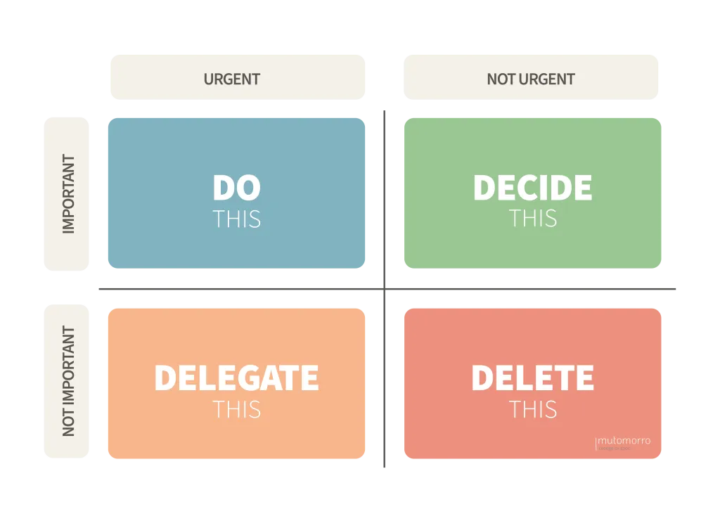
This Framework Turns Your To-Do List Into a Strategic Plan
Feeling overwhelmed by a never-ending task list? Meet the Eisenhower Matrix aka the method that separates the noise from what actually moves the needle. When you’re managing client work, testing new tools, and trying to grow your business, it’s easy to feel like everything needs your attention at once. But the truth is, not everything matters equally. This approach helps you sort through the chaos whether you’re a solo freelancer or running a lean team so you know exactly where your time should go. What is the Eisenhower Matrix? It’s a simple tool that helps you sort tasks based on two things: urgency and importance. That way, you’re not just reacting, you’re making space for what actually matters. The matrix has 4 quadrants: Quadrant 1: Urgent + Important (DO) These are fires that can’t be ignored. Examples: A campaign deadline today, broken client system, payment issues holding up a project. Action: Handle it now. Quadrant 2: Not Urgent + Important (PLAN) This is where the real growth happens. It doesn’t feel urgent, but it’s what sets your business up for the long haul. Examples: Updating onboarding workflows, improving delivery systems, building that long-overdue client dashboard. Action: Block time for it and commit. Quadrant 3: Urgent + Not Important (DELEGATE) Looks urgent. Isn’t valuable. Someone else can handle it. Examples: Meeting requests that don’t require you, tool setup that someone else can handle, quick questions better answered by a bot. Action: Assign it, automate it, or create a system around it. Quadrant 4: Not Urgent + Not Important (DELETE) These are the little distractions that eat up hours. Examples: Refreshing analytics five times a day, endlessly tweaking branding, aimlessly clicking through tools for “research.” Action: Let it go. Seriously. Want to use this in ClickUp? Here’s a fast setup that keeps you focused: 1. Create a List for your weekly priorities (call it something like “Weekly Focus” or “Task Triage”). 2. Add a custom dropdown field with four options: Do First, Schedule, Delegate, Eliminate. 3. As you add tasks, assign the right category. 4. Create views filtered by each label so you can jump into the right mindset fast. 5. Bonus: Set a weekly reminder to review and reassign every Friday.
0 likes • Oct '25
@Jamie Miralles lmao that's wild! I like the Smart Inbox part of his system and how it's structured, but flexible enough to adapt to any type of project or task I want to throw at it. The Smart Inbox basically catches anything I forget, like forgetting to set due dates, or connecting tasks to projects. It keeps things from getting lost in the system. I haven't heard of Tana, but I'll have to check it out. I haven't used the AI features too much with Notion yet, there's still this nagging part of me that doesn't quite trust it not to let something slip through.
1 like • Jul 26
@Manny Torres I think it's more about being consistently inconsistent. I basically set a few rules for myself and then aside from that, I give my flexibility to play with new systems on a regular basis. My brain simply is not going to stick with anything for months and months and months without tinkering or wanting to improve it. So I set my rules as this... 1) Due dates ONLY are used if there are real consequences to the thing not being complete on that date. Otherwise, use different ways to flag urgency on tasks besides dates. (This is trickier than you'd think - most project/task systems only surface things based on date.) 2) Priority list is decided daily. Everything else is in the parking lot. This is the only way I can accommodate life deciding to get extra life-ish and derailing my plans. It's much easier to manage curveballs for a few hours than it is to adjust my whole week. I hate putting time into planning only to have my plan implode, it makes me not want to plan anything. And doing it daily means it's easy to create a consistent rhythm. I have Claude Code project currently that checks in with me daily in the morning after reviewing my calendar and inbox and list and suggests what it thinks I should work on. Then it checks in again in the afternoon to see what I got done and updates my list. This really has helped with the sense of overwhelm of seeing a massive list. 3) Goal-based planning is weekly with the inspiration being "If only one thing improved in my life or business this week, what would it be?" That sets the tone for what "projects" I want chip away at this week. (Notice it's not "what's one thing I want to *complete* this week." 4) Close the loops as fast and as often as I can. I've noticed that one of the things I struggle with is open loops. Anything that is not complete or that I need to take action on stays in a running list in my brain on repeat until it's done. The sooner I can close the loop, the more processing power I free up in the brain and the less stress I am involved in.
Jun 25 •
One of our members needs support... can you help?
Is your best friend fighting cancer? Mine is. Chemo is kicking her butt HARD and she needs some help getting her daughter back home to help her. Claudine has been here to support this community and now she needs some support too. Pancreatic cancer survival rates are... well, not great... and that extra time together and support is everything right now. She's a single mom with kids that still depend on her, and getting the right care and support are her best chance to beat this. I know times are tough on everyone right now, but if you have even a few dollars to spare to help her daughter get home to help, they've put together a GoFundMe fundraiser... https://gofund.me/ea49a0a5c Thank you in advance for your support! Admins - I hope this ok to post... if it's not, I'll take it down.

1 like • Jun 26
@Erick Gomez Thank you so much!
1-10 of 267

@christina-hooper-6575
I help neurodivergent entrepreneurs design businesses that work with their brains.
Active 7d ago
Joined Sep 10, 2025
Chattanooga Valley, GA
Powered by