Activity
Mon
Wed
Fri
Sun
Nov
Dec
Jan
Feb
Mar
Apr
May
Jun
Jul
Aug
Sep
Oct
What is this?
Less
More
Preach360™
142
5.0
Free
21 contributions to Preach360™
13d •
Starbucks Raffle (Post Your Keyword to Enter!)
Since it's now fall in north GA (USA), it's time for a Starbuck's gift card raffle! 🍂 To enter, just post the keyword for your next sermon in the comments. Ready? Go! 👇 Also, remember that our weekly community call is tomorrow at 11am ET. Bring any questions you have or topics you'd like to discuss. Join here.

0 likes • 13d
Luke 7:36-50 Debt
Jul 7 •
Want to try Claude with Preach360 this week?
I'm looking for a few people who would like to try Claude/Anthropic as their AI model for Preach360 this week. I can take up to five folks. Volunteer in the comments. 👇 And just a reminder: Live office hours today 11:00 AM ET! Bring your questions, this Sunday's sermon, and whatever else you want to talk about. I love Office Hours!
1 like • Jul 8
I use Claude. So if you have room, Id be interested.
Jun 23 •
No office hours today, but...
Since I'm at the PCA GA hosting a ministry booth all day, I'm unable to do office hours. But if you have any questions this week, let me know below in the comments and I'll get back to you!
1 like • Jun 24
[attachment]
May 14 •
Keyword Roundup! 🤠
What is your sermon text this week... and what's your keyword? Post in the comments. 👇
3 likes • May 15
Luke 5:12-16 “clean” The Contagious Cleanness of Christ “The problem isn't whether Jesus is able. It's whether He's willing — for someone like you.” Redemptive Touch Desperate Heart Better Priest Dependent Life
May 6 •
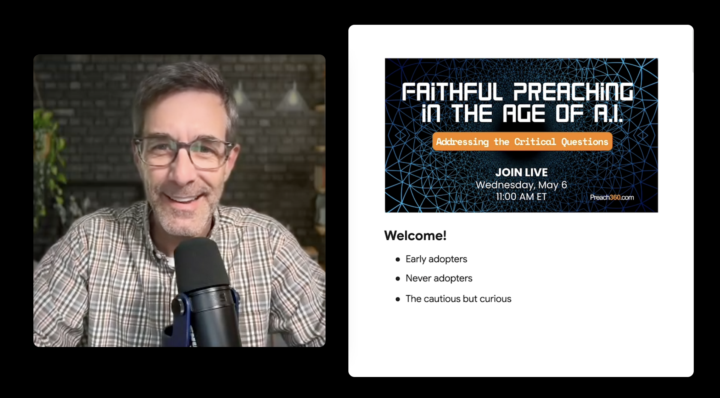
A.I. and Preaching (Video Replay)
Here's the replay of today's session on "Faithful Preaching in the Age of A.I." We cover the 7 fundamental human realities of preaching, the 5 pitfalls of misusing AI, and a way to redeem the technology for good that preserves pastoral integrity. Watch here and feel free to share: https://www.tella.tv/video/faithful-preaching-in-the-age-of-ai-e663 Thoughts? Comments? Share below!
1 like • May 8
I’m sorry that I missed this. had a family need that arose last minute, but I will give the video watch soon. I am sure it was great.
1 like • May 8
I shared the link with several pastor friends. Not sure if they popped on. Been trying to get my brother-in-law to try it. He signed up for a trial period (Rob Cord)
1-10 of 21
@chris-talley-5385
Husband to Beth (the best wife in the world),
Proud Father of a Nurse, a Marine and a Sailor
Church Planter/Pastor - LakewayPres.org
Active 7d ago
Joined Feb 5, 2026
ENFP
Morristown, TN
Powered by