Activity
Mon
Wed
Fri
Sun
Aug
Sep
Oct
Nov
Dec
Jan
Feb
Mar
Apr
May
Jun
What is this?
Less
More
Owned by Cherie
This is a community where traditional approaches & groundbreaking innovation come together creating new possibilities for post traumatic growth.
Memberships
Skoolers
168.4k members • Free
9 contributions to QTX Post Trauma Growth Academy

27d •
The Healing Journey
Something I hear so often from clients and other facilitators is that healing is a lifetime journey. My big question to this is why? Is there not a solid goalpost for what healing looks like? Or is this journey a scam? Healing should have an end or its not healing. IT is something else. Without the shift from the healing portion of our life's journey to the post traumatic growth portion we keep circling back to the pre-existing patterns because there is nothing out in from of them yet. This is a crucial moment in a client's journey when they turn around and go... Ok now what? Children are offered numerous different entry points to learning their preferences... What they like and don't like. They try things. They quit things and we take that as the journey to finding out what they like. As adults we call this something else. It is important to support this learning with our clients. So what if you try it and don't like it. Now you know. What do you want to explore next. WE build curiosity!
0 likes • 27d
@Ivy Moon so would you say at that point you were healing or were you growing and learning because that’s a different mindset right? That’s nothing broken. You’re just learning skills right
May 20 •
Let's put our minds together!
What do you currently do when a client hits a trauma loop that does not respond to mindset, somatic tools, or talk-based processing?
1 like • May 21
@Melanie Starr thank you for sharing your approach
2 likes • May 30
@Eliane Elhaddad I hear that and what I see so often is saftey is almost impossible to achieve because the war is going on within self. The QTX protocol is proficient about utilizing the state when it shows up and creating the safety within self and completion within the loop with in just a few minutes.

May 21 •
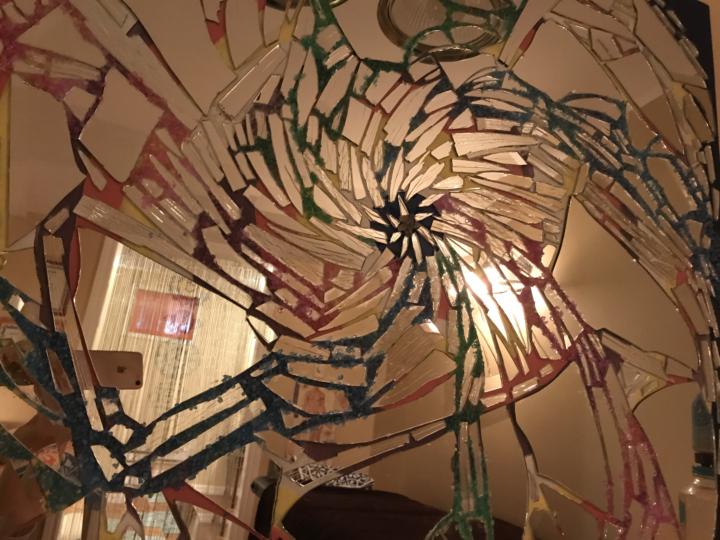
Reintegrating the shards of the self
Cherie, I love your broken mirror imagery. It's a metaphor that speaks deeply to me as well. I created this spiral mosaic of broken-mirror shards in 2020. There's a whole story behind it, because the mirror spontaneously broke itself the moment I uttered the words to my daughter two rooms away: "When you make physical appearance your God, bad things happen." SMASH! We jumped, could not believe it! AS I was sweeping up the shards, I decided I could not throw them away and instead spent a month making this. It became a deeply meaningful metaphor of healing from a lifetime of exposure to narcissists and narcissistic abuse.
1 like • May 21
OMGosh I love that. I use the broken glass imagery everywhere. Check out the website The website https://quantumtherapeutix.com
1 like • May 24
@Melanie Starr thank you melanie
May 21 •
Please introduce yourself here so that we can all be playing together!
Hello everyone please share with the community about who you are and what you do. I am excited to get this community rocking out.
4 likes • May 22
@Brandi Beverly Brandi, I hear that. And I actually think what you are naming is one of the most important pieces of this conversation. When there was no real developmental space for a core self to form safely, the person often builds around survival. Roles, schemas, caretaking, vigilance, achievement, crisis response, advocacy, intellect, sexuality, attachment adaptations — all of these can become organizing structures when the original self did not get to develop in safety. And while every person’s story is unique, this pattern is something I see often in complex trauma and dissociative populations. That is part of why I am so interested in the mechanism underneath it. Because when identity is built around survival adaptations, the work cannot only be about insight. The system has to find the frozen places where those adaptations became necessary, and then begin restoring order to the timeline, memory, body, and sense of self. So I would not place you outside the conversation. I would say you are naming the very center of it. For QTX, this is where the flashback pathway matters. We are not only looking at what happened. We are looking at where the system began organizing itself around what happened — the meanings, assumptions, protections, and survival rules that kept shaping the future.
1 like • May 23
@Brandi Beverly I hear this and I can feel the weight you are carrying. I have also been where you stand and there is a way out. Dm me
May 21 •
Complex Trauma and CPTSD Are Not the Same Thing
I wanted to share this here because this distinction is foundational to Quantum Therapeutix. Complex trauma does not automatically = CPTSD. Just as trauma does not = PTSD. What is the defining factor in that distinction? The loops. The triggers. (Real triggers not just emotion.) The flashbacks. The patterns that track throughout someone's life. Following them. Chasing them. That distinction matters because when we collapse the two the depth of the dissorder is not acknowledged. CPTSD is a disorder in the most literal sense. The disorder or time, memory, bodily functions. Read the full article here: https://quantumtherapeutix.com/complex-trauma-vs-cptsd-clinical-distinction/ Question for the group: Where have you seen complex trauma and CPTSD this distinction — and what impact do you think that could have on client’s rehabilitation?
0 likes • May 22
@Brandi Beverly Yes. This is exactly the problem I keep coming back to. The people with the deepest trauma histories are often the ones with the least access to care that can actually reach the depth of what they are carrying. And when the only options are wildly expensive programs, limited scholarships, or one practitioner within driving distance who accepts state medical services, that is not real access. That is a system telling people to survive something nearly impossible and then making the pathway to help nearly impossible too. This is part of why I am building QTX as a training pathway for practitioners. The goal is not to replace every modality. The goal is to give more trained people a way to work with the mechanism underneath trauma loops, especially where the client has been cycling for years and traditional access points have not been enough.
0 likes • May 22
@Brandi Beverly That is a really important question. EMDR and QTX are not doing the same thing, even though both may involve trauma memory, body response, and material that is not fully resolved through talk therapy alone. EMDR generally works through bilateral stimulation while the client brings up traumatic material and the nervous system reprocesses it. QTX works through the dissociative mechanism itself. We are following the flashback pathway back to the frozen survival moment — or sometimes the moment just behind it, where the child’s system embedded the assumptions, meanings, and survival rules that continued shaping the future. In memory, the client is seeing what happened. In flashback, the client is being the unresolved moment. QTX is designed to work with that distinction. The client remains verbal, responsive, and physically observable, but we are not just asking them to retell the story. We are tracking the live state, the body, the loop, and the pathway the system is already using to relocate into the past. As far as “better results,” I would not frame it as QTX versus EMDR. EMDR has helped many people. But there are also clients who do not get full resolution through EMDR, especially when dissociation, CPTSD, looping states, and frozen child-state material are still organizing the present. QTX was built for that level of stuck survival pattern. So I would say: EMDR is a recognized trauma-processing modality. QTX is a different protocol working through a different access point — the dissociative flashback pathway — with the goal of resolving the loop at the level where the system is still living it.
1-9 of 9
@cherie-doyen-1251
I'm Cherie Doyen founder-Quantum Therapeutix. I train therapists coaches & healers in the QTX State Protocol for rehabilitating CPTSD & Dissociation.
Active 1d ago
Joined Apr 18, 2026
MO