Activity
Mon
Wed
Fri
Sun
May
Jun
Jul
Aug
Sep
Oct
Nov
Dec
Jan
Feb
Mar
Apr
What is this?
Less
More
Owned by Charles
Analytical Edge Academy is a professional community for serious thinkers who refuse intellectual stagnation. The world rewards clarity, not noise.
Memberships
37 contributions to The Analytical Edge Academy

4d •
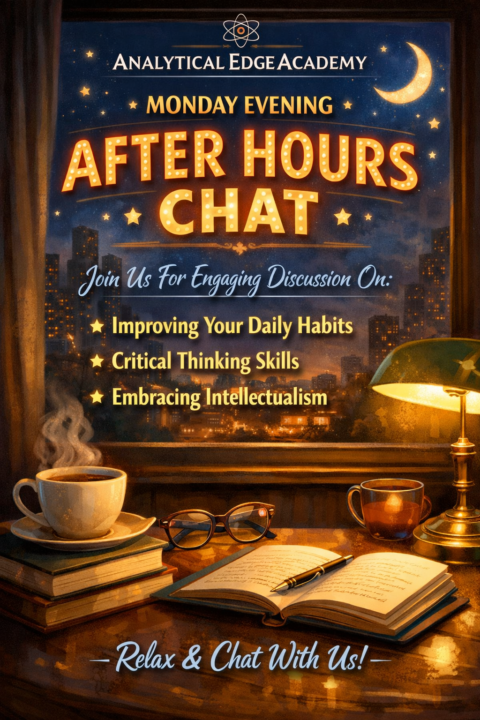
Let's Chat!!!
Tomorrow evening, we'll hold another session. So much to talk about in regards to critical thinking, intellectualism and more. Hope to see you there.
0
0
15d •
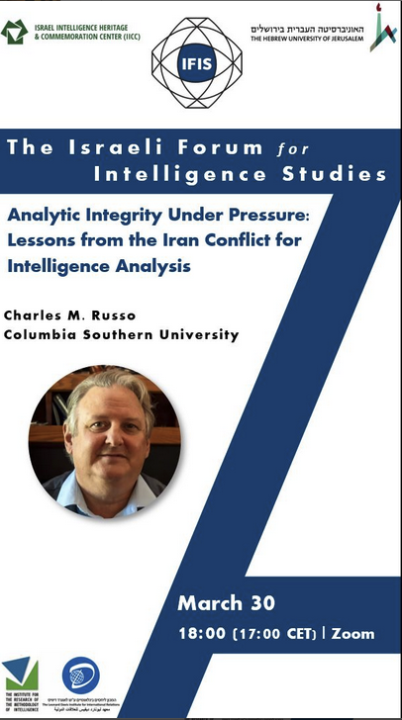
Israeli Forum for Intelligence Studies (IFIS)
Next week the Israeli Forum for Intelligence Studies (IFIS) will hold its monthly online meeting, with Dr. Charles M. Russo, PhD, Lecturer in Columbia Southern University. Dr Russo will present "Analytic Integrity Under Pressure: Lessons from the Iran Conflict for Intelligence Analysis" 🗓️ Monday, March 30, at 11 am EST / 17 pm CET https://huji.zoom.us/j/85125143086?pwd=AYx7Ilr0XocIfDShWtqbEaefd2REis.1 Become a friend of IFIS here https://www.ifis.co.il/
0
0
21d •
Something new is coming
Something new is coming. Over the next two weeks, I’ll be publishing a four-part series for my Substack subscribers focused on critical thinking, intelligence analysis, analytic integrity, and the growing pressure that AI, misinformation, and information overload are placing on sound judgment. This series is built for those who care about disciplined reasoning in serious work—educators, analysts, leaders, students, and professionals who understand that speed is not wisdom and access to information is not the same as understanding. The essays will tackle four timely issues:how AI may be making bad analysis easier,why verification has become one of the most important skills of our time,why critical thinking is increasingly a civic and national security necessity,and why analytic integrity remains the trait we cannot afford to lose. I have long argued that clear thinking is not a luxury. It is a professional obligation and, increasingly, a public necessity. If that resonates with you, I invite you to subscribe and follow the series as it rolls out. We do not need more noise.We need more disciplined thought. #CriticalThinking #IntelligenceAnalysis #AI #Leadership #Education #AnalyticIntegrity #Substack #Misinformation #NationalSecurity https://drcharlesmrusso.substack.com/
0
0

29d •
Live Chat This Saturday: Intellectualism in Modern Time
Live Chat This Saturday: Intellectualism in Modern Time What happened to wanting to be an intellectual? This Saturday, join me here in Skool for a live chat on a question that has serious implications for our culture, education, and public discourse. We are surrounded by information, but not necessarily by depth, discipline, or wisdom. Somewhere along the way, the pursuit of intellectualism lost its value in the eyes of many, and society is paying the price for it. In this discussion, we’ll examine why intellectualism appears to be in decline, why serious thought is often dismissed, and what that means for the future of our society. More importantly, we’ll talk about what it takes to reclaim intellectual seriousness in an age dominated by distraction, speed, and shallow commentary. Saturday, March 14 6 PM Central | 7 PM Eastern | 4 PM Pacific This is for those who are tired of surface-level thinking and want something deeper. If you care about critical thinking, analysis, intellectual discipline, and meaningful dialogue, this conversation is for you. And do not stop at the live chat. Serious thinkers need training, not just inspiration. That is exactly what my courses inside The Analytical Edge are built to provide. If you are ready to sharpen your reasoning, strengthen your analytical ability, and develop a more disciplined mind, sign up and get started here: https://www.skool.com/the-analytical-edge-3643 Be there. Bring your questions. Bring your mind.
1
0

30d •
New article published and many more.
https://drcharlesmrusso.substack.com/p/critical-thinking-skills-in-crime?r=2hpkc5 For crime analysts, a quick reminder: a map is not a conclusion, a timeline is not a theory, and a link chart is definitely not a confession. My latest article, “Critical Thinking Skills in Crime Analysis: Pattern Analysis, Temporal Analysis, and Link Analysis,” explores the thinking skills behind solid analytical work — the kind that helps us separate coincidence from connection, correlation from causation, and “interesting” from “actionable.” In other words: how to keep our brains engaged when the software starts looking a little too confident. Proud to put this one out. I hope it’s useful to analysts, supervisors, and educators working to strengthen analytic tradecraft.
0
0
1-10 of 37

@charles-russo-5951
Former intelligence professional, veteran, educator, and author.
Active 3d ago
Joined Dec 12, 2025
Rockwall Texas