Activity
Mon
Wed
Fri
Sun
Nov
Dec
Jan
Feb
Mar
Apr
May
Jun
Jul
Aug
Sep
Oct
What is this?
Less
More
Leadership Skool
1.8k
5.0
Free
Clinical supervision
21
Free
Natural Energy Solutions
76
Free
The Strengthen Tribe
63
Free
The Autistic CEO
9
Free
4 contributions to Break Your Attachment Patterns

Sep 2 •
Most people don’t know what “locus of control” is — but it quietly shapes how they experience relationships.
Locus of control = your belief about what influences your outcomes. Not a personality trait. Not an attachment style. Just a cognitive orientation that interacts with everything else. There are two general patterns: External locus of control You believe outcomes depend mostly on: - other people - circumstances - unpredictability In relationships, this often shows up as: - feeling like connection “happens to you” - reacting strongly to shifts in a partner’s behavior - difficulty accessing agency during conflict It doesn’t cause anxious attachment, but it can intensify it. Internal locus of control You believe outcomes depend mostly on: - your choices - your boundaries - your responses In relationships, this looks like: - feeling able to influence the dynamic - choosing partners intentionally - responding instead of spiraling It doesn’t create secure attachment, but it can support it. Clinically, these systems interact. Attachment, trauma history, nervous system conditioning, and locus of control are interdependent. None of them operate alone. A useful reflection: “How much influence do I feel I have in this moment?” That question often reveals more than the attachment label itself.


1 like • Sep 3
Good insight, Natalia. I can see how I can integrate this reflection into sessions with some of my clients; thank you.
Jul 26 •
The Attachment Shift Moment
What’s one moment recently where you noticed your attachment system shifting, even slightly? Maybe you paused before reacting. Maybe you didn’t chase. Maybe you soothed yourself instead of spiraling. Share it. These micro‑shifts matter more than people realize.

1 like • Jul 26
The attachment shift moment was tolerating the anxiety after communicating a healthy boundary.
Jun 11 •
What Self-Abandonment Looks Like
If someone makes you feel embarrassed for having needs, don’t minimize that. That’s the moment self‑abandonment starts to take root.

1 like • Jun 11
So true, Natalia.
May 12 •
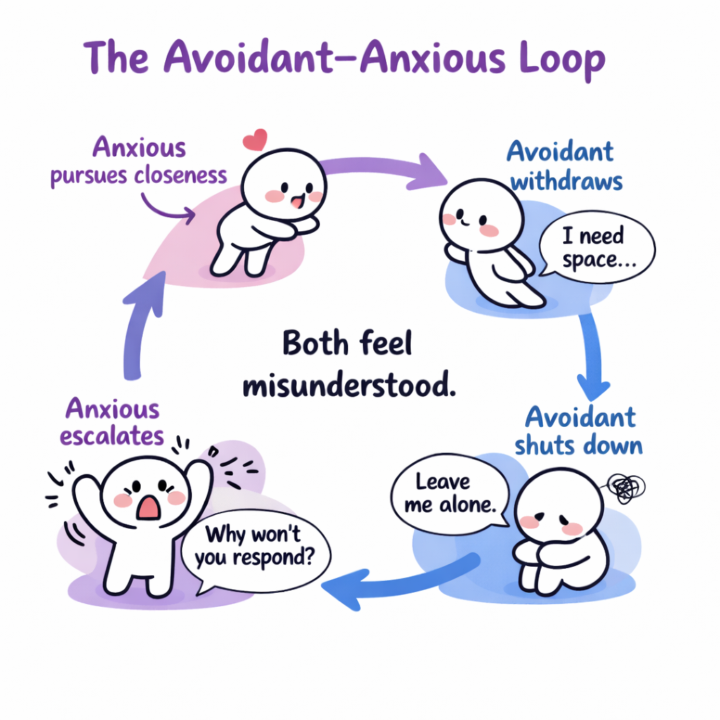
The Avoidant–Anxious Loop Explained
Ever notice how the more you reach for someone, the more they pull away — and the more they pull away, the more your anxiety spikes? That’s the avoidant–anxious loop. It’s not about being “too much” or “too cold.” It’s two nervous systems reacting to each other in predictable ways: 1. Anxious pursues closeness → seeks reassurance, connection, safety. 2. Avoidant withdraws → needs space to regulate overwhelm. 3. Anxious escalates → the distance feels threatening, so intensity rises. 4. Avoidant shuts down → the escalation feels unsafe, so they retreat. 5. Both feel misunderstood → one feels abandoned, the other feels suffocated. This loop isn’t love — it’s survival mode. Once you can see the pattern, you can interrupt it. And once you interrupt it, you can finally build a secure connection instead of chasing emotional survival. 💡 Try this: Look at the graphic below and notice which part of the loop feels most familiar to you. That’s where your nervous system learned to protect you — and where your healing begins.
1 like • May 13
Aww, yes, the push-pull cycle that can happen in relationships. That's a great chart and great explanation. I think what feels most familiar to me is avoidant-avoidant. Over the years, my nervous system protected me by becoming more focused on whatever was going on in my life at the time as a way of self-reliance.
1-4 of 4
