Activity
Mon
Wed
Fri
Sun
Aug
Sep
Oct
Nov
Dec
Jan
Feb
Mar
Apr
May
Jun
What is this?
Less
More
Memberships
🏖️PROSPERITY ISLAND CLUB
589 members • Free
AI Product Academy
324 members • Free
AI Legacy Builders Circle
92 members • Free
Moves BETA Test Group #2
349 members • Free
The Success Club
13.7k members • Free
ambITious AI
2.7k members • Free
Ninjas AI Automation
3.6k members • Free
BUNDLES BY JONEL
593 members • Free
Laptop Income System
26 members • Free
15 contributions to School of AI

30d •
New Courses Added and FREE Coupons for all 129 Courses
Use Course Coupoms JUNFREE01 JUNFREE02 JUNFREE03 129. Ethics, Bias & Trust in AI https://www.udemy.com/course/ethics-bias-trust-in-ai/?referralCode=6BC068B7C0EEA55CF744 128. AI Use Cases Across Industries https://www.udemy.com/course/ai-use-cases-across-industries/?referralCode=F6EE7C20EDC6F7DD51BE 127. Product Thinking & Problem Framing for AI https://www.udemy.com/course/product-thinking-problem-framing-for-ai/?referralCode=53F4AA37DE5E2BDB7F0C 126. Product Thinking & Problem Framing for AI https://www.udemy.com/course/product-thinking-problem-framing-for-ai/?referralCode=53F4AA37DE5E2BDB7F0C 125. Data Literacy for Product Owners https://www.udemy.com/course/data-literacy-for-product-owners/?referralCode=AE1D322A488441A61CA4 124. How Machine Learning Really Works https://www.udemy.com/course/how-machine-learning-really-works/?referralCode=5CD67B159E132D6274A4 123. AI Fundamentals for Business https://www.udemy.com/course/ai-fundamentals-for-business/?referralCode=D950D6142EBF3EC71758 122. Claude Design Mastery: Build AI Visual Assets https://www.udemy.com/course/claude-design-mastery-build-ai-visual-assets/?referralCode=E05F242801AB5A32C546 121. Anthropic Claude for Absolute Beginners

0 likes • 28d
Thank you, Vivian!
May 8 •
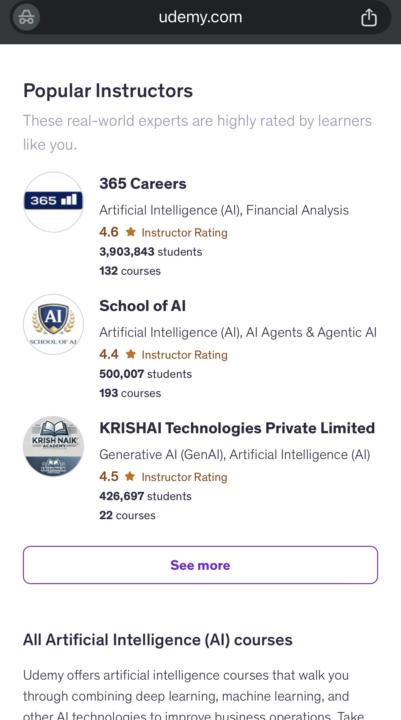
From Building AI Courses to Becoming Udemy’s #2 Popular AI Instructor
From late nights building courses to reaching over 500,000 learners globally — today, School of AI is ranked as the #2 Popular AI Instructor on Udemy. It’s honestly surreal to see School of AI listed alongside some of the biggest names in online education. What started as a mission to make AI practical, hands-on, and accessible has now grown into a global learning movement. Over the last few years, I focused on one thing relentlessly: → Teaching AI in a way that helps people actually build → Breaking down complex AI concepts into practical systems → Creating real-world projects instead of just theory → Making AI education accessible to beginners, professionals, and builders worldwide This journey was never about chasing rankings. It was about helping people transition into the future of AI with confidence. Today: • 500,000+ learners • 193 AI courses • Thousands of projects built by students worldwide • A growing global AI community through School of AI And we’re only getting started. The next phase is even bigger:Agentic AI, AI Engineering, AI Governance, Autonomous Systems, AI Product Development, and real enterprise AI transformation. To every learner, supporter, and builder who trusted School of AI — thank you.Your support made this possible. The mission remains the same: Build practical AI education that creates real builders for the AI era. #AI #ArtificialIntelligence #Udemy #SchoolOfAI #AIAgents #GenerativeAI #MachineLearning #AIEngineering #OnlineLearning #TechEducation
1 like • May 9
Amazing--congratulations, Vivian!
Feb 24 •
Agentic AI Mastery: Claude Code, Clawdbot & Beyond
The era of prompts is over. The era of Agentic AI systems has begun. I’m excited to introduce Agentic AI Mastery: Claude Code, Clawdbot & Beyond — a hands-on course designed for engineers and builders who want to move beyond chatbots and build real multi-agent, production-ready architectures. In this course, you’ll design event-driven systems, implement guardrails, build personal and enterprise agents, and ship a complete capstone project ready for your portfolio. If you want to think like an AI systems architect and build autonomous workflows that actually scale — this course is for you. The future is agentic. Let’s build it.

0 likes • Feb 24
@Vivian Aranha Thank you for the link. I got this message when trying to make sure the coupon code is applied: "The coupon code entered is not valid for this course."
0 likes • Feb 24
@Vivian Aranha thank you--that worked!
Jan 30 •
We are missing a chat feature here
Join me in WhatsApp - we can communicate faster https://chat.whatsapp.com/JuqbToSN6bcJAY94jLzZEd
1 like • Jan 30
Joined as well—thank you!
Jan 27 •
From Local LLMs to Production Agents: A Complete LangChain & LangGraph Journey with Ollama
Over the next few weeks, we're launching a video series that takes you end-to-end from "I just installed Ollama" to "I can design and ship serious, graph-based AI agents using LangChain and LangGraph, entirely on my own machine." Who This Is For This journey is designed for: - Developers and data practitioners who want hands-on experience building agentic AI systems - Startups prototyping AI features before committing to expensive API costs - Enterprise teams with data privacy requirements who need local-first solutions - Tech leaders and researchers who want to deeply understand agent architectures without being locked into hosted models Prerequisites Before starting, you should have: - Basic Python knowledge: functions, classes, pip, virtual environments - API/JSON familiarity: understanding request/response patterns - Terminal comfort: running commands, navigating directories - Hardware: 16GB+ RAM recommended; GPU optional but helpful for larger models What This Journey Covers Across the series, we'll walk through five major phases. Each phase ends with tangible projects you can run locally and adapt to your own use cases. --------------------------------------------------------------- Phase 0 – Local Stack: Ollama + Python Estimated time: 1-2 hours We begin by setting up a local AI sandbox: - Installing and configuring Ollama - Pulling and running popular open models (e.g., Llama, Mistral) - Understanding hardware requirements and model selection for different tasks - Creating a clean Python environment and wiring up a minimal script to talk to a local LLM By the end, you'll have a lightweight local playground where you can experiment without API keys or usage limits. Troubleshooting covered: Model selection guide, memory optimization, when local models shine vs. their limitations --------------------------------------------------------------- Phase 1 – LangChain Fundamentals with Local Models Estimated time: 3-4 hours Next, we introduce LangChain as the "capabilities layer" on top of your local model:
1 like • Jan 27
Very cool! Looking forward to seeing this set of instruction!
1-10 of 15

@carl-scott-6722
I'm looking for a way to escape my 50-plus hours a week job and I'm hoping this is that opportunity!
Active 20h ago
Joined Dec 30, 2025
Las Vegas NV & Honolulu HI
Powered by