Activity
Mon
Wed
Fri
Sun
Nov
Dec
Jan
Feb
Mar
Apr
May
Jun
Jul
Aug
Sep
What is this?
Less
More
Owned by Brandon
We’re exploring how science, culture, and meaning connect—so you can craft your personal code for life.
Skoolers
153.9k
Free
7 contributions to The Ideology Project

May 26 •
7th American Party System?
Why does American politics feel so unstable right now? Why does it feel like fewer and fewer people actually feel politically at home in either major party anymore? One possibility is that America may be transitioning into a new political party system. Most people have never heard of the idea of American Party Systems, but it is actually a long-running concept in political science and American history. The basic idea is that American politics tends to move through long eras where both major parties generally agree on most of the underlying structure of society, while fighting intensely over specific issues within that structure. Then eventually something changes. Technology changes communication. Economic systems evolve. Old coalitions fracture. New factions emerge. Institutions lose trust. And the political system slowly reorganizes itself around a new set of alliances, assumptions, and priorities. According to this framework, the United States has already gone through multiple major party systems: 1st Party System (1790s–1820s) Federalists vs Democratic-Republicans 2nd Party System (1828–1850s) Democrats vs Whigs 3rd Party System (1850s–1890s) Republicans vs Democrats during the Civil War and industrial expansion era 4th Party System (1896–1932) Industrial capitalism and business-oriented Republican dominance 5th Party System (1932–1968) The New Deal era and FDR coalition politics 6th Party System (roughly 1968/1980–2016?) The Reagan, Bush, Clinton, Obama era of globalization, neoliberal economics, and the post-Cold War political order Now the obvious question becomes: Are we currently watching the early stages of a 7th Party System? Because over the last decade, it feels like something fundamental has shifted. Populism. Nationalism. Institutional distrust. Social media fragmentation. Globalization backlash. Political realignment. The breakdown of old coalitions. And growing numbers of people who feel politically homeless inside the old system.
0
0
May 20 •
Re-engagement
Hey everyone! Life, work, and grad-school prep pulled me away for a while, but I’ve still been developing a lot of these ideas in the background and I want to start re-engaging here consistently again. One thing I’ve been thinking about a lot lately is how modern people may increasingly belong to competing “Cultural Information Networks” instead of one shared national culture. Historically, most people inherited: - religion, - traditions, - values, - identity, - and worldview from local institutions and family/community networks. Now a huge percentage of that transmission is happening online through algorithms and digital tribes. I’m curious: Do you think it's more advantageous to be United under one robust culture or have multiple cultures negotiating survival amongst each other under a veil of a shared reality?
0 likes • May 21
@Jonathan Lightfoot thanks for the comment! Another way I think I could rephrase my question would be this: If you check out my lesson on the 7 overlays, it will s how how all societies have some mixture of these settings. My question would be: where do you think each one of these settings should be set to, and is it acceptable for other people to advocate for different settings?
0 likes • May 22
@Turk Roga well give me two different society, I will rum them through thw model I built and then we can analyze the output. They can be from any time in history.
Nov '25 •
What to expect!!
Welcome to the Ideology Lab We live in an extraordinary moment. For the first time in history, human beings understand how belief itself works — how our brains, cultures, and environments create meaning. But that knowledge arrived just as the old systems collapsed. Religion lost its authority. Ideology fragmented into tribes. And billions of people are now living without a stable moral or cultural framework. That’s what we call the Age of Drift — a world full of freedom, but short on direction. This community exists to change that. We’re not here to tell you what to believe. We’re here to help you understand how belief systems function — so you can build one that fits your life, your values, and the world we’re moving into. Using the framework of political theorists Ball, Dagger, and O’Neill — plus insights from neuroscience, genetics, and cultural evolution — you’ll learn the anatomy of every ideology: 1. Explanation – How did we get here? 2. Orientation – Who am I, and where do I fit? 3. Evaluation – What’s good or bad? 4. Prescription – What should we do next? You’ll explore how past ideologies succeeded and failed, “spar” with their ideas, and gradually build your own — one that’s honest, adaptive, and grounded in both science and compassion. Our mission is simple: By the end, you’ll have a personal operating system — your own living ideology — that gives you clarity, direction, and peace of mind in a chaotic world. Welcome to the next evolution of belief. > “Absorb what is useful, discard what is useless, and add what is uniquely your own.” — Bruce Lee
0 likes • Dec '25
@Sam Ninni I just posted my brief essay on the Blip and Snap. Its an evolutionary framework on why the world feels so crazy right now. Let me know what you think!
0 likes • Apr 10
@Turk Roga Im doing my best to keep it active. SKOOL doesnt send me notifications when I have interactions and as you can see, interactions are few and far between, so im often late to responding. The goal of this group is to give a model to compare societies and a frame work to look at political ideologies through a lens of cultural evolution. Love to hear more from you!

Apr 7 •
Introduction
Introduction I wonder if you and I have things in common. I work 6 days a week. 3 pm to 10 pm Tuesday through Friday. 9 am to 5 pm Saturday through Sunday. My day off is Monday. I drive for a living.
0 likes • Apr 10
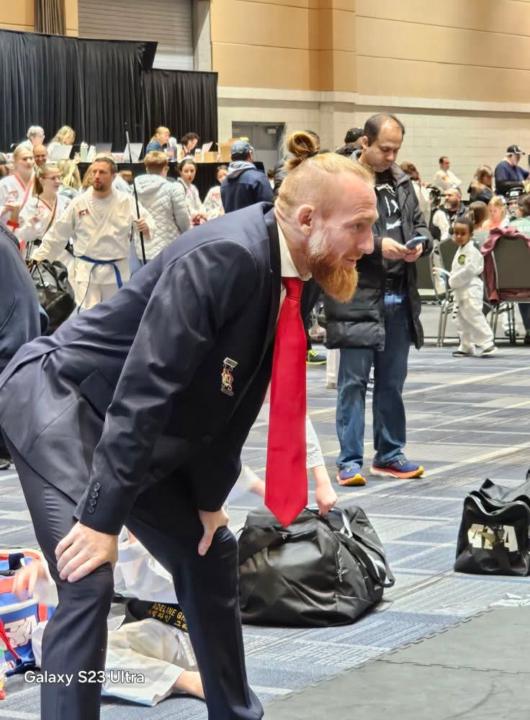
I work pretty much 6 or 7 days a week as well! I current run a martial arts school and I am officially registered for class in graduate school at CMU. MPA.
Dec '25 •
Lessons 8 - 11
With the insights from Chapters 1 - 3, and the understanding we get from the framework of Chapters 4 - 7, I will now start to publish some of the beleifs iv come to have with the perspective this model unlocks. I will present them in the same format as Ball, Dagger, and O’Neill from Chapter 3. Let me know if you have any questions. About the project or even about how this framework interprets current affairs. Brandon
1
0
1-7 of 7
@brandon-mcqueen-5636
I help curious minds make sense of modern chaos by designing their own ideology and moral compass.
Active 52d ago
Joined Nov 11, 2025