Activity
Mon
Wed
Fri
Sun
Aug
Sep
Oct
Nov
Dec
Jan
Feb
Mar
Apr
May
Jun
What is this?
Less
More
Memberships
AI Code that Works
949 members • Free
Digital Products AI Barn
710 members • $7/m
Codex Club
125 members • Free
Skoolers
167.3k members • Free
AI Website School
638 members • $29/month
The 1-Person Business
3.5k members • Free
AI Authority Engine™
797 members • $29/month
BraveBrand
490 members • $14/month
The RoboNuggets Network (free)
55.1k members • Free
5 contributions to AI Code that Works

5h •
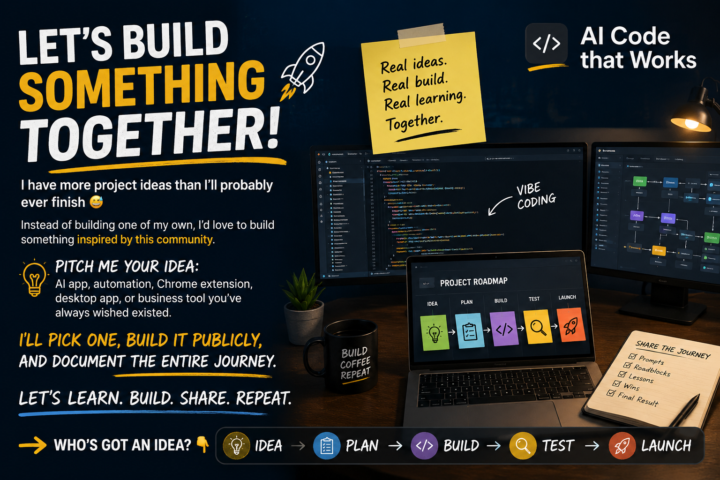
Let's Build Something Together 🚀
I've got a fun challenge for the community. Pitch me a small AI app, automation, Chrome extension, desktop app, or business tool you've always wished existed. I have more project ideas than I'll probably ever finish 😅, but I thought it'd be fun to build something inspired by this community instead. I'll pick one that stands out, build it publicly, and document the entire journey from idea → planning → vibe coding → finished MVP. I'll share the prompts, roadblocks, lessons learned, and the final result so everyone can follow along and hopefully learn something they can apply to their own projects. Vote for your favorite project idea(s) by simply 👍 liking the comment(s) you want to see built. I'll use the community votes (along with what I think would make a great project) when choosing what to build. Who's got an idea? 👇
1
0
6h •
Claude Fable 5 in my life! - Video Wall Builder
The idea was simple: Build a Video Wall Builder that lets you drag-and-drop multiple videos into customizable layouts (2×2, 3×3, 4×4, etc.), play them independently, and even expand a single video inside the app without taking over the entire monitor. Before writing a single line of code, I spent time with ChatGPT refining the idea into a detailed mvp_prd.md, followed by a plan.md and an architecture.md. That upfront planning gave the AI a clear roadmap instead of just a vague prompt. Then I handed everything to Claude Fable 5 (High).. It one-shotted the project to about 75% of the way there. 🤯 The result was a working Electron + React desktop app featuring: ✅ Support for Video, URL, OBS & Camera ✅ Dynamic 1×1, 2×2, 2×3, 3×3, 4×4 & custom XxX layouts ✅ Drag-and-drop video loading ✅ Independent playback controls for every tile ✅ Container-scoped full-screen (expand a tile without taking over the monitor) ✅ Windowed, maximized, and borderless modes ✅ A polished UI that already feels like a real desktop application I didn't stop after the initial build. I continued refining the architecture, playback engine strategy, workspaces, scenes, custom layouts, plugin-oriented design, and long-term roadmap. Each iteration made the next coding session even more effective. One thing that really surprised me was how far I was able to push Claude Fable 5 (High) on the $20/month Claude Pro plan. Although the project spanned three 5-hour usage windows because of the Pro plan's session limits, the actual development only took about 4 hours and 7 minutes of active coding time. The first usage window was exhausted in 1 hour 21 minutes, the second in 54 minutes, and the third in 1 hour 52 minutes. We completed the project in just two conversation contexts, staying well under Claude's available context window. By the end of those sessions, the app had grown from an idea into a polished MVP with dynamic layouts, drag-and-drop media loading, workspaces, scenes, source management, persistent settings, an FFmpeg-backed playback strategy, Windows packaging, and a documented long-term architecture.
1
0

3d •
Every Project Starts with a Good Plan
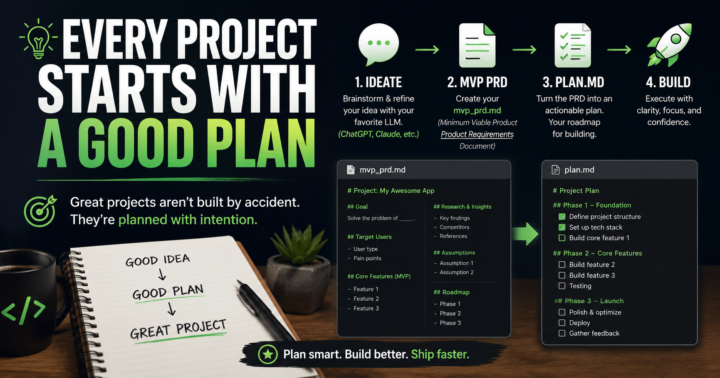
One of the biggest upgrades to my AI workflow has been spending more time planning before I start building. I'll usually have a back-and-forth conversation with ChatGPT or Claude to discuss my concept, pressure-test ideas, uncover edge cases, and shape the project into something that actually makes sense. Once the idea is solid, I turn it into an mvp_prd.md (Minimum Viable Product Product Requirements Document), which is a living source of truth document that captures the project's goals, scope, research, assumptions, and roadmap. From there, I convert the mvp_prd.md into plan.md, which becomes the actionable task list I work through while building. A few extra minutes of planning can save hours (or days) of rebuilding later. How do you ideate your projects before you start coding?
0 likes • 2d
@Alex Brockway I am working towards building skills and assets I can monetize one day. Currently, I've been building out projects as a hobby, as a learning experience, and to perfect my workflows. I've been working on building out a Skool community of my own in a different but parallel niche focused on ai website development. I would love to be able to eventually quit my boring unfulfilling day job, so I'm hopeful to get there via the ai revolution one way or another. I do have lots of ideas. It's both an gift and a curse. Thank you for your interest & communication.
2d •
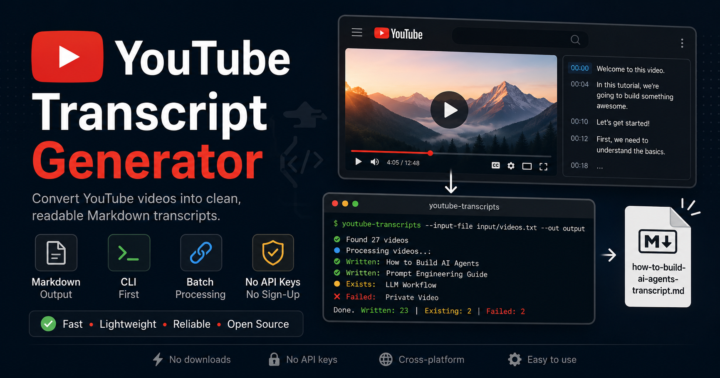
YouTube Transcript Generator - Build Log
One of my biggest frustrations with online YouTube transcript generators is that, in my experience, they sometimes struggle with longer videos or don't make it easy to get the full transcript in a format I can immediately use. So I decided to vibe-code my own standalone CLI tool. The real goal wasn't just downloading transcripts, it was turning YouTube videos into AI-ready Markdown documents. Once a transcript is saved, I can drop it straight into ChatGPT, Codex, Claude, or any other LLM to generate summaries, action items, project plans, documentation, research notes, content ideas, or even complete implementations inspired by the video's content. I thought it'd be fun to share exactly how this project came together. For this build I used ChatGPT Pro (Codex included)($20/month) for ideation and project planning, then handed everything off to Codex for implementation. Also worth noting: from initial idea to a polished GitHub repository, this entire project took me just a smidge over 1hr to complete & only used about 15% of my current 5-hour ChatGPT Pro usage allowance and 4% of my weekly allowance. Here's the exact workflow I used to build the project from idea to GitHub repository. ChatGPT (Ideation) 1. I want to build a stand alone CLI based youtube video transcript generator. Please help me create a mvp_prd.md. Output into one single inline markdown mvp_prd.md 2.Create a 1200x630px image for my project "YouTube Transcript Generator". 3. Update this image to 830x400px for my github readme header. Codex (Implementation) 1. Create a plan based on mvp_prd.md and then save it in the root as plan.md 2. I have this project open in vscode. Lets assume that is where the end user will be guided to use this tool from now on. Lets build around that implementation. Is it ready to test from the terminal command line inside of the project root in vscode? 3.Create a command prompt where I can pass the single YouTube video URL in the command. We'll save the urls.txt method for batch processing
4d •
I ❤️ vibe-coding!
Hey everyone! 👋 I'm Brandon. I've gone all-in on vibe coding over the past year. I love taking an idea and seeing how far I can push AI to turn it into a polished, working product. Here are a couple projects that I have recently vibe coded: 1) Pinterest Image Scraper Chrome extension. It scans any Pinterest board, finds every loaded image, upgrades them to the highest available resolution, and downloads the entire board into a neatly organized folder with one click. No Pinterest login required. It's a huge time saver for designers, creators, and anyone collecting inspiration. 2) TourDrop This is a small Windows desktop app for launching CloudPano or other web based 360 virtual tour exports locally/offline. Drop in a ZIP or folder, it detects the tour root, starts a local server, and opens the tour in your browser without needing hosting, Node, Python, or command-line setup. My stack is mostly Codex, Claude Code, ChatGPT, VS Code, and GitHub. I'm always experimenting with better prompts, workflows, and ways to ship faster with AI. I'm here to learn from other builders, share what I discover, and hopefully contribute a few useful ideas along the way. Looking forward to seeing what everyone is building! 🚀

0 likes • 3d
@Alex Brockway Yes both of them are completely finished. I haven't released the Pinterest Image Scraper yet but Tour Drop is available to test out if you'd like. https://github.com/brandonfailing/tour-drop I started my vibe coding journey with Claude Code but ran into the same token burning issues everyone else has so I tried Codex and I absolutely love it. I haven't found anything that it can't do that I used to do on Claude.
1-5 of 5

@brandon-failing-4718
I'm a tech enthusiast weaving dreams in lines of code. An eternal optimist on a journey of self-discovery, spreading positivity one smile at a time.
Online now
Joined Jul 1, 2026
Powered by