Activity
Mon
Wed
Fri
Sun
Nov
Dec
Jan
Feb
Mar
Apr
May
Jun
Jul
Aug
Sep
What is this?
Less
More
Owned by Bonez aka
Home of Bone Archivist BoneZ. Chasing mysteries, audit trails and evidence. Assumptions challenged. Coffee double strength.
136 contributions to FINDOUTOLOGY
2d •
HUGE FINDOUTOLOGY SHOUT-OUT TO JOHN 🚨
🚨 HUGE FINDOUTOLOGY SHOUT-OUT TO JOHN 🚨 Well, well, well... JOHN HAS ONLY GONE AND DONE IT. 😂❤️ And the important bit? HE DID THIS ONE HIMSELF. Now I thought the poor man had pins and needles in his foot and had gone a bit quiet... Turns out he wasn’t limping. HE WAS WOODSHEDDING. 😂 Clearly the little crack of the Chief Whip worked. A few firm reminders of: “John... chronology.” “John... evidence.” “John... what exactly are they relying on?” “John... FOLLOW IT THROUGH.” ...and off he went. No BoneZ reconstructing the whole case at 2am. No emergency archaeological dig through 900 emails. No “John... where is the letter?” 😂 He took what we’ve been learning, got the documents together, worked through the process, and formal representations were made against: PCN GI43104973 Market Street Car Park, Lampeter Issued: 2 June 2026 The representations did not simply say: > “This isn’t fair, please cancel it.” They actually dealt with the case. They set out the factual circumstances, challenged whether those circumstances had genuinely been considered, raised the signage issue, required the supporting evidence, addressed discretion, and preserved the position if the matter had to go further. And then... 25 SEPTEMBER 2026 The response arrived: “After consideration of the circumstances can confirm that the Penalty Charge Notice has now been cancelled.” 🎉🎉🎉 THAT is what I want people to see. This is not about somebody magically waving a legal wand. It is about learning how to: READ → FIND OUT → SUBSTANTIATE → RESPOND → FOLLOW THROUGH. John has been sitting in our meetings, listening to BoneZ bang on about contemporaneous records, evidence, procedure, timelines, audit trails and asking the right questions... And now he has actually gone away and used it himself. That, for me, is the whole point of FINDOUTOLOGY™. Not creating dependence. Creating people who can look at a document and say: “Hang on... what actually happened here, what is the evidence, what is the process, and what do I need to do next?”
2 likes • 2d
Amazing
1 like • 19h
Sure is
2d •
THE 9 PHASES OF A CASE
🔎 FINDOUTOLOGY™ — THE 9 PHASES OF A CASE A case doesn't start with “They're wrong!” 😂 It starts with: “Okay… show me.” This is the 9-phase method we're using to stop drowning in emails and turn a mountain of paperwork into something you can actually follow. 1. IDENTIFY — What actually happened? Strip the story back and identify the event, decision, transaction or record we're questioning. 2. REQUEST — Get the records. SARs, correspondence, decisions, calculations, notes, recordings — whatever should evidence what happened. 3. EXTRACT — Pull out the important bits: dates, names, amounts, reference numbers, system entries and statements. No conclusions yet. Just what does the record actually say? 4. COMPARE — Put observable evidence vs what we're being told side by side. Do they match? If not, there's our question. 5. SUBSTANTIATE — The magic word. 🪄 Don't argue. Ask: “What contemporaneous record substantiates that statement?” Look for the source record, calculation, authority, audit trail, provenance or decision record. 6. RECONCILE 🔥 — This is where my DWP/ICE case is now. We've gathered and extracted the records and asked for substantiation. Now we're resolving what matches, what contradicts, what remains unanswered and what simply isn't held. In my case, ICE has already issued its Final Decision, but I've subsequently asked what underlying evidence was actually examined — including telephone/authentication records, financial calculations, medical evidence, Decision Maker records and audit/provenance material. 7. ESCALATE — Only after reconciliation. Take the clean evidence, not the kitchen sink, to the appropriate complaint, regulator, ombudsman, tribunal or other remedy route. 8. REMEDY — What actually needs putting right? Correction, disclosure, reconsideration, apology, repayment/redress or another appropriate remedy depending on what the evidence establishes. 9. CLOSE & ARCHIVE — Index the final evidence, outcome and unanswered points. Record what was established and what wasn't. Then shut the cupboard. 😂
1 like • 2d
John skipped them all it seems.... BOOM in - da - bag
2 likes • 2d
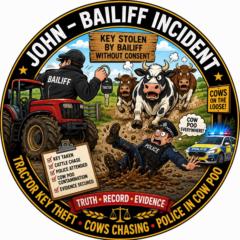
What 900 buff that's amazing 😍 😍 😍 Can I share this also. So this week we raised in this group alone 1800k Ash got a result so did you. John god is well pleased with you.. I am to. Thought you were getting pins n needles in ya one foot that's up. Really ya been wood shedding in secret well done.. Ya cows will be moooooooo ing today. John. If you could do a little bundle how you did it. Help others
6d •
Mondays meeting
A great meeting last night guys Thank you so much.great we are moving on and a subject close to my grain... Not oats or barley freedom... However that a word needs studying as NOTHING IS FREE.. Takes a huge amount of work.. I will get a bundle on this subject we can study more next week. I will upload one ❤️ Video below a briefing from the master Thank you again all https://youtu.be/0dEmzX9OWvA?is=pC1RfgVfRrluQ7lx
1 like • 5d
I blooming LOVE THOS ONE. 🔎 THE ALIENATION TEST For every statute using alienate / alienation, Joyce finds: WHO could alienate? → WHAT could they alienate? → TO WHOM? → WHOSE CONSENT? → WHAT remained after alienation? → WHO was the new holder holding OF? That last question is the cracker. And if by “the Alienation Act” you mean a particular document Maxwell/Miller referred to, send me the title/date or screenshot. There are English, colonial and overseas statutes carrying very similar names, and I don't want us accidentally proving English allodium with a New South Wales Crown Lands Alienation Act. 😂
0 likes • 2d
@Joyce Grieveson ya can't use templates Joyce it's one to one ❤️
1-10 of 136
Active 19h ago
Joined Jun 9, 2026