Activity
Mon
Wed
Fri
Sun
Aug
Sep
Oct
Nov
Dec
Jan
Feb
Mar
Apr
May
Jun
What is this?
Less
More
Owned by Bobby
Advanced clinical perception training for healthcare professionals on neural adaptation, chronic illness, systems thinking, and human health patterns.
Memberships
17 contributions to The IGNITE Institute

May 26 •
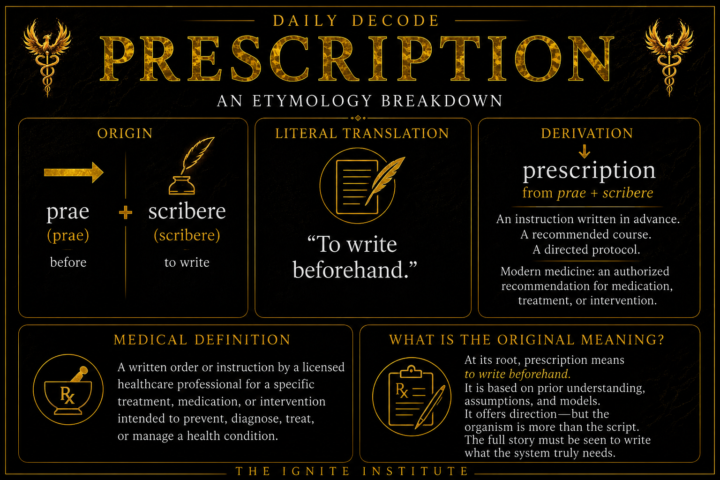
Daily Decode - PRESCRIPTION
prae + scribere (Latin) prae = before scribere = to write Original meaning:“To write beforehand.” A prescription was originally an instruction written in advance. A predetermined course. A directed protocol. A recommended action. Modern medicine defines a prescription as: An authorized recommendation for medication, treatment, or intervention. But the deeper implication is important: Prescriptions are based on prior models of understanding. They assume: - what the problem is - what caused it - what intervention should happen next And sometimes prescriptions are lifesaving. But within complex chronic illness, many organisms do not respond identically to standardized protocols. Because humans are not isolated symptoms. They are adaptive systems shaped by: - nervous system state - environment - stress load - trauma physiology - behavior - relationships - meaning - biology - perception A prescription may influence the system. But it does not automatically resolve the conditions generating the adaptation itself. At its root, prescription means: to write beforehand. Which raises a deeper systems question: What happens when treatment protocols are written before the full pattern is truly perceived?
0
0
May 24 •
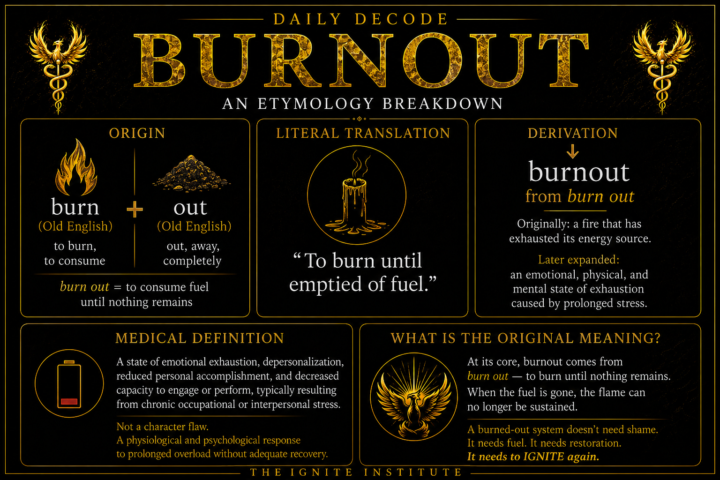
Daily Decode - BURNOUT
burn out = to consume fuel until nothing remains Originally: A fire that has extinguished after exhausting its energy source. Modern medicine uses burnout to describe emotional exhaustion, depersonalization, reduced capacity, and collapse under chronic stress. But from a systems perspective, burnout may not be weakness. It may be an organism operating beyond sustainable energetic capacity for too long. The nervous system adapts. Stress hormones remain elevated. Recovery decreases. Meaning disconnects from effort. Performance becomes survival. The organism begins conserving energy. Symptoms emerge: - emotional numbness - chronic fatigue - brain fog - cynicism - anxiety - insomnia - loss of motivation - physiological dysregulation Especially within healthcare, many high performers are rewarded for overriding biological limits. But suppression is not sustainable regulation. Eventually, the system compensates until it no longer can. And yet… The opposite of burnout is not merely rest. It is reconnection to energy, meaning, coherence, purpose, physiology, and aliveness. At The IGNITE Institute, we ask a different question: What if people are not broken… What if they are exhausted systems that have lost connection to the conditions required to stay lit? Because a burnt-out organism does not need shame. It needs fuel. It needs regulation. It needs restoration. It needs to IGNITE again.
1
0
May 22 •
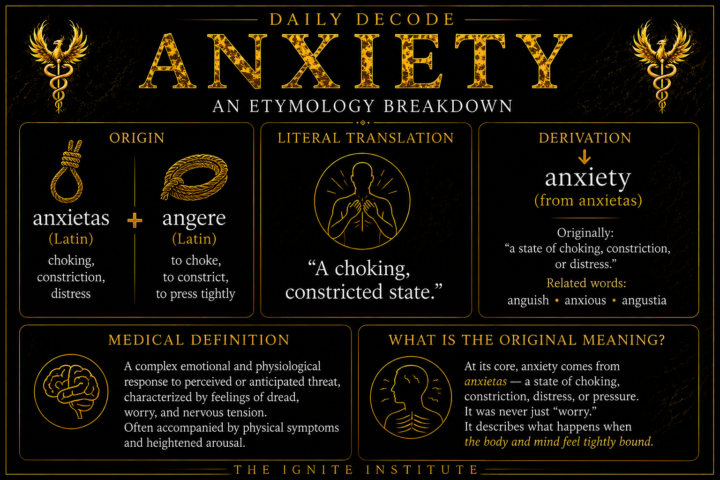
Daily Decode - ANXIETY
anxietas (Latin) = choking, constriction, distress Original meaning: A state of tightness. Constriction. Pressure. Not simply “worry.” The body experiences anxiety physically: - tight chest - shallow breathing - racing heart - muscle tension - hypervigilance - gastrointestinal dysregulation The organism prepares for threat. Modern medicine often treats anxiety as a disordered emotional state. But from a systems perspective, anxiety may also represent an adaptive survival response within an overwhelmed nervous system. The organism learns: - to anticipate danger - to remain alert - to scan constantly for threat - to stay activated for protection Over time, chronic stress physiology can become baseline. The system no longer remembers safety. Anxiety is not always irrational. Sometimes it is a highly intelligent organism attempting to predict, prevent, and survive perceived danger. The question may not simply be: “How do we suppress anxiety?” But: “What conditions taught the organism it must remain constricted to survive?” Because healing may begin when the nervous system experiences enough safety, regulation, and coherence to release the adaptation itself.
2
0
May 21 •
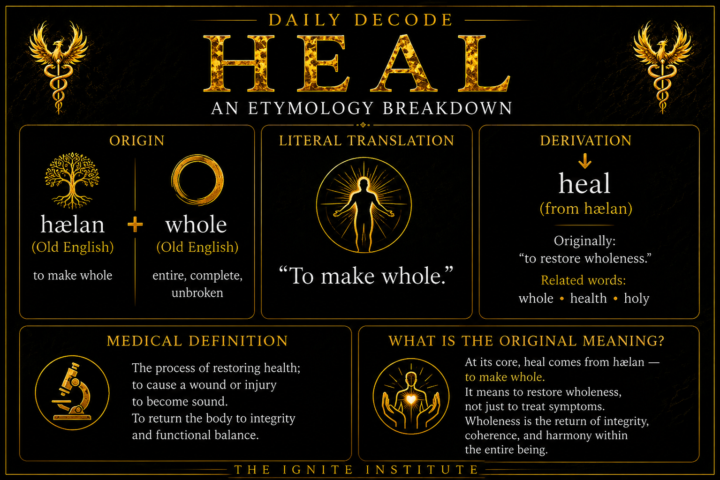
Daily Decode - HEAL
hælan (Old English) = to make whole Original meaning:To restore wholeness. Not merely to suppress symptoms.Not simply to eliminate pain.To return something to integrity. Related words: - whole - health - holy Originally, healing implied reintegration. A restoration of coherence across the organism. Modern healthcare often focuses on symptom reduction: lower the fever reduce the inflammation suppress the anxiety control the behavior And sometimes those interventions are necessary. But healing may involve something deeper than symptom management alone. Because many chronic conditions emerge alongside fragmentation: - nervous system overload - emotional suppression - chronic stress - environmental mismatch - relational disconnection - loss of meaning - physiological dysregulation The organism adapts in order to survive. Healing begins when the system no longer has to remain fragmented for protection. Not perfection. Not endless optimization. Wholeness. The restoration of coherence between body, mind, behavior, environment, physiology, and perception. At its root, to heal meant: to make whole again.
1
0
May 20 •
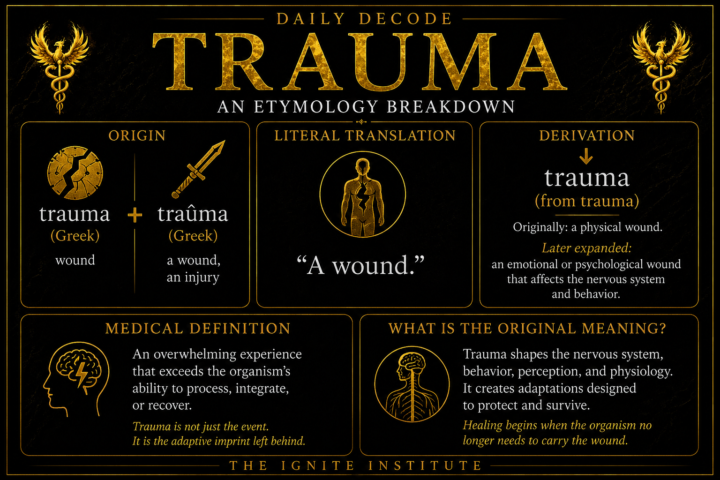
Daily Decode - TRAUMA
trauma (Greek) = wound Original meaning: A physical wound. A breach in the body. Modern understanding expanded the word into psychology and nervous system physiology: An overwhelming experience that exceeds the organism’s ability to process, integrate, or recover. But trauma is not only the event itself. Trauma is often the adaptive imprint left behind. The nervous system changes. Behavior changes. Perception changes. Physiology changes. Hypervigilance. Dissociation. Avoidance. Emotional shutdown. Chronic stress activation. Protective behavioral loops. These are not random failures. They are intelligent adaptations developed within overwhelming conditions. The organism learns: - what feels safe - what feels dangerous - what must be suppressed to survive Over time, those adaptations may begin expressing as: - anxiety - chronic illness - addiction - burnout - autoimmune dysfunction - relational instability - nervous system dysregulation Modern healthcare often focuses on symptom suppression. But trauma-informed systems thinking asks a deeper question: “What adaptation is this organism still carrying?” Because healing may not simply involve removing symptoms. It may involve creating enough safety, coherence, and regulation for the organism to no longer require the adaptation itself.
2
0
1-10 of 17

@bobby-apeiron-2304
The IGNITE Institute Architect | MD | Quantum Pathologist | 6/2 Reflector | Author | Husband | Father
Active 11d ago
Joined May 5, 2026