Activity
Mon
Wed
Fri
Sun
Aug
Sep
Oct
Nov
Dec
Jan
Feb
Mar
Apr
May
Jun
Jul
What is this?
Less
More
Memberships
Secret Society Peptides
176 members • Free
Orion Peptides
288 members • Free
The Iron Forge Brotherhood
38.2k members • Free
Peptides for Newbies
6.4k members • Free
1 contribution to Orion Peptides

12d •
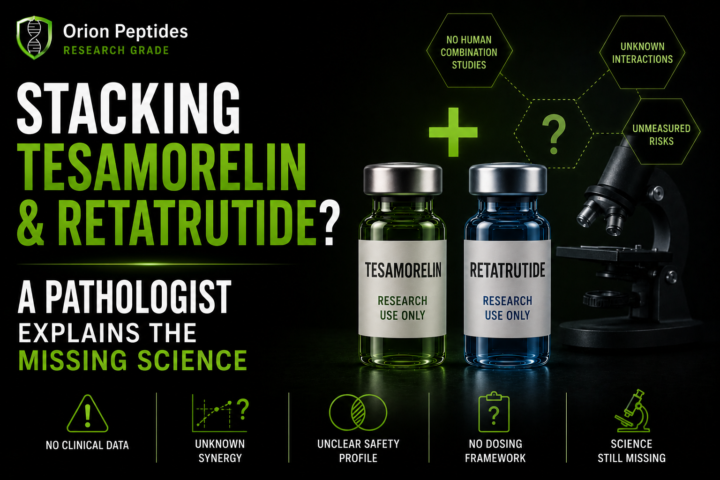
Stacking Tesamorelin & Retatrutide? A Pathologist Explains the Missing Science
Tesamorelin and Retatrutide are often discussed together in online protocols as if combining them is simply an extension of modern peptide science. That assumption skips every layer of actual clinical evidence. Let’s separate what is known from what is being extrapolated. Tesamorelin: What the Actual Data Was Built On Tesamorelin works by stimulating endogenous growth hormone release through growth hormone releasing hormone receptor (GHRH-R) activation. Its regulatory approval in 2010 was based on two phase III trials in HIV-associated lipodystrophy, running 26 weeks with extension data out to one year. That detail matters. These trials were not designed to evaluate: • healthy adults • aesthetic recomposition use • long-term endocrine modulation in non-disease populations So the safety and metabolic data sit inside a very specific clinical box. Outside that box, the evidence base becomes extrapolation. The IGF-1 Axis: Where Interpretation Becomes Important Sustained growth hormone signaling increases circulating IGF-1. IGF-1 is not just a metabolic marker. It is a mitogenic signal, meaning it influences cellular proliferation pathways. This is where the literature becomes nuanced rather than dramatic. There are population-level associations, including large meta-analyses in journals such as The Lancet, suggesting correlations between elevated IGF-1 levels and certain cancer risks. But correlation is not causation, and these findings do not establish a direct clinical outcome in controlled therapeutic use at approved dosing. What they do establish is a mechanistic caution point: If you chronically elevate a growth signaling axis, you are engaging pathways that are biologically linked to cell division. That is a fact of the system, not a prediction of outcome. Retatrutide: The Missing Layer Is Data Retatrutide is a multi-receptor incretin-based compound acting across GLP-1, GIP, and glucagon pathways. It is still in clinical development, with human data emerging but not yet mature in terms of long-term multi-year safety or complex interaction profiling.

2 likes • 12d
I’m going to stack them. 2 mg per week Reta, 1 mg per day (5) for the week of Tesa. Starting TESA next Monday.
1-1 of 1