Activity
Mon
Wed
Fri
Sun
Jul
Aug
Sep
Oct
Nov
Dec
Jan
Feb
Mar
Apr
May
What is this?
Less
More
Owned by Baz
A retired doctor with anxiety helps adults 50+ reclaim a quiet(er) mind without apps, tech, or pills by regulating their overactive nervous system.
Use my free 10-Minute Silent Sound Reset practice, backed by science & led by a retired doctor and fellow anxiety sufferer — to decrease your anxiety.
Memberships
The Ads Corner
309 members • $9/month
YouTube to Skool
29 members • $47
Mindset Skool
261 members • $49/month
Pick Your Online Business
1.1k members • Free
Skool Monetization Lab
155 members • Free
The Content Revenue Lab
968 members • Free
Skoolers
184.1k members • Free
16 contributions to The Quiet(er) Mind Reset

1d •
What Hypervigilance Actually Looks Like When You’re Over 50
It's not always panic attacks. Sometimes it's just an absolute inability to sit still and enjoy the afternoon. When most people hear the word "hypervigilance," they picture someone pacing the floor, hyperventilating, or on the verge of a full-blown panic attack. And while that's certainly one flavor of anxiety, it isn't what chronic hypervigilance usually looks like when you're in your fifties, sixties, or beyond. For us, it's a lot quieter. And in many ways, that makes it far more exhausting. After living with anxiety for over sixty years and spending years in medicine, I can tell you exactly what hypervigilance looks like in older adults. - It looks like an inability to sit on your porch and read a book without feeling a strange, hollow urgency in your chest. - It looks like checking your phone at 9:00 PM to see if an email came in, even though you retired three years ago. - It looks like constantly managing the mood of everyone in the room to make sure nobody is upset. - It's the sensation of having your foot hovering over the brake pedal, 24 hours a day, waiting for an accident that never happens. You aren't necessarily panicking. You're simply "always on." Your nervous system is constantly scanning the horizon for a threat. And when you carry that low-grade tension for decades, your body eventually forgets how to turn it off. The baseline shifts. You stop noticing that your shoulders are practically touching your ears, and you just accept that being completely exhausted by 3:00 PM is a normal part of aging. As a doctor, I saw this constantly. Patients would come in complaining of insomnia, digestive issues, or mysterious muscle aches. They'd tell me they were just "getting older." But beneath the physical symptoms was a nervous system that had been running hot since 1985. For the longest time, I was right there with them. I thought I just had a busy mind. I didn't realize my inability to relax was actually a biological alarm system stuck in the "on" position.
1
0


7d •
THE SCIENCE BEHIND THE RESET
The 10-Minute Silent Sound Reset is grounded in the anatomy of the vagus nerve and the physiological effects of rhythmic breathing. It works by combining two elements—slow, rhythmic breathing and low-frequency vocalization—to help shift the autonomic nervous system out of a hyper-vigilant, overstimulated state and into a calmer, more regulated one. Here is a summary of the science behind how it works: 1️⃣ Vagus Nerve Anatomy and Rhythmic Breath The vagus nerve is the body’s primary "calm down" pathway (parasympathetic nervous system). It runs from your brainstem down to your gut, passing through the heart, lungs, and vocal cords. In states of anxiety, breathing often becomes short, shallow, and irregular, which signals a sense of threat to the nervous system. The reset introduces a slow, predictable breathing cadence, which acts as a "metronome" for your nervous system, signaling safety. Prolonged and controlled exhalation, in particular, has strong scientific support for improving autonomic regulation and increasing parasympathetic activation. 2️⃣ The Mechanism of "Silent Sound" (Vocalization) The "sound" element—which involves a low, slow humming or "Mmmmmm" sound on the exhale—provides a direct vibrational stimulus to the vagus nerve. Because the vagus nerve passes directly through the vocal cords, the physical vibration of humming creates a physiological cue for the nervous system to downregulate. Emerging research supports the idea that vocal resonance (humming, chanting, and toning) influences autonomic regulation and may have different neurological effects than breathing alone. For example, some studies suggest that while slow breathing directly increases vagal tone, adding vocalization may increase alpha and theta brain wave activity, which is associated with deeply relaxed states. 3️⃣ Treating the Root Cause Rather than just trying to stop racing thoughts—which are a symptom—the practice treats the *root cause*: an overstimulated nervous system. By combining the slow breathing and the physical vibration of the vocal cords, the 10-Minute Silent Sound Reset gives the body a reliable, mechanical way to de-escalate, helping you regain a sense of internal control.

9d •
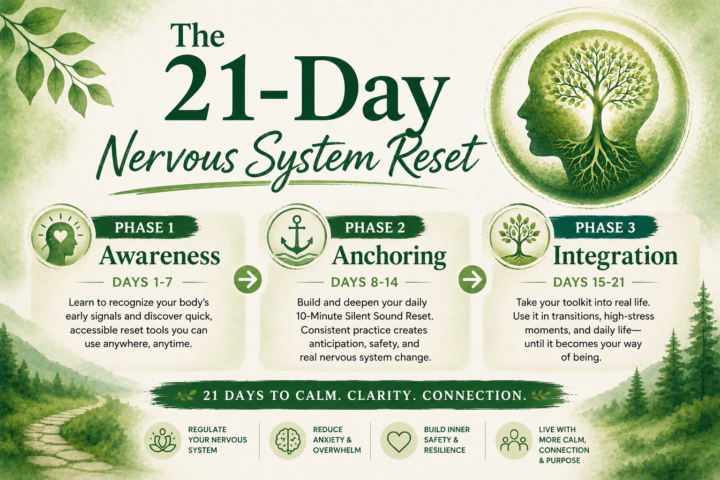
21-DAY CNS RESET THREAD
This thread is for you to post your progress in the 21-Day Nervous System Reset Course. Post using this model: - Phase 1, Day 1 (etc.) - Today's Anchor: Insert your comment here. Example: - Phase 1, Day 1 - Today's Anchor: I became aware of the space to choose today at [time of day].
0
0
13d •
AT 70ish, I STILL EXPERIENCE DAYS WHEN MY ANXIETY IS HIGH
YESTERDAY WAS A DOOZY It started like any other day. I woke, spent some time rubbing Kona's belly, and then softly padding my way to the kitchen to make a cup of coffee. We soon headed out to the mini dog park that we visit each morning; it's part of our routine that he expects. However, when we returned, I felt the first wave of anxiety washing over me. I thought it was rather early for that, and as I thought about what might've triggered it… I came up empty. That happens sometimes. It's not always possible to identify the trigger for every single anxiety response. That's the way the rest of my day went. One anxiety wave followed by a few hours of relative ease, and more anxiety waves. It's exhausting when I experience a day like this. Anxiety in itself is exhausting, both mentally and physically. ENGAGING IN THE PRACTICE I engaged in the 10-Minute Silent Sound Reset many times. Each time, I was able to signal my nervous system to back down, but not completely. As we say in Zen, "right now, it's like this." That means that all we have is the present, and it's silly to victimize ourselves by regretting the past or worrying about the future. I could have lamented that my practice was not completely effective and just relegated it to the junk pile and given up. I also could have thrown in the towel and said, "What's the use? It'll always be like this in the future." But that's not in my nature. I know this practice is effective most of the time. And I can't imagine where I would be without it. Even on my worst anxiety day, I'd rather have a practice that is 70% effective at signaling my nervous system to calm than have no tool at all. DON'T GIVE UP ON HIGH-ANXIETY DAYS Anxiety is not an easy partner to live with, as it tests every bit of patience and resolve that we possess. I'm grateful that my high-anxiety days are few and far between. Yours can be, too. Increase your daily practice to three times a day; once in the morning, once at midday, and once in the evening.
0
0

1-10 of 16
@baz-morris
A retired doctor who suffered with anxiety all his life helps adults 50+ reset their overstimulated nervous systems to reclaim a quiet(er) mind.
Active 1m ago
Joined Apr 24, 2026
INFJ
Vancouver, WA
Powered by