Activity
Mon
Wed
Fri
Sun
Sep
Oct
Nov
Dec
Jan
Feb
Mar
Apr
May
Jun
Jul
Aug
What is this?
Less
More
Memberships
Pilot Mastery Lab
156 members • $47
4 contributions to Pilot Mastery Lab
9d •
Domain V Live Workshop - Part 2 (July 30th, 11AM EST)
I've actually been there. The phone call, during a snow storm. Thankfully, nobody got hurt (and the plane was fine) but we now had an emergency on our hand where a disabled aircraft needed rescuing after arriving in blizzard conditions and finding itself in a snowbank. The clock was ticking, and we needed to coordinate across multiple departments to ensure safe retrival as well as to protect our brand reputation. Once the aircraft was back warm and dry in a hangar, the real work began - the SMS investigation that would help us proactively protect our stakeholders ever more efficiently. What holds a department together in that hour is not courage and it is not improvisation. It is a plan that was written and rehearsed before anyone needed it. That is where we go tomorrow. Domain V, Part 2: OPS4 (Emergency Response Plans) and OPS5 (Safety Management Systems). Thursday, July 30 · 11AM ET · live in the community. Here is why I am giving these two equal depth. Most candidates study the SMS hard and treat the ERP as a checkbox. The real exam tests the ERP at the same granularity as the SMS. They are not two competing topics. They are one safety architecture seen from two angles, and this session is the safety core of the whole course. What we will cover: - The priorities of work, in order, and the second slot that costs people the point. - Why "all-hazards" does not mean what it sounds like it means. - Who the company's highest responsibility actually is in the first hour, and why it is not who feels loudest. - NTSB Part 830: accident versus incident, the dollar threshold that does not exist, and the notification triggers the exam baits. - The exercise ladder, and the difference between the most thorough exercise and the most common one. - The real goal of an SMS, which is not "make us safer." - The four pillars, in order, with the sub-element counts, drawn from a blank page. - Who holds the final risk-acceptance call. It is not the safety manager, and it is not you. - Just Culture, and the reason it is not a no-blame culture.

1 like • 9d
See you then
25d •
Turning knowledge into action
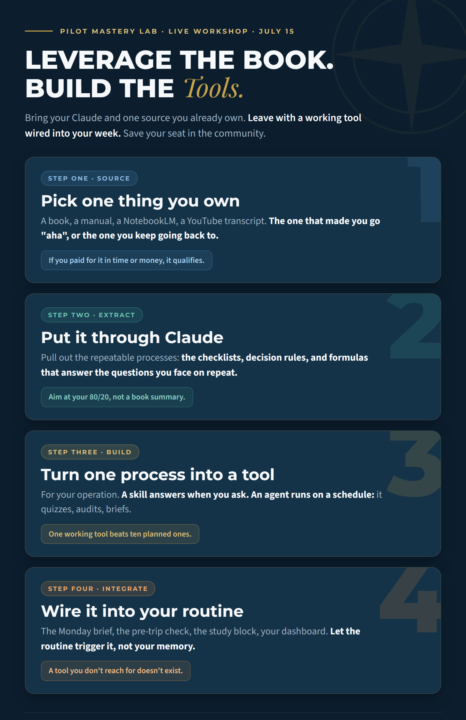
Hi everyone! Thank you for bearing with me as I transition roles in my career. You'll notice as you look around that some things look different, and I'm working really hard to unify the work of this group as a focused effort to serve you better! I had an amazing conversation with @Mark Laverdiere one of our newest members recently, and we shared our joint appreciation for automation and AI - yet one thing I learned is that gaining knowledge rapidly might give the perception that we are growing or learning, but in reality, producing something from it can be just as frustrating or not bear the fruit we expect. I want to invite you to a workshop this week - Thursday at 11AM EST (check the "Calendar"!) to dive into the NBAA CAM manual together, and find practical ways to turn its knowledge into repeatable skills or processess so that you don't have to hold all of it in your own head! Who's in? Put a 🤖 in the comments if you're interested!!
1 like • 25d
JD. Would love to but that’s the same time as the weekly cam meeting this week.
1 like • 24d
What ever is best for your schedule.
Jun 21 •
Upcoming Call - NBAA CAM modules (Wednesday)
Happy Sunday everyone! I'll be hosting another call Wednesday 1900 Eastern Time (Toronto). For those of you starting the 6 month to CAM, I'd love to hear what it's looking like this year and how we can maximize the support for you here! Additionally, if you'd like calls setup for study group let me know!

1 like • Jun 21
Excellent. See you then.
Jun 1 •
Finding your Why
Why I'm Here (Read and Post This Before You Start the NBAA CAM course 🚧STILL A WORK IN PROGRESS!🚧 ) Before you open a single module, this is the first thing you do here. The CAM is about six months of real work, roughly two hours a day, six days a week. Nobody crosses that finish line on motivation alone. The candidates who go the distance are the ones who got clear, on day one, about why they were doing it. So tell us. In a few sentences: when this gets hard, what is the reason you will keep going? Name the people who depend on your judgment, the standard you want to hold, or the version of yourself on the other side of this exam. Skip the resume answer ("it is good for my career") and go a layer or two deeper. The honest reason is the one that will still be standing in month four. Post your why below. 👇Then read a few others and welcome someone in. You are about to spend six months in the same arena as these people, and it helps to know what everyone is fighting for. Date your post. Six months from now, come back and read it. I will go first.
1 like • Jun 1
I am here much like yourself JD. I've been flying corp for many years and now have the time to do and learn more. As my fatherly role of uber eats/drives is slowly coming to an end with my daughters independence I figured now is a good time to take the next step and dig deep into operations and the CAM program is the way to do it. Also as a newer FAA ATP pilot I figured this would also help me learn about the Part 91/135 rules and ops. As a pilot who never formally went to post secondary I do anticipate a massive learning curve with how to study. I hope the 6months to CAM and your program can help mitigate those and keep me on track to succeed. Although our time at skyservice was short and remote I had great appreciation for how you operated and lead as our chief pilot and look forward to that continued guidance while on my journey.
1-4 of 4
@scott-iwaniuk-4520
Corporate pilot. TC ATPL, FAA ATP, CAAC ATP. Currently enjoying the Falcon2000LX/LXS
Active 8h ago
Joined May 30, 2026
Calgary
Powered by