Activity
Mon
Wed
Fri
Sun
Oct
Nov
Dec
Jan
Feb
Mar
Apr
May
Jun
Jul
Aug
Sep
What is this?
Less
More
Clief Notes
48.5k members • Free
15 contributions to Clief Notes

10d •
Am I over-engineering AI workflows and who else? 🙃
Something I read in The Age of AI made me rethink how I use ICM. My natural tendency is to approach ICM through business process orchestration. I define the stages, describe the steps, and try to make the whole workflow explicit. But sometimes I take this too far and turn the stages into strict rules. The result becomes over-engineered, uses more tokens, and often works less naturally with AI. I recently had the opposite experience. We replaced a detailed process with a simple skill that described the essential pattern, and the results were much better. That made something click for me. Maybe stages should act as an interpretable scaffold, rather than a fixed algorithm. They can clarify the purpose, context, constraints, handoffs, and expected outcome, while still allowing the AI to work out the best path. AI may free us from having to define an entire process in advance. But if we specify less, evaluating the outcome becomes even more important. We need to check the quality of the result, capture what we learn, and use that learning to improve the scaffold over time. Does anyone else start with ICM and then gradually slip back into rigid, rule-based process design? How do you decide what needs to be specified and what should be left for the AI to infer?
1 like • 8d
@Mikee Trompeta i wish it was only claude.md that I had to re-organise :'(
1 like • 7d
@Mark Gubuan I lost count of the eggs I've broken Mark 😆

11d •
Context Windows filling up even with ICM, what to do?
I am rigorously using the ICM-architect as my first step when starting new projects. Also must admit I'm running at least 3 projects in parallel at almost any point in time and all day. I always have compute enough but the Context Windows are filling up faster than I'd like. Was hoping using ICM would cure this by design but I'm having to switch models constantly to keep AI awake here. What is the general approach to this? What's your take on this?

0 likes • 8d
@Piseth Seng I have this second brain of WikiLLM by Karpathy. Is that the same method you use for your projects?

Jul 10 •
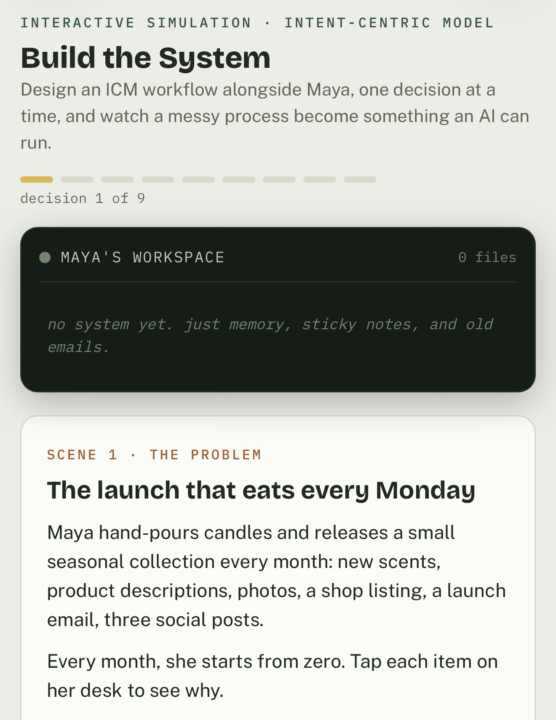
New to ICM? Get hands on learning experience here
Step-by-step interactive guide from idea to output. Design an ICM workflow alongside Maya, one decision at a time, and watch a messy process become something an AI can run again and again. Right now, Maya has to try to remember what needs to be done and where each piece of information is kept. She needs a better solution. https://claude.ai/public/artifacts/7c9618f4-8324-4048-902c-cbcf77c9c102 Let’s build one with her. 😀
0 likes • 8d
I just noticed that and loved it. Thank you so much for it.

8d •
Which AI Governance segment are you most interested in?
1.AI governance as a business function, not just compliance. 2.The regulatory landscape - EU AI Act risk tiers, US sectoral rules, and any local requirements. 3. Role clarity: provider vs deployer vs modifier. 4. Risk-based classification of AI use cases - not all AI use carries the same stakes. 5. Human oversight requirements. 6. Data provenance and IP exposure 7. Model accountability chains 8. Transparency and disclosure obligations 9. Incident response for AI failures 10. Governance as an iterative process, not a one-time policy
2 likes • 8d
none of them would hold you back to learn and apply ICM for sure.
10d •
Distaste of Over-defining ICM stages and lessons-learnt transportation issues, here is my take:
I’m wondering who has come across with the risk of over-defining ICM stages. My understanding is that Jake recommends simple rules that give AI enough structure to recognize and apply patterns, not a rigid process describing every step. But if that’s true, we also need a way to learn from outcomes and improve those patterns over time. This is where I’m struggling. I’ve used Windows for years, but folders, files, and Git are still my kryptonite. I currently move lessons learned from my local project folders into the Git-based ICM structure manually. Has anyone built a simple workflow where a local Windows project can use an ICM repository, capture lessons from actual outcomes, and feed them back into the shared ICM files? How are you handling this in practice?
1 like • 9d
@Colm Whelan perfect. That's how I started tho, on Onedrive. Then I moved those folders to google drive, which made me more flexible to use any LLM to work with. gemini, claude, codex, all of it. My projects are similar to yours: I start with one os_root folder, a bit like ICM. I kick off the project, write a PRD as Jake mentions here, and then create the folders based on what that PRD needs. I’m not a software developer. I’ve always been more of a generalist. I’m a civil engineer by background, but I’ve also worked in finance and business development. For the last year, I’ve been on the AI/business-transformation side. For me, building something is only half the job. The other half is continuously improving it. Every project, change, and bit of feedback becomes useful material for improving both the system and the way you work. That’s why I’m a little uneasy about relying only on Windows folders. As this grows, I want a place where all that knowledge can keep accumulating and stay easy to work with.
1 like • 9d
@Ali ELBaitam yeah and I'm a civil engineer happens to grow AI skills lately :). What a struggle that git 😁
1-10 of 15

Active 2d ago
Joined Apr 20, 2026
ENFJ
Powered by