Activity
Mon
Wed
Fri
Sun
Oct
Nov
Dec
Jan
Feb
Mar
Apr
May
Jun
Jul
Aug
Sep
What is this?
Less
More
📚The Skool Bookshop
197
5.0
Free
AI Writing Easy AF for Authors
926
5.0
$5/m
9 contributions to Get Grounded | Calm Marketing

🚀
🔥
Jul 2 •
🔁 Follow up by being useful, not by hovering
This is where most people either ghost their own business or turn into That Person. There's a third option and almost nobody uses it. 👀 Bad follow-up reminds someone they owe you something: 🚩 "Just circling back!" 🚩 "Did you get a chance to think about it?" 🚩 "Bumping this up your inbox! 🙂" Every one translates to: WHERE IS MY DECISION. Pressure on them, ick on you. Lose-lose. The reframe: a follow-up is not a reminder. It's another deposit. 🏦 Instead of asking where their decision is, send something NEW and useful and let your continued existence do the work: ✅ "Saw this and thought of your launch — [link]. No reply needed." ✅ "Here's the answer to that thing you asked last week." ✅ "This is live now if the timing's better. Still totally fine if not." You're staying in contact by being the person who GIVES things — not the person tapping the glass asking for money. 🐟 People remember the giver. They mute the tapper. Don't be the tapper. Two quiet rules that keep this sustainable (because sustainable is the whole brand 💜): ⏳ THE RULE OF THREE-ISH. A few genuine value-touches with nothing back? Let it rest. Not because follow-up is wrong — because CHASING is. A no-for-now gets to be a no-for-now. They know where you live. 🗒️ KEEP A TINY LIST. You will not remember who you sent what. A two-line note — name, what you sent, when — turns follow-up into a 2-minute task instead of a "wait… did I already message them??" spiral. Low energy demands low admin. Build it so future-you barely has to think. (Future-you says thank you, by the way.) 🎯 YOUR ONE THING: Pick one person who went quiet. Instead of "just checking in," find ONE genuinely useful thing and send THAT instead. That's the entire technique. 📤

2 likes • Jul 2
Also, no answer can be the answer. Accept it and move on.
🚀
🔥
May 11 •
This week we're talking about minimum viable marketing. 🌱
Not as a cute phrase. As a real question you can answer for your specific business, with your specific energy, in your specific life. Most of us inherited a marketing system. We watched someone else do it, or read a course, or copy-pasted a strategy from someone with a team, a different audience, and 6 hours a day they don't use for caregiving or a day job. Then we blamed ourselves when we couldn't keep up. That's a design problem, not a discipline problem. So before we talk about what to add this week, let's figure out what's actually happening right now. Here's a quick audit — grab a piece of paper or open a note: List every marketing thing you're currently doing or "supposed to be" doing. Email newsletter, social posts, a podcast, a YouTube channel, SEO, collaborations, a Facebook group, daily stories — whatever's on the list, written or unwritten. For each one, answer two questions: 1. Is this actually bringing in new people or revenue, or do I just believe it should? 2. If I stopped doing this for 30 days, would anything measurable change? Most people find that 1-2 things are doing most of the work. The rest is either faith-based marketing (we believe it helps but can't prove it) or obligation marketing (we feel like we should, so we do). Neither of those is wrong necessarily — but you should know which is which. The goal of this week: figure out what your actual minimum is, get really good at that thing, and make peace with letting the rest go for now. Drop one word in the comments: what marketing activity are you most suspicious of right now? The one you keep doing but kind of wonder about. 👇

1 like • May 18
I think I'm really good at newsletters - I'm consistent each Saturday you can expect one from me. I'm really bad at: everything else.
🚀
🔥
May 12 •
The advice is always "be consistent." Nobody tells you consistent at what size. 🧠
Here's what actually matters: the frequency you can sustain without white-knuckling it. Not the frequency that sounds impressive. Not the one the course told you to hit. Because here's the math most people skip: Posting daily for 2 weeks then burning out and disappearing for 6 weeks performs worse than posting once a week, every single week, for a year. The algorithm notices. More importantly, your audience notices. Inconsistency trains people not to expect you. So let's figure out your actual number. The right-sizing exercise: Think about your lowest-energy week in the last 3 months. Not a crisis week — just a hard, draining, nothing-left week. How much marketing could you have done that week without it feeling like punishment? Be honest. Not aspirational. That number — that floor — is your minimum viable consistency. Whatever you can do on your worst week is the frequency you should build your system around. Everything above that is a bonus, not a baseline. If the answer is "one email per month," then build the best monthly email in your niche and own it. If it's "one post per week," make that post count. Depth and reliability beat volume every time for the kind of audience we're building — people who actually read, actually buy, actually stay. One more thing: if you're writing content from scratch every time, you're making this harder than it has to be. Batching 4 posts in one focused hour is a completely different cognitive load than writing one post four separate times. If you haven't tried batching, try it once. It changes the math. What's the floor for you — what could you actually do on a hard week? 💬

0 likes • May 18
I don't suppose my floor can be zero, can it?
🚀
🔥
May 12 •
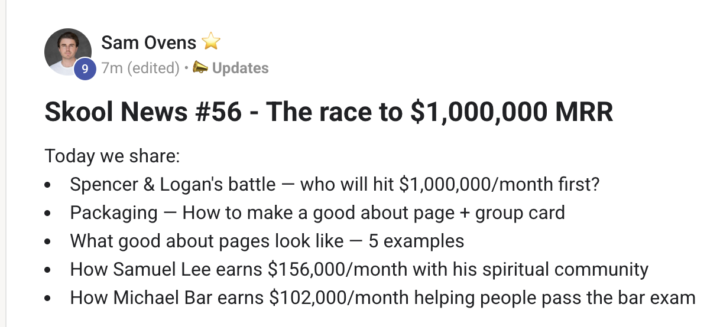
I get it... but this stresses a lot of people out
This is from the main Skool room from one of the founding people. People look at this and start stressing - they get worried "they are failing" because they are only making $2k a month or $500.... THIS STUFF DOESN'T MATTER in the end! So ignore these styles of posts 𝗦𝗲𝘁 𝘆𝗼𝘂𝗿 𝗼𝘄𝗻 𝗴𝗼𝗮𝗹 𝗮𝗻𝗱 𝘆𝗼𝘂𝗿 𝗼𝘄𝗻 𝗽𝗮𝗰𝗲.
2 likes • May 18
I'm getting so tired of other people bragging about what they make per month without telling people how much they paid to make that amount. 'Yeah you for making $1,000,000 last year, but how much did that cost you? $750,000 in marketing/ads?' They just don't tell the whole story and for authors that don't realize that, it can be so discouraging.
🚀
🔥
May 16 •
Today is Saturday. Take the day off. 🌱
And if Saturday is actually your busiest day — if you work retail, have kids home all weekend, or your business runs on a schedule that makes Sunday your Monday — then pick a different day and take that one off instead. This is not a wellness post. This is a business post. Here's the practical case for intentional time off: Most of us think we're being productive when we're in low-grade work mode all the time. Tabs open, phone nearby, half-thinking about the email we need to send while we're supposed to be watching a movie. It feels like we're staying on top of things. What we're actually doing is never letting our brain fully disengage — which means we never get the creative recovery that happens when it does. The ideas that solve your problems, the reframes that unstick your copy, the decisions that have been sitting in a pile in your head — those tend to arrive in the gap. On a walk. In the shower. The Tuesday afternoon you gave yourself completely off and just read a book. You can't manufacture the gap while you're still half-working. What intentional time off actually looks like (vs. what we usually do): What we usually do is stop the official tasks but stay in "available" mode. We check Slack. We scroll Instagram and call it research. We answer one quick email. We're technically off but cognitively still on, which means we get none of the restoration and all of the guilt. Intentional time off means closing the tabs. Turning off the notifications — not forever, just for the block of time you're protecting. Doing something that has nothing to do with your business and not framing it as inspiration-gathering. It means telling yourself the business will still be there when you get back. Because it will. If you can't take a full day, protect a window. Two hours where you are actually unavailable, actually not thinking about it, actually doing something else. That's not nothing — for a lot of us, that's significant. One thing worth setting up so time off doesn't break everything:

1 like • May 18
I don't have this luxury, but... I do take days off once I've submitted my final draft to my PA for uploading (I did this yesterday and then spent the rest of the day in the pool).
1-9 of 9