Activity
Mon
Wed
Fri
Sun
Nov
Dec
Jan
Feb
Mar
Apr
May
Jun
Jul
Aug
Sep
What is this?
Less
More
7 contributions to Deconstructing with Aleeza


0 likes • Sep 1
Canonise it and only allow it out when white ideology is dead and buried. Then burn it all.

Aug 31 •
White Privilege Question from Chamieka
White folks, I’m stumped. Can you help me out? Something I've noticed after years of being fully invested in this work is that a lot of white folks are self-aware. They know when they're operating from privilege. They can name it, dissect it, write beautifully about it. And then they do the thing anyway. "I understand it's a privilege to..." Okay. You understand it. But what's the point of naming your privilege if you're still leveraging it for your own benefit at every turn? That's not humility, that's confession without repentance. It's the same as saying "I know this system harms people" while still cashing in on it because it's easier. Or saying "I know it's a privilege to do this" and doing it anyway because you can. Awareness without accountability is a performance. It's a way to soothe your own guilt without ever changing your behavior. I saw someone post recently about how they moved out of the United States because things are "so bad here." They wrote about how aware they are that leaving is a privilege, but they left anyway. That's the part I can't wrap my head around. If you know it's a privilege to leave, and you claim to be invested in anti-racism, why not stay and fight alongside the people who can't? It's like watching a house on fire and saying "wow, this is terrible, I understand it's a privilege to have an escape route" and then walking out the door while the rest of us are trapped inside. At some point, acknowledging something without acting on it becomes a shield. A way to keep your hands clean while the rest of us are covered in ash. You don't get credit for noticing your privilege if you refuse to disrupt it. You can't hold awareness in one hand and avoidance in the other and call that growth. That's self-preservation wearing progress as a costume. If you know better and keep doing the same thing, you're not doing the work. You're narrating it from a safe distance. So I’ll ask you straight up: what does accountability actually look like for you? Not the version you’d give in a workshop. In your actual, everyday life. What are you doing with your awareness, because naming your privilege isn’t enough. You get to opt out of this whenever you want, and you know it. That’s the whole problem. The real work starts when you decide to use it differently, even when nobody’s watching and even when you could just walk away.
0 likes • Aug 31
A friend recently told me - until the pain of remaining the same doesn’t outweigh the pain to change to something new, unfamiliar and lower runged - that change in neural pathway won’t occur - I’ve somewhat butchered his quote and manipulated it - but I felt instinctually to mould it to fit the context better.
Jun 2 •
Anyone still thinking about Natchez?
I am still thinking about it, you? @Sarah Jones @Alexander Skye @Davina Kerrelola @Amy Maez
0 likes • Jul 20
@Amy Maez “I think the acceptance requires a great deal of processing grief and other difficult emotions” - I couldn’t agree with you more - the truth lies in our cells, our bones, our DNA/ancestry, and just like epigenetics / intergenerational patterns/data/pathways- for it to be processed means emotions which were suppressed - going back generations - that is exactly why on TikTok for example you mostly only get deflections, denials, whataboutisms etc - otherwise you run from there rather than facing - that somewhere in you/your body lies hidden something (your shadow if you like) that you’ve never been able to address ever - and likely nor have our kin who came before us - the systems of oppression run deep. Only today my brain was occupied by falling into the rabbit-hole that I myself have spent over 3 decades assuming / hoping that I was that male hetro YT image/idea - doing everything I could to push myself into that social status/upper hierarchy. I did in the last week fall into Afropessimism - (Frank Wilderson III) and Saidaya(sp?) Hartman - and I must say - it fitted really well with my understanding / sense - that the structure we are in - cannot be adjusted or circumnavigated around - the only route plausible is abolition. There’s also something else in that theory - which routes back to Natchez here - that juxtaposition - that almost dependent relationship - I’ve also seen flutters of it on TT - the idea that YTs on the whole seem to always appropriate or centre themselves according to BLK ppl and their culture - like something you are forever defined by - Afropessimism posits - that the foundation is one of a parasitic nature - the idea that YT culture when put under the microscope seems to disappear - showing you all the places it’s been appropriating from - it seems like a radical theory perhaps - but IMO - it’s the best that fits so far to my sense, my history and my learning thus far about how Race has been formed, the other systems of oppression that we all live under and perpetuate - and how the biggest scandal which structures the globe today - started from the Transatlantic Slave Trade and has evolved on the surface only - leaving and relying on the same framework of othering always underneath - and it has fundamental ties to Capitalism, Patriarchy and other systems of oppression of the marginalised.
0 likes • Jul 20
I forgot to add; I suspect the reason why we seem chained in a language (as you infer) that keeps us from seeing the system from the outside - is by design - the tools of the system are not meant to dismantle the system - as a matter of fact the system lives perpetually in concepts and illusions that continuously keep us away from ever seeing it separate from ourselves - we act as the system by default - and have learned to live in the illusion that we are separate agents to it - but the evidence repeatedly indicates the system operates in the dark in us at all times - and we can’t seem to ever get a spotlight on it - a new language is needed to see the system as separate to us - but that goes hand in hand in bringing up the darkness of how it operates in us also - (“The masters tools… “ A.Lorde)
Jun 23 •
Police are not supposed to be "neutral" about violence.
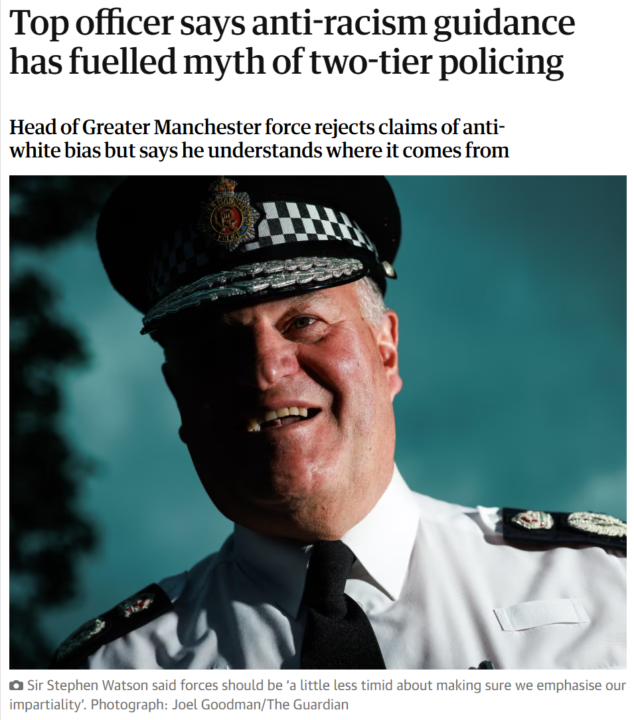
This article explores sentiment about police actions in Britain that made me examine how police are viewed there From the article... Watson has been called Britain’s “anti-woke” police chief after he instructed officers not to take the knee during Black Lives Matters protests in 2021 because it would undermine impartiality. He said he would “probably kneel before the queen, God and Mrs Watson, that’s it”. Speaking to reporters in Stockport, Watson said forces should not “use the language of being anti-racist” because it implies officers have “some activist role”. Of course we’re fiercely opposed to racism but we’re the police,” he said. “We are not activists. If we overstep … this is what then informs the public perception of two-tier policing. ________________ Full article Top officer says anti-racism guidance has fuelled myth of two-tier policing | Police | The Guardian https://share.google/Bwc7BuE5jXPHKGR9j Reflection questions 1. What does "neutrality" mean to you? Is neutrality the same as fairness? 2. Can institutions be neutral about harm? Why or why not? 3. Is racism a political issue, a social issue, a public safety issue, or something else? What leads you to that conclusion? 4. What's the difference between being anti-racist and being an activist? Are they always the same thing? 5. Have police historically been neutral in matters of race? What examples come to mind? 6. When institutions claim neutrality, who tends to benefit? Who might be overlooked or harmed? 7. Should police be neutral about hate crimes, domestic violence, or discrimination? If not, what makes those issues different? 8. If racism causes measurable harm, what role should public institutions play in addressing it? Where do you think the line should be drawn?
1 like • Jun 25
Just a quick response here from someone who was born and bred in England. 1. I think it’s important to see what someone looks like; all data in its variance tells us things. 2. Sometimes or even most times our throw away off the cuff comments reveal or give away the most about us - 3. He did kneel, I believe this year to become a “Sir”. 4. He said he would “probably kneel in front of God”. 5. Islam can mean “submission (to God)” - I find the true act of kneeling something momentous in actuality - we are lowering ourselves to something above us, bigger than us, bigger than our egos and identity even - similar to the act of prayer - 6. The recent Nowak (killing) case and the Right Wing response to it included them replicating what they frowned upon and criticised with Black Lives Matter but ended up kneeling for a case where the parents of a white man said it wasn’t racially motivated - but the RW/Far Right perceived / portrayed it as such. Will come back to your questions later - always appreciate your posts. And btw - the roles we play, the uniforms we wear and whom we serve defines us - and that’s the product we become. If it conflicts hard for someone - they refuse to wear that uniform, serve that master and become someone who has the courage to stand alone.
1 like • Jun 25
“Of course we’re fiercely opposed to racism but we’re the police,” he said. “We are not activists. If we overstep … this is what then informs the public perception of two-tier policing.” The police has been found here (Government commissioned reports) on countless occasions to be systemically racist. It’s run and operated in a majority White Male Patriarchal manner/system. Two Tier policing has been the case for decades if not even longer - based on societal/social/racial systemic bias - Countless cases show this time and time again when the ones who have suffered and continue to are Black/Asian/Women/LGBTQ+ and other marginalised people. When he mentions the perception of Two Tier policing he is referencing an increasing feeling amongst White people that they are now the marginalised, being taken over (invaded), the minority, the oppressed and so on…. Whilst showing all the tropes to Authoritarian rule and Fascism. *I’ll come off my soapbox now*
May 24 •
What kind of ancestor will you be?
All this. Having Thomas Jefferson be an atrocious yet revered (not by me) colonizing ancestor of mine, I strive to be the kind of person that would make him turn in his own grave. Original post from Chamieka House-Osuya 👇🔽 "I don’t usually write on Sundays, but I’ve been sitting with something I can’t put down. It came out of a wonderful conversation I had recently, and I keep turning it over: what would it actually mean for white people to be good ancestors? When I first heard the phrase “good ancestor,” it didn’t feel simple or inspiring. It felt heavy. Not because it’s some new concept, but because it put words to something a lot of us have been going around for years without ever saying out loud. We keep having the same conversations about race and history. They keep falling apart in the same spots every single time. That exhaustion is real and it adds up. It does not level off the more you go through it. It gets heavier, especially when you are being honest and what you get back is defensiveness instead of any real reflection. A lot of white folks hear these conversations and immediately turn inward in entirely the wrong way. They are not reflective or curious, but merely protective, making it about defending themselves instead of facing what is being said. And then we end up completely stuck, because the focus shifts to their fragile feelings, and the actual harm never gets dealt with. It just sits there, unchallenged and unchanged, while everyone argues around it in circles. That is the pull in two directions at once: wanting to be honest about what is real, while knowing how quickly honesty gets shut down when it feels too close. Still, if anything is going to move, there has to be a way forward for the people who are actually willing to do something different. It cannot be a way that makes it easier, but just a way that keeps the responsibility exactly where it belongs. The idea of being a good ancestor does that in a way that feels incredibly grounded and real. Being a good ancestor means not looking away, but sitting with what came before you and being honest about what you’ve gained from it. It is a defining decision point where you either continue what was handed down, or you actively interrupt it.
0 likes • May 25
Excellent piece.
1-7 of 7