Activity
Mon
Wed
Fri
Sun
Nov
Dec
Jan
Feb
Mar
Apr
May
Jun
Jul
Aug
Sep
What is this?
Less
More
Reliance Baseball
34
$5/m
12 contributions to Reliance Baseball
Apr 17 •
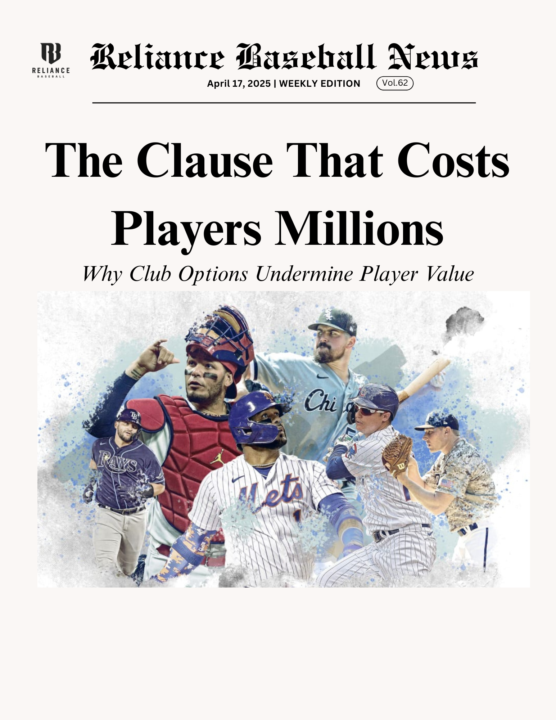
The Clause That Costs Players Millions
“Options suck.” That was Michael Weiner’s blunt take on club options—and years later, it still holds true. Club options aren’t just contract language. They impact free agency timing, player leverage, and long-term earning potential. Teams exercise them when it benefits the club. Players often lose leverage when it matters most. In our latest Next Pitch article, I break down why club options remain one of the most one-sided clauses in baseball contracts.

1 like • Apr 20
Yup, from the early-in-the-career player perspective they definitely do.
Apr 3 •
Inside the MLB Draft: How to Climb Into the Top 5 Rounds
Every year, players get drafted higher than expected—and most people assume it’s because teams suddenly “fell in love” with the talent late in the process. That’s rarely the case. In today’s MLB Draft, movement into the top five rounds is less about last-minute evaluations and more about positioning. Bonus pools, slot values, and team-specific draft strategies have reshaped how decisions are made. The players who move up boards are often the ones who fit a team’s financial plan just as much as their scouting profile. The old model of pre-draft deals may look different, but it hasn’t disappeared—it’s evolved. In this article, I break down how the modern draft actually works behind the scenes and, more importantly, what players, families, and agents can do to create real opportunities on draft day.

0 likes • Apr 4
I would love to sit it in on a MLB team's draft day "war room" (physically or electronically in this day and age of Zoom-tronics) just once to see how this draft day strategy unfolds. Basically just a fly on the wall. Must be fascinating, but like you say, every team probably does it differently - must be a once in a lifetime experience regardless of which table you are at though.
Jan 8 •
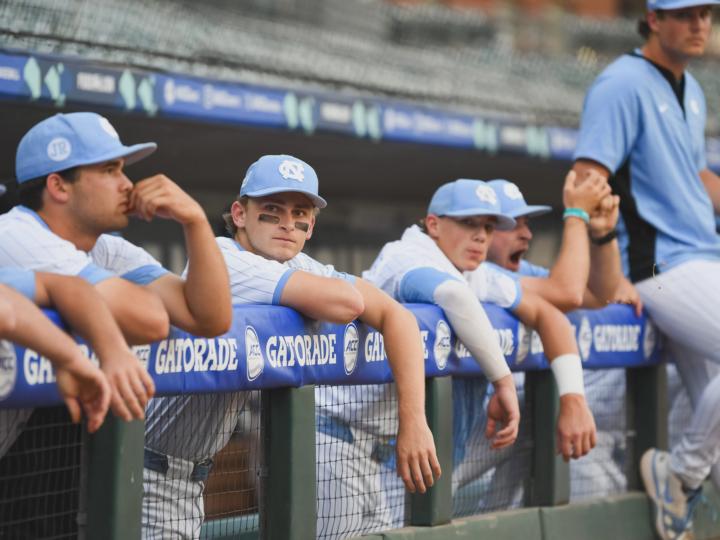
Is Power 4 Baseball Built to Develop — or to Win Now?
For decades, families viewed a scholarship to an elite college baseball program as a signal of opportunity. Commit to the SEC or ACC, and the assumption followed naturally: you’ll play early, you’ll develop, and the draft will take care of itself. In today’s college baseball landscape, especially within those two conferences, that assumption deserves a closer look. This isn’t an indictment of elite programs. It’s a framework for decision-making grounded in data, roster math, and the realities of the NIL and transfer-portal era. In the first five rounds of the 2025 MLB Draft, 31 of the 60 hitters drafted and signed came from the SEC or ACC. The number alone reinforces the dominance of those conferences at the highest levels of amateur baseball. But where a player is drafted from is only part of the story. The more important question is how those hitters arrived at that point — and whether elite college baseball is truly designed to develop young players, or structured to win immediately. In an era where proven production can be acquired through the transfer portal, the path for incoming freshmen has quietly changed, especially for hitters expected to compete for playing time right away. What the data reveals next challenges one of the most common assumptions families make when committing to elite programs.
1 like • Jan 8
There was an article posted by another baseball outlet (Baseball America?) which talked about college baseball no longer being the developing ground for pro ball, and that it falls on the individual player to get the specific guidance/instruction/development plan set up through orgs like Driveline to get themselves better. All the college program and coaches do now is tell the player what they need to improve on and then accomplish those goals or they won't get the playing time. It is every man, woman and child for themselves now when it comes to accomplishing a career in baseball.
Oct '25 •
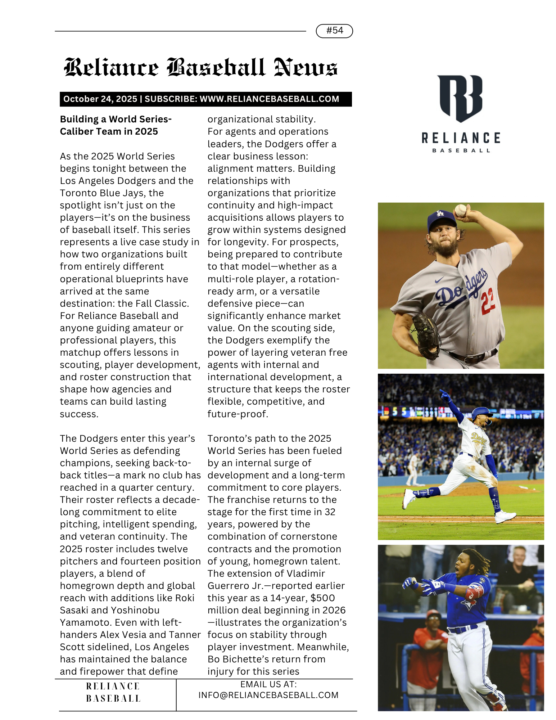
Roster Architecture Meets Championship Stage
The 2025 World Series isn’t just about who wins—it’s a masterclass in how champions are built. This article explores how roster construction, long-term player investment, and international scouting define winning organizations and what lessons agents, scouts, and players can take into 2026 and beyond.
2 likes • Oct '25
There was a FB post I saw this that that showed the 26 man roster construction breakdown for each team (ie FA, trades, drafts etc.) and they were basically identical in terms of a balanced allocations. Goes exactly what you said Jason and that great organizations use all their available resources and roster construction channels to produce championship caliber teams.
Sep '25 •
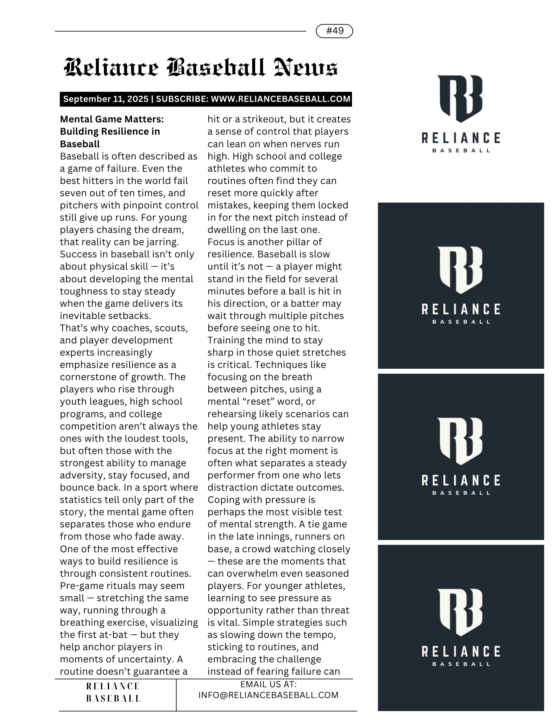
Mental Game Matters: Building Resilience in Baseball
🚨 In this edition of Reliance Baseball News, we’re talking about the mental side of the game. From routines to focus to bouncing back from slumps, resilience might be the most valuable skill a player can build.
1 like • Sep '25
The mental aspect of the game is what separates the short-timers from the future Hall of Famers. Always is the last great hurdle to develop...and right on queue, the Philadelphia Phillies posted on LinkedIn today a job opening for a "Mental Performance Coach" position based out of their ST complex in Clearwater, FL. Great article, thank you Jason for posting.
1-10 of 12

@alex-marks-3065
SMWW Certified Baseball Scout and Aspiring Baseball Professional
Active 5d ago
Joined May 19, 2025