Activity
Mon
Wed
Fri
Sun
Sep
Oct
Nov
Dec
Jan
Feb
Mar
Apr
May
Jun
Jul
Aug
What is this?
Less
More
Orion Peptides
359 members • Free
The Iron Forge Brotherhood
49.1k members • Free
12 contributions to Orion Peptides

13d •
Statins, CoQ10 and Mitochondria: What the Biochemistry Actually Tells Us
There is a fascinating biochemical connection between statins, cholesterol synthesis, coenzyme Q10 (CoQ10), and mitochondrial energy production. But the internet version of this story often takes a real mechanism and pushes it much further than the clinical evidence allows. The simplified claim goes something like this: Statins block cholesterol production → CoQ10 production falls → mitochondria lose their ability to make ATP → muscle symptoms occur → therefore everyone taking a statin should take CoQ10. There are pieces of real biology inside that statement. But there are also important caveats. The relationship between statins and CoQ10 is more complicated than “statins deplete CoQ10 and cause mitochondrial dysfunction.” And understanding that distinction matters — particularly because statins remain among the most extensively studied medications for reducing cardiovascular risk. First: What Do Statins Actually Do? Statins work primarily by inhibiting an enzyme called: HMG-CoA reductase This enzyme sits near the beginning of the mevalonate pathway, a biochemical pathway involved in producing cholesterol and several other important molecules. When HMG-CoA reductase is inhibited, the liver produces less cholesterol. That triggers increased expression of LDL receptors and greater clearance of LDL particles from the bloodstream. The result: Lower LDL cholesterol → lower atherosclerotic cardiovascular risk. This is the fundamental reason statins are prescribed. But the mevalonate pathway doesn't only contribute to cholesterol synthesis. It also produces intermediates used to make other biologically important molecules. And one of those is related to: Coenzyme Q10. What Is CoQ10? Coenzyme Q10 — also called ubiquinone — is a lipid-soluble molecule found throughout the body. It has two major biological roles that are particularly relevant here. 1. Mitochondrial electron transport CoQ10 participates in transferring electrons within the mitochondrial respiratory chain.


0 likes • 13d
so. they are starting to link statins to Alzheimer’s and dementia the reason is your brain is made up of mostly cholesterol and depends on it when statins stop making you produce cholesterol it effects your brain .
27d •
Best Peptides for Bodybuilding Research in 2026: 9 Compounds Scientists Are Studying
Thanks to everyone who continues supporting our peptide research content. Your support helps us continue breaking down complex scientific topics and separating evidence from hype. Orion Peptides Discount Code: Parker15 (15% Off) Introduction: Peptides and the Future of Performance Research Few areas in biotechnology have attracted as much attention as peptide research. Over the last decade, peptides have moved from being a niche scientific topic into mainstream conversations around: - Muscle biology - Recovery pathways - Metabolism - Growth hormone signaling - Tissue repair - Longevity research However, popularity has also created confusion. Online discussions often mix together approved medications, experimental compounds, animal research, and speculation — making it difficult to understand what science actually shows. This guide examines 9 peptides and peptide-related compounds commonly discussed in bodybuilding research, focusing on: - Current scientific evidence - Proposed biological mechanisms - Regulatory status - Limitations of existing research This is an educational review of published research and should not be considered medical advice or a recommendation for personal use. How We Ranked These Peptides This research overview evaluates compounds based on: 1. Research Evidence We reviewed: - Human clinical studies - Animal research - Laboratory findings - Published scientific literature 2. Scientific Mechanisms We analyzed how each compound interacts with pathways involving: - Growth hormone signaling - IGF-1 activity - Cellular repair - Tissue biology 3. Regulatory Status Each compound was reviewed based on: - FDA approval status - Research classification - Anti-doping regulations 4. Research Interest We considered how frequently each compound appears in: - Academic research - Sports science discussions - Biotechnology literature Best Peptides for Bodybuilding Research: Quick Overview

0 likes • 27d
good article, took them all what one would you say is best for building muscle. if it is another one besides these, also seremorelin thought’s I hear very ineffective in older people ??
Jul 22 •
What Temperature Should You Store Peptide Vials At? (2026 Storage Guide)
One of the biggest misconceptions in the peptide space is that every peptide must immediately be frozen or that refrigeration is somehow inadequate for proper storage. Spend enough time reading forums and you'll quickly find conflicting recommendations. Some people argue that peptides should always be stored at -20°C, others suggest refrigeration is perfectly acceptable, while some claim freezing can actually damage certain compounds. The truth is far less complicated. The optimal storage temperature depends largely on three factors: - Whether the peptide is lyophilized or reconstituted. - How long you intend to store it. - Whether it will be exposed to moisture, light, or repeated temperature changes. For most researchers, proper handling practices are considerably more important than obsessing over a few degrees of temperature difference. In many cases, moisture and repeated freeze-thaw cycles are far more detrimental to peptide stability than choosing between refrigeration and freezing. Quick Answer For most lyophilized peptides: - Six months or less of storage – refrigeration (2–8°C) is generally more than adequate. - One to two years of storage – freezing at approximately -20°C becomes preferable. - Multiple years of storage – long-term freezer storage is recommended. - Reconstituted peptides – refrigeration remains the standard recommendation. - Short periods during shipping at room temperature are generally acceptable for many lyophilized peptides. - Perhaps the most important consideration is maintaining stable storage conditions. Peptides that are continuously stored at an appropriate temperature will generally fare better than those repeatedly exposed to changes in temperature and humidity. What Actually Causes Peptides to Degrade? Temperature is only one piece of the stability equation. Researchers are typically concerned with several factors that may contribute to peptide degradation, including: - Heat exposure - Moisture - Oxidation - Light exposure - Repeated freeze-thaw cycles - Improper handling practices

0 likes • Jul 22
there is always the debate weather tesamorelin needs refrigeration ???
Jun 24 •
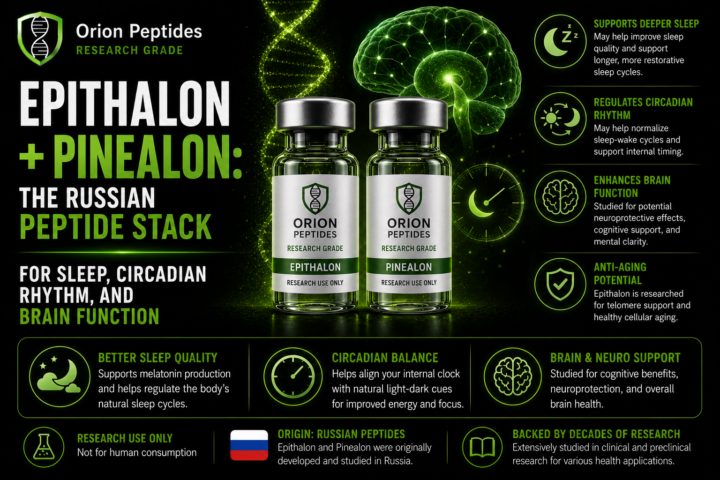
Epithalon + Pinealon: The Russian Peptide Stack for Sleep, Circadian Rhythm, and Brain Function
Epithalon and Pinealon are two of the most frequently discussed—but least understood—peptides in longevity and neurobiology research. They’ve been studied for over 40 years in Russian research programs, yet much of the literature has never been fully translated into English, which is part of why they remain under the radar in Western discussions. Together, they are often described as a complementary system: - One targeting circadian timing and pineal function - The other targeting cortical and neurochemical support But to understand why they’re paired, you have to start with where the research began. Origins: Leningrad, 1980s In the 1980s, researcher Vladimir Khavinson at the Leningrad Institute was tasked with studying biological aging in high-demand military personnel, including aging soldiers and submariners. His team discovered that extracts from bovine pineal glands appeared to restore certain biological rhythms in aged animal models. When administered to older animals, researchers observed something unexpected: - Restoration of endogenous melatonin production - Improved circadian rhythm regulation - Improved physiological resilience markers This led to the development of a synthetic peptide derivative: 👉 Epithalon (Epitalon) — a 4–amino acid peptide derived from pineal gland research. Later, a second peptide was developed with a more brain-focused profile: 👉 Pinealon — a tripeptide designed for neurocognitive and cortical support. The Pineal Gland: The Body’s Timekeeper The pineal gland regulates the body’s internal clock through melatonin production. Melatonin is not just a “sleep hormone.” It also plays roles in: - Circadian rhythm regulation - Immune modulation - Cellular repair cycles - Antioxidant activity However, the pineal gland undergoes age-related changes: - Progressive calcification - Reduced signaling efficiency - Declining nighttime melatonin output By later adulthood, melatonin amplitude can be significantly reduced compared to earlier life stages.
1 like • Jun 24
is it true to run a round of fox04 before epi
Jun 22 •
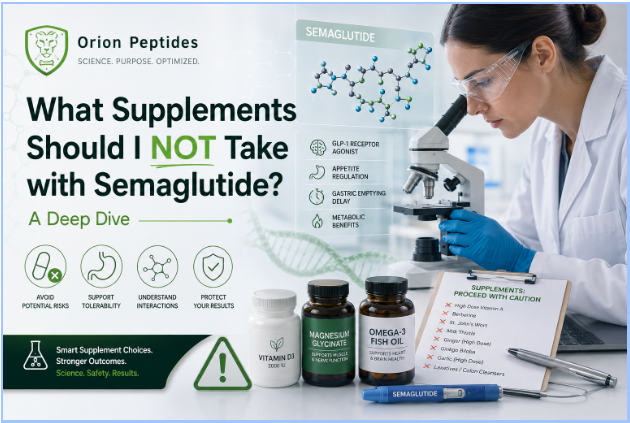
𝐖𝐡𝐚𝐭 𝐒𝐮𝐩𝐩𝐥𝐞𝐦𝐞𝐧𝐭𝐬 𝐒𝐡𝐨𝐮𝐥𝐝 𝐈 𝐍𝐎𝐓 𝐓𝐚𝐤𝐞 𝐰𝐢𝐭𝐡 𝐒𝐞𝐦𝐚𝐠𝐥𝐮𝐭𝐢𝐝𝐞? 𝐀 𝐃𝐞𝐞𝐩 𝐃𝐢𝐯𝐞
Hey everyone, So, you’ve started or are considering starting semaglutide. Maybe you're getting it through a clinic, or maybe you're one of the many who have turned to research peptides to help with weight management. It's a powerful tool, but I've seen a lot of questions pop up about what you can and can't take with it. In the quest for optimal results, it's easy to think that stacking more supplements will just speed things up. But the reality is, that semaglutide is a potent compound, and combining it with the wrong things can lead to some seriously nasty side effects or even render the medication less effective. I wanted to put together a comprehensive guide based on the research I've been doing. This isn't medical advice—this is just the result of many hours of reading studies and clinical data, and I want to share it with the community to make sure we're all doing this safely. Remember, when we talk about handling research compounds, knowledge is your best defense against a bad time. Let’s get into it. The Golden Rule: The "Empty Stomach" Mandate Before we even talk about specific supplements, we have to address the elephant in the room regarding oral semaglutide (like Rybelsus). If you are taking the pill form of semaglutide, the timing of everything you put in your stomach is critical. Semaglutide is a finicky peptide. For it to absorb properly, it needs an empty stomach. Studies show that taking oral semaglutide with food or other oral medications significantly alters its absorption. In fact, participants who ate just 30 minutes before taking it had "limited or no measurable semaglutide exposure," while those who fasted had measurable levels . The absorption and peak concentration in your blood can be about 40% higher if you take it on an empty stomach . This means that if you take a fiber supplement, a multivitamin, or any capsule at the same time as your Rybelsus, you are essentially throwing your dose down the drain. You must take oral semaglutide first thing in the morning, 30 minutes before your first food, beverage, or other medications, with no more than 4 ounces of plain water .
0 likes • Jun 23
Ryan good info, so iam on reta and taking berberine daily so stopping it correct
1-10 of 12

@albert-lancellotti-3371
66 years young love lifting, boxing, and supplements
Active 4h ago
Joined Jan 5, 2026