Activity
Mon
Wed
Fri
Sun
Sep
Oct
Nov
Dec
Jan
Feb
Mar
Apr
May
Jun
Jul
Aug
What is this?
Less
More
Blackburst AI
8 members • Free
Build Market Close
321 members • Free
Hermes AI Business Mastery
177 members • Free
Clief Notes
45.8k members • Free
AI Workshop Lite
49.6k members • Free
AI Automation Agency Hub
332.6k members • Free
330 contributions to Clief Notes

May 19 •
COMMUNITY COMPETITION MEGATHREAD 🏆
📣 Update (8/3/26): Comp 10 Rules Added, Submissions Due by 8/8 11:59 PM, Winner Announced 8/15 --- What this thread is: I’ve seen a number of people either not know competitions are going on or know how to find them so here is a quick single source thread where you can get to them all. I’ll keep this updated as new challenges are released. See the current challenge as well as all past challenges below! Format for community challenges: https://www.skool.com/cliefnotes/how-competitions-work-from-now-on?p=84912d60 Weekly leaderboard competition: Alongside the biweekly challenges, there is a weekly leaderboard challenge where the member at the top of the 7 day rolling leaderboard wins a free upgrade to their membership. This winner is announced on Mondays typically. @Joshua Hubbard has gone another step further and created a thread linking to all competition entries. Link here: https://www.skool.com/cliefnotes/the-competition-archive-every-entry-every-week-every-link?p=bd752987 --- Current Challenge: Competition 10 The Challenge 💪 - Build a full folder-based diagnostic auditor that tells you why something is broken. Rules & submissions 🗒️ - https://www.skool.com/cliefnotes/weekly-comp-10-the-diagnostician?p=367505f3 Good luck everyone! --- Past Challenges Competition 1 The Challenge 💪 - Build a brand voice document for a pet grooming business Rules & submissions 🗒️ - https://www.skool.com/cliefnotes/first-ever-weekly-competition-is-live?p=90f50bf9 Results🏆 - https://www.skool.com/cliefnotes/weekly-comp-1-winner-ian-barriopedro?p=0501b57e

0 likes • 20h
@Conor O Driscoll what’s cool as you get to see other people’s work so if you’re doing the competition yourself, you’re going through the same process they are and then you can look at the gaps between what people who did a better job than you did and see where your gap is and fill in the blanks by looking at everyone else’s submissions
0 likes • 6h
@Anthony Brady VIP /Premium gets access to every entries evaluation of the submission so you see where it failed and what worked.
4d •
The Lyceum
Anyone else getting pumped? I know I am. Mission Control setup and ready for countdown

1 like • 13h
@Nathan Smith cool I will jump on it.
1 like • 11h
@Carlos Rojas Ortiz Usually it ends in a steer towards Shopify.

👑
2d •
LangChain finally on the folder train
Saw one of the software engineers on the agent team post this today. Thought it was nice to see them finally seeing the light

0 likes • 16h
I bought the domain agentsasfolders.ai and .com.
0 likes • 16h
My most viewed and responded post in Clief Notes.
Jul 2 •
Agents as Folders.
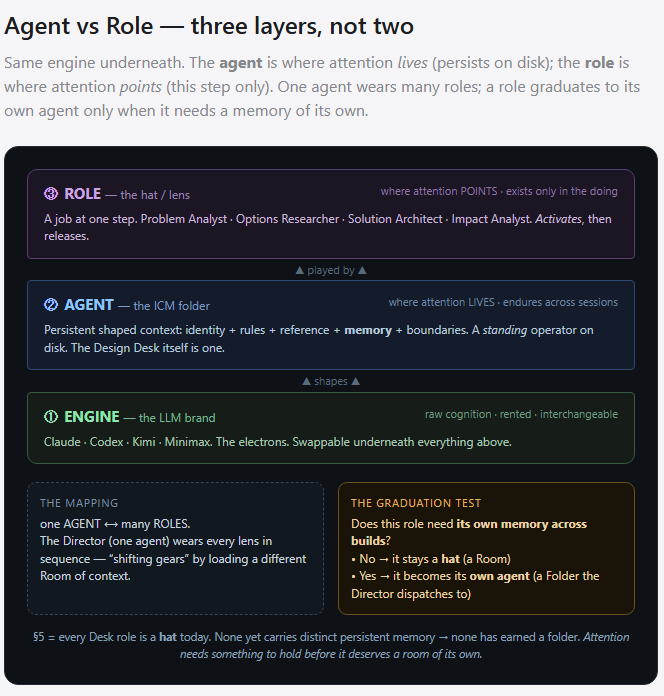
Recently a lot of excellent community discussion around how to ICM, largely because that’s the foundation but also refocused due to @Bas Rosario’s Post on ICM as building a Cake. Having experienced rapid growth in my past, one of the hardest things to do is keep language and definitions aligned. If I say the Agent did this, where does your brain go? Lines get crossed because you have so many levels of understanding and perspective. Some people are coming from non-technical backgrounds and have learned through corporate ai marketing. Others coming from corporate environments where language is defined for them by the management and designers building their infrastructure. Mini cultures with their own language. One of the brilliant aspects of ICM is it's commonality with almost anyone on a computer. It's just a folder, from that foundation we can all get on board. What's difficult is what happens next. I had this conversation with claude during a planning session. Claude asked me did I want agents or roles? I responded back by did he mean an agent like claude or codex, which is really an LLM, a purpose built agentic piece of software that the market tells me is an agent that does stuff? Or a folder acting as an agent with a specific role. I didn't know what the underlying meaning implied, how to answer? So I asked here was the response. 1. Engine — the LLM brand (Claude, Codex, Kimi, Minimax). Raw cognition, rented capacity, the electrons. Interchangeable. 2. Agent — the ICM folder. Persistent shaped context: identity + rules + reference + memory + boundaries. A standing operator that exists on disk and endures across sessions. This is your "folders hold attention" — an agent is where attention lives. 3. Role — a lens/hat: a function performed at one step of a process. It exists only in the doing. Where attention points right now.
1 like • 27d
@Jose Guerrero Yes I am drinking from the firehose right next to you.
0 likes • 16h
Update: I am now the proud owner of agentsasfolders.com and agentsasfolders.ai

17h •
What do you do when waiting for prompts to come back?
A pad of scrap paper beside the keyboard has done more for my throughput than most of the tooling I changed this year. The minutes a model spends building are the minutes to spend deciding what happens after it lands. - The next sequence - the two or three work orders after this one, written while this one runs. - Notes on the output - what to keep and what to challenge, marked as you read rather than after. - Designs - page layouts, folder trees, flows. Faster to draw than to describe. The dead time in an agentic session is real. A job runs for a few minutes and there are three things you can do with that window: watch it, interrupt it, or think. Watching teaches you nothing and interrupting usually costs a rerun. Writing by hand does something a second chat window does not. The keyboard pulls you back into the work; paper keeps you above it, which is the seat you are supposed to be in while an agent is running. The reading half matters more than the planning half. Marking what to challenge as an output comes in, rather than reaching the end and reconstructing it, is the difference between a next instruction that corrects course and one that just says carry on. The bit I have not solved is getting any of it back into the system. Everything on that pad is orientation the workspace never sees. One of the synced writing tablets pointed at a folder would close that - handwriting arriving as context on the next prompt, and the notes logged as part of the record of how a build actually went. If anyone here has wired one up, I want to hear how. Genuinely think that is one of the more interesting unbuilt pieces sitting in plain sight...
0 likes • 17h
@Alex Brown I don’t right now. I will if I need to figure an idea out that is fuzzy. I get concepts that start to form across builds and learning that I need to flush out or I have a gap that I need to surface and work with, get unstuck. 1 Thing: I am not primarily a content creator. I don’t conceptualize content. I conceptualize systems first. I observe patterns and signals and build systems/solutions to those pain points, The content is an afterthought. I can see how a scratchpad would be more useful when building creating content.
0 likes • 17h
@Leonard Dauksza
1-10 of 330

Online now
Joined Aug 2, 2026
INTP
Powered by