Activity
Mon
Wed
Fri
Sun
Jun
Jul
Aug
Sep
Oct
Nov
Dec
Jan
Feb
Mar
Apr
What is this?
Less
More
Owned by Aziz
Insider tips, career hacks, and proven strategies to land interviews, offers, and build your professional brand.
Structured options trading for busy professionals. A framework, not a feed. Execution over speculation. Raise your calibre.
Memberships
Grow With Evelyn
2.8k members • $33/month
29 contributions to CALIBRE CAPITAL

1d •
New Trade Alert - 04-27-26
📈 NEW ENTRY — TSM (Taiwan Semiconductor) Bull Call Vertical Spread - Buy the 370 Call / Sell the 380 Call - Expiration: June 18, 2026 - Debit paid: $4.80 ($480 per spread) - Breakeven: $374.80 - Max profit: $520 per spread - Max loss: $480 per spread (your debit) - Stop loss: 50% of debit ($240) - The play: TSM is at $402 — already trading above both strikes. We're paying $4.80 for a structure that becomes worth $10 at expiration if TSM simply closes above $380. That's a ~7% cushion before we lose the thesis. We're not paying for direction here — we're paying for time. Semis still leading the tape and TSM is the tollbooth the whole industry has to pay. 📈 NEW ENTRY — MU (Micron Technology) Bull Call Vertical Spread - Buy the 450 Call / Sell the 460 Call - Expiration: June 18, 2026 - Debit paid: $4.80 ($480 per spread) - Breakeven: $454.80 - Max profit: $520 per spread - Max loss: $480 per spread (your debit) - Stop loss: 50% of debit ($240) The play: MU is at $496 — both legs deep in the money. Same logic as TSM: $4.80 in for a structure worth $10 at expiration if MU stays above $460. ~7% cushion. Memory demand is real and MU is the cleanest expression of it. ⚠️ Read this before you click: - These are spreads, not single calls. Profit is capped at $520 per contract — but so is your loss. - The most you can lose is what you put up. Period. - Cut at 50% of debit if the thesis breaks. Protect your powder. - Position size with discipline. Never bet more on one play than you're willing to learn from. - Don't copy the play if you don't understand the structure. Ask in the chat first. Trade wisely. Stay sharp. — Aziz
1 like • 11h
This is the updated price for TSM. MU is already extended so we will sit that one out.
1 like • 10h
@Diptiman Mitra June 18
20d •
VIAV 45 CALL $4.6 EXP 06/18
Ticker: VIAV - Viavi Solutions Position: $45 Call Expiration: 6/18 Entry: $4.60 Contracts: 1 (Total: $460) Current Stock Price: $41.11 Breakeven: $49.60 Thesis: Bullish continuation play — looking for upside momentum into mid-June. Needs a strong push above resistance to get ITM. Plan: - 🟢 Scale out near $49–$52 - 🔴 Cut if premium loses key support / momentum dies - ⏳ Time decay in play — watch closely into May Status: Holding — watching price action closely 👀
0 likes • 20d
@Soumaila Kone solid!
0 likes • 1d
Exited this trade on 04/24/2026 with a 93% return
12d •
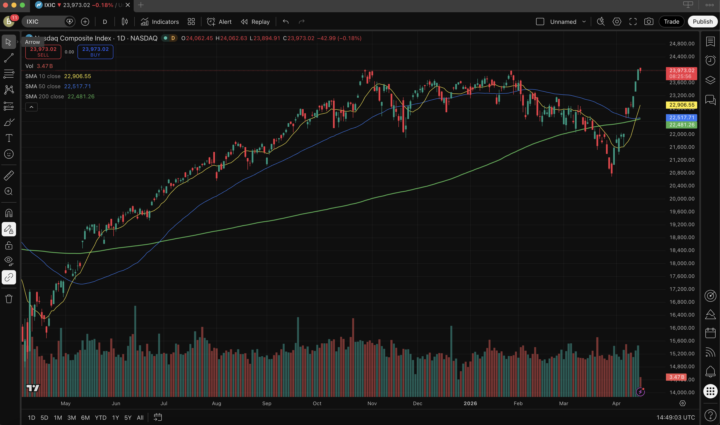
THE EAGLE EYE | Wednesday, April 16, 2026
WHAT THE MARKET DID THIS WEEK The S&P 500 hit a new all-time high yesterday at 7,022. Today it gapped down to 6,937 at the open, recovered to 7,040 intraday, and is currently sitting at 7,013. Look at the chart. That is not weakness. That is the market digesting a 3% weekly move. The Nasdaq is at 23,960. Down slightly from yesterday but look at the bigger picture. It recovered sharply from the March pullback and is pressing right into the resistance zone near 24,000. The 10 day moving average at 19,482, 50 day at 17,860, and 200 day at 18,547 are all well below us. The structure is intact. We are trading above every major moving average. The key SPX levels are clear. Resistance at 7,100. The 50 day moving average at 6,791. The 200 day moving average at 6,679. As long as we hold above those moving averages, the trend is our friend. Two things drove this week's strength. Earnings season opened and the banks came out swinging. JPMorgan posted $16.5 billion in profit, up 13% year over year. Citigroup grew net income 42%. When the big banks print numbers like that, capital moves into risk assets. That benefits everything on our Watchlist. Second, the Iran situation is cooling. Markets fully recovered from the March war scare. Traders are now pricing in a potential peace deal. The environment is favorable. That does not mean it is forgiving. THE ACTIVE PLAY MNST (Monster Beverage) $80 Call | Entered at $2.20 | Expiration June 18 MNST closed yesterday around $74.66. We are below our strike. Two months until expiration. The Runway Rule gives us until mid May before we need to make a decision. No panic. The thesis has not changed. Monster has consistent earnings growth and brand dominance in its category. We have time. That is the whole point of how we trade. But we are watching this one closely. If MNST does not show momentum toward $78 to $80 in the next two to three weeks, we reassess. WATCHLIST SCAN The semiconductor and AI infrastructure names are leading this week.
19d •
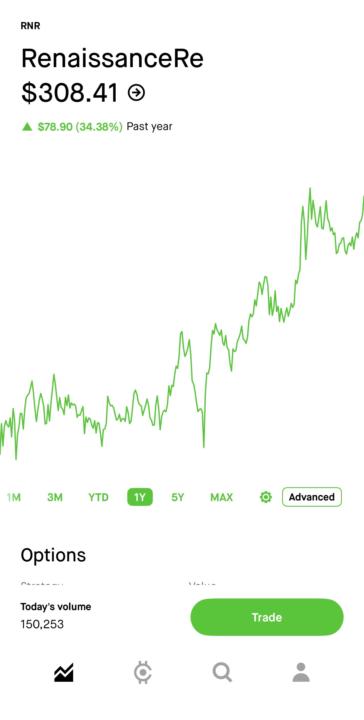
THE LIQUIDITY TRAP: A $570 Lesson You Need to See
Lab members, let me show you something I don't see enough people talk about. Everybody teaches you about calls and puts. Strike prices. Expiration dates. Greeks. But almost nobody teaches you about what happens when you're ready to sell and there's no one there to buy. That's a liquidity trap. And I walked right into one. THE SETUP I had 3 contracts on RNR. Calls. Paid $1.90 per contract. Total investment: $570. The app showed a "market value" of $3.00 per contract. On paper, that's $900 sitting in my account. Looks fine, right? Now look closer. THE REALITY The bid was $0.00. Not $0.10. Not $0.05. Zero. No buyers. The open interest dropped to zero. The ask was $0.30 with 9 sellers, meaning other people were also trying to get out and nobody was buying. That $900 market value? It's a number on a screen. You can't deposit a number on a screen. WHY IT HAPPENED RNR was trading at $307. My breakeven was $351.90. The contract was deep out of the money with 9 days to expiration. Time decay had already eaten 99% of the value. But the real killer wasn't the direction or the timing. It was the fact that this contract had no participants. No volume. No open interest. No market. WHAT THIS TEACHES YOU When you enter a position, you're not just betting on direction. You're also betting that someone will be there when you want to exit. If that second bet fails, nothing else matters. Before every entry, check three things: 1. Volume on that specific strike and expiration. Not just the stock's volume. The contract's volume. 2. Open interest. This tells you how many contracts are actively held. Zero open interest means you could be the only person in the room. 3. Bid/ask spread. A tight spread ($0.05 to $0.10) means healthy liquidity. A wide spread (or a $0.00 bid) means you're walking into a trap. This is especially important for longer dated contracts. The further out in time you go, the thinner the liquidity can get on certain strikes. Stick to strikes near the money on high volume names. That's where the participants are.
0
0
20d •
🎓 WHAT IS A SYMPATHY PLAY?
A sympathy play is when you enter a stock because another stock in the same sector is already moving on a catalyst that benefits the entire group. Simple example. Oil drops. UAL jumps. You look at DAL and realize the exact same catalyst applies. Same sector. Same fuel cost relief. Same demand strength. That is a sympathy play. You are not picking DAL because of DAL. You are picking DAL because what is driving UAL also drives DAL. WHY IT WORKS When a catalyst hits an entire sector, the market does not price every name at the same speed. The leader moves first. The rest follow. If your thesis is sector-wide, the followers give you a second entry point. THE RISK Sympathy plays can fade faster than the primary name. If the catalyst weakens, the leader tends to hold up. The follower gives back gains first. That is why you size the sympathy play equal to or smaller than the primary. Never bigger. HOW WE USED IT TODAY UAL was the primary play. Ceasefire news dropped oil 13%. Airlines benefit directly. UAL moved first. Then we looked at DAL. Same thesis. Same catalyst. But DAL also beat earnings this morning, owns a refinery that hedges fuel costs, and has an AmEx partnership generating $8.2 billion in revenue that does not depend on seat demand. The sympathy play actually had stronger fundamentals than the primary. That does not always happen. But when it does, you pay attention. Eyes open. Moves calculated. Aziz | EagleTrade Educational purposes only. Not financial advice.
0
0
1-10 of 29

Active 4h ago
Joined Feb 10, 2026
Powered by