Activity
Mon
Wed
Fri
Sun
Dec
Jan
Feb
Mar
Apr
May
Jun
Jul
Aug
Sep
Oct
Nov
What is this?
Less
More
5 contributions to Daily Email House

9d •
Calling in favors
Over the weekend, I got a nice bundle of new subscribers, via my upcoming Monetization Case Study presentation optin, from Kieran Drew. I had promoted a new lead magnet of Kieran's back in spring. I now asked him to promote tomorrow's presentation in turn. Some time this week, I'm expecting Csaba Borzasi to send me some of his readers. Last week I promoted a lead magnet of Csaba's to my list. That list swap came on the back of a 1-1 email a few weeks ago in which I sent Csaba a link to an offer that was similar to an offer he is thinking of creating, and which I thought might be interesting for him to see. In the next few days, I expect Liz Wilcox will send me some readers as well to the same optin page. Liz ran an affiliate contest earlier this year. I participated and won. The prize was a solo ad in Liz's newsletter of 30k readers, which I didn't use until now. Here's where I'm going with this. A couple weeks ago, I interviewed @Tom Render on the topic of cold outreach, which he has had a lot of success with. Tom has a lot big clients and makes a lot of money, so I asked him if he still does cold outreach. He replied: === Yeah, I do it. It depends. I would say, right in this phase, I'm more building relationships. Like this call, right? If I decide later this year or next year, I'm going to come out with a copywriting course, you're at least going to give it the time of day, to look at it, because we had this call. Whether you actually promote it or it's a completely different question. It might depend on the quality, but you're going to give it the attention, right? And so I'm sort of always digging the well, because why would I not be? === It's nice to have favors to call in, like I've been able to do to get more people onto my presentation tomorrow, and like Tom will be able to do with me, if he ever decides to create a course. Maybe you don't have any favors to call in. Yet.

5 likes • 9d
Can never have too many people owning you a favour 😎. But that means giving generously first.
15d •
Different kinda mechanism for info sellers
Case study: Earlier this year I started working with a list owner to help him make more money from his list. He was making on average $2,200 per month from a list of over 6k people ($2,500 per month was a good month). I told him he should be making at least $1/subscriber each month, eg, over $6k per month from his list. He asked if I could help him get there. I was confident I could. And so I made him the following offer (verbatim): === * We work together for a year * Since you're already averaging around $2,500 per month, we set that as the baseline, and everything up to $2,500 is yours each month * Over $2,500 we split it 75/25, with 75% going to you and 25% going to me * A $3,100 one-time fee to get started * After the year is up, you don't owe me anything, and you get to keep 100% of your email revenue === He responded to say, "Unsurprisingly, it's a fair and viable model." He paid me the $3100 upfront and we've been working together since. (He's been over $6k for the past 3 months, and paying my share of it.) I realized this morning that this deal — "pay me something and after that I consult you on commission" — is not just payment terms. It is also a UNIQUE MECHANISM. If you sell information, you might think that your unique mechanism must be baked into the information itself. Some secret technique... or a proprietary 5-part S.Y.S.T.E.M. that can be abbreviated into an acronym. It certainly can be. But it doesn't have to be. Another type of mechanism (at least if you sell information) can be HOW your customers learn, not WHAT they learn. My deal above is an example of that kind of unique mechanism, when it comes to consulting. Can you think of other examples of this? I've got two other examples in mind. One is from my own offers... another is from a recent post in this community. Can you guess what they are?
2 likes • 15d
@John Bejakovic Haha. Thanks. I might have to use that as my tagline somehow... Fyi, this works well with royalties too. Especially if things didn't go that great. Rather than getting ditched, let the client use the royalty as credit to hire you again for something else. They paid $20k for a sales letter. But your royalty is only $5k cos it didn't do that well. Let them use it as credit to write a new one for $15k, rather than begging to fix the letter for free or something horrible lol. Only do that if you're confident you'd do better next time though.
1 like • 15d
@John Bejakovic I think it works by aligning incentives, and rolling those one into the other. I can get a $20k sales letter. And when the $20-40k royalty roles in, let them use that against my $150k/year fractional CMO offer etc... Every time you make a win, you double dip on bigger packages :). Profit shares from Fractional CMO roll into share options etc...
20d •
[Solved] How to evaluate business opportunities
I am an opportunity seeker, in the most miserable sense of the term. I got started in high school, by responding to classified ads in the back of the local newspaper. I then followed the bizopp advice of online gurus... I bought courses... I invested in software because I thought it was the future. I keep looking for hot new things, secrets, and shortcuts. I've spent tens of thousands or possible hundreds of thousands of dollar chasing various business opportunities. It almost never works out. Sometimes it does. In fact, on a few occasions it's worked out so well (getting into copywriting, starting my own email list, creating info products) that it's allowed me to survive and even thrive. It's the reason I'm able to be here right now, writing you. Thanks to the many decades of my opportunity seeking, I've come up with 3 questions that help me evaluate new business opportunities these days. I am willing to tell you what these 3 questions are. I am wanting to tell you. I am WAITING to tell you. Except, I know from previous experience that if I just tell you, nothing much will come of it. So I'd like to invite you to think for a moment. What are some questions you might ask yourself to evaluate a business opportunity? Write them below. There are no wrong answers. If your question matches any of my questions, I'll let you know. And one way or another, if there is engagement enough and different questions enough, I'll gradually share my own business opportunity evaluation questions as well, even if nobody comes up with the exact same ones. But if folks aren't very interested in this... I am fine putting these back into the Bejako Trunk of Valuable Ideas to Keep for Myself. [Update: This riddle has been answered. You can find the answers below among the comments. But before you get to those, it makes sense, for your own benefit, to think about how you would answer this riddle. It's much more likely to stick in your mind in that way and to be useful to you in the future.]

4 likes • 20d
Would this be easy to do? Or the opposite, how easy would this be to mess up and see no results.
28d •
$100 contest: Reasons to be cheap
Today, a biz owner whose emails I read sent out an email that opened with: "This email is for you if you want quality help on [achieving business outcome] but don't want to commit the [lotsa shekels] that top-shelf collaborators charge." I winced at this. The fact is, this guy is a legitimate expert, who deserves to get paid based on the business value of his services, and yet here he is, leading off the pitch for his new offer by saying, "It's cheap relative to what you might expect." I think there's a lot of value in raising your prices. I think it can even make sense to be the most expensive in your field. Sometimes, on occasion, it can still make sense to offer something at an "attractive" price. But in that case: 1. I don't think it makes sense to lead off with that. Instead, it makes sense to first and foremost fully sell the "quality help" that this biz owner only got to later, and to emphasize that before appealing to cheapness. 2. It makes sense to give a legit public reason for the "attractive" price, and that reason can never be "I am doing it because I'm afraid you won't pay the going rate for this," even if that is part of your private motivation. I wonder if we can come up with a list of such reasons. I'd like to invite you to think for a moment, and comment below with one or more reasons you could use to justify a particularly "attractive" price, which is lower than the going rate for whatever it is that you sell. I'm inviting you to do this for two reasons: 1. Because if you do it now, there's an excellent chance you will remember this important lesson, and you won't make the same mistake this biz owner made in his email today. 2. Because I'm running a little experimental contest. The last person to comment on this post wins $100, which I will PayPal to you in case you are the winner. How do we determine the last person? I will come back to this post periodically and check the comments. If when I come back, there have been no new comments with a reason to be cheap FOR A WHILE... then then last commenter will win and I will announce the fact.
1 like • 27d
@John Bejakovic Ha, probably. Every old school marketer has a retirement sale at least twice.
2 likes • 27d
Because they're a repeat customer, reward loyalty.
Apr 26 •
Enforcement is key
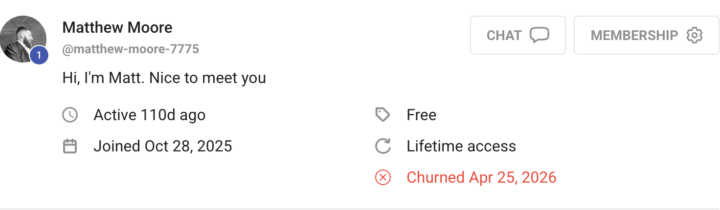
Yesterday this group had 483 members. Today it has 474*. Over the past 24 hours, I've removed 10 people from this group, following up on this discussion on written rules. As proof, I am attaching 10 "churned" profiles of former House members, with yesterday's churn date. I'm not holding up these removed ex-members to shame them. I have nothing against them personally. But rules are rules, and Daily Email House has its rules. As a few people commented in the discussion I linked to above: Enforcement is key. No sense in having rules if you're not going to enforce them. I'd also add, not only is enforcement key... but public enforcement is key. Yeah, maybe somehow you project a different vibe if you have rules and you stick to them in private, behind the curtain, where only you and the person you're dealing with are privy to what went down. But it helps the objective of the rules massively if you make a public showing of enforcing rules. That way, the rules don't just punish the transgressors, but are a reminder and an encouragement and even a reward for everyone else who did not transgress. This doesn't apply to just kicking people out of communities for not engaging: - It's the same thing with deadlines for your promos to your email list - It's the same when dealing with disrespectful readers or clients or partners - It's the same for turning someone away from your offers, because he or she is not going to get value out of those offers, and you've set a policy for yourself to not sell to people like that In each case, enforcement is key... and public enforcement is the Golden Key. (*) Daily Email House yesterday had 483 members... minus the 10 members I removed makes 473... and yet the group now has 474 members? A few days ago, I finally filled out the necessary fields to make this group discoverable via the Skool discovery network. Today a dude found Daily Email House via Skool, and asked to join.
2 likes • Apr 27
@Britt Malka @Chris Dyson I'd be careful with this, cos I've gotten a few of these 'you're not active' sequences from people, yet I read their emails every day. Email tracking, currently, is woefully inaccurate. So you might be deleting people who want your emails. I'm not sure if there's a good work around/set up that actually can track things, maybe there is. But just thought I'd give the heads up.
1-5 of 5
Active 2d ago
Joined Dec 20, 2024
Powered by