Activity
Mon
Wed
Fri
Sun
Nov
Dec
Jan
Feb
Mar
Apr
May
Jun
Jul
Aug
Sep
Oct
What is this?
Less
More
Chess Courses by RCS
4.5k
$1
Chess Master School
4.3k
Free
14 contributions to Chess Master School

Sep '24 •
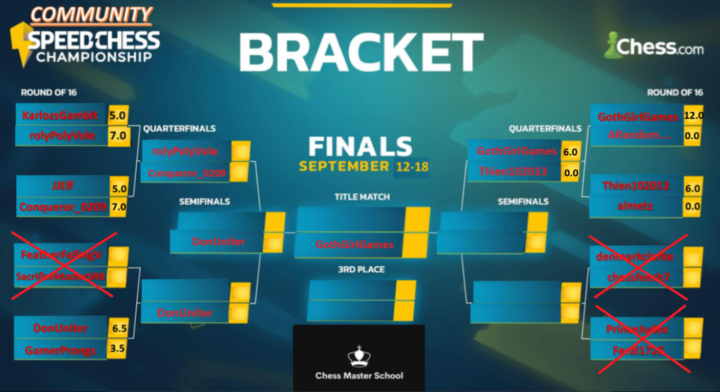
COMMUNITY SCC (UPDATE 10)
Hi guys, yesterday we started playing Quarter-finals!!! Due to a lack of participation from some of the competitors, the bracket is a bit modified.. We are deeply sorry this happened, despite the great effort we put into this event. Anyways, here's the result of the first Quarter-final: @Jennifer Strandqvist 6.0 vs @Thien Vo 0.0 (FORFAIT) LINK FIRST MATCH: https://www.chess.com/game/live/118632525535?username=gothgirlgames

6 likes • Sep '24
Oh my, that is not good. Would say it worth to ignore round of 16 then. The matches on the left was very close. Maybe KarlozsGambit and JJElf could be moved to lower-right quarterfinal for a second chance.
0 likes • Sep '24
Alright... guess it safe to say the event got canceled then. Congrats to the four winners 😉👍

1 like • Aug '24
so they managed to move from and to every square, but not b6

Aug '24 •
Need help with calculation
Hi! I use the "checks, captures, attacks" method but more often than not i'm still left with an overwhelming amount of possible moves and lines, not to mention how deep to actually calculate a line beyond the very forcing moves etc. Does anyone (particularly more advanced players) know about a more efficient method? How did you improve? Thanks for the replys in advance
0 likes • Aug '24
Nobody really calculates everything, so practice to guess what opponent will do and focus on that. Then analyze the games to both catch how close your calculation was to being correct if they played on the side you expected, and what motivated their moves if they played somewhere you didn't expect them too. You want to build up the experience and knowledge base of what kind of moves to calculate. Checks, captures and attack is fairly short term and good start to not blunder the game away or miss punishing the same for your opponent. Then you want to look at where you both are strong and the differences in your positions. Most principles will set you up for that. Then if you learn a opening properly they mostly come with a strong idea of this, if they somehow don't you can use the rule of playing in the direction your pawn-chain points. If there is no pawn-chains to follow, the center should be open and wild enough to be where the play is at. Don't bother with the tactics in this regard in the opening, it better to lose to one now and then and remember it to the next time and try to calculate it out each time. Lose and learn, just make sure to look at it afterwards so you really do know to not do that particular thing next time. But we can't stop and calculate or refuse to take a gambit or such, let your opponent show you instead.
Aug '24 •
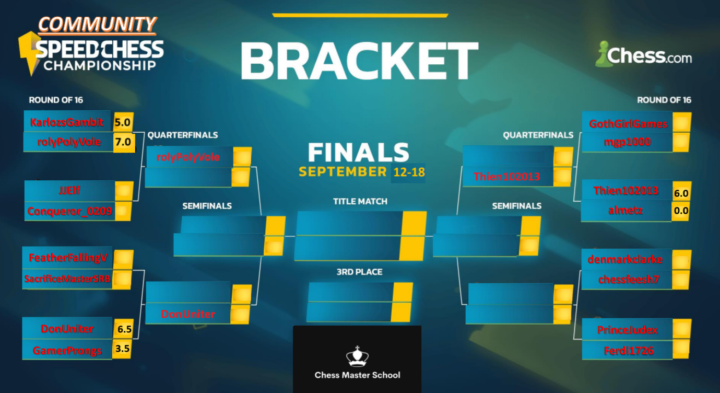
COMMUNITY SCC (UPDATE 7)
Hi guys, other two R16 have been played!!! @Thien Vo 6.0 vs @Angela Metz 0.0 (FORFAIT) LINK FIRST MATCH: https://www.chess.com/game/live/118326518107?username=almetz @Gamer Prongs 3.5 vs @Juan David Padilla 6.5 (FORFAIT) (First 3|2 game doesn’t count for the result) LINK FIRST MATCH: https://www.chess.com/game/live/118330727339?username=gamerprongs
3 likes • Aug '24
Congratulations, as a sidenote my opponent hasn't responded to me reach out or reached out themselves. 3½ days left so no worries but just in case it comes down to having to debate walkover.
1 like • Aug '24
So starts today? and are we done here in terms of these threads and updates? are the rest of the event happening in the event group or through DMs for example.
1-10 of 14

@jennifer-strandqvist-1827
Sweden-USA
Lose and learn
Better day by day
2000ish Chess
2600 blitz
2400 rapid
Active 335d ago
Joined Jul 24, 2024