Activity
Mon
Wed
Fri
Sun
Jun
Jul
Aug
Sep
Oct
Nov
Dec
Jan
Feb
Mar
Apr
May
What is this?
Less
More
Memberships
Clief Notes
26.8k members • Free
46 contributions to Clief Notes

Apr 4 •
🏁 The Archive 2.1 Check-In
After watching the Flagler workshop and reading the companion: Vote below, then tell us in the comments: where did you land on the PhD thought experiment?
Poll
53 members have voted

0 likes • 35m
For me it’s less about the specifics right now and more about the bigger shift. The ceiling we used to aim for is now the floor we’re all standing on.
Apr 4 •
🏁 The Archive 1.2 Check-In
After reading the full history of thinking machines: Vote below, then tell us in the comments: which part of the timeline surprised you the most?
Poll
57 members have voted
0 likes • 2h
Cosmic rays got me. Chaos can hit at any level, any time. Is bit flipping something the system accounts for, or is it just pure randomness you absorb?

Apr 1 •
Good news
This course set me up with the knowledge. One of my clients is picking up 10 seats of Claude enterprise and I’ll be leading the team on how to get set up correctly for the long term. Cheers. Let’s hope this is just the beginning!
1 like • 14h
Great news on the project @Alexander Paschka What friction have you encountered thats aided understanding?
2 likes • 13h
@Alexander Paschka hear you loud and clear. Look forward to hearing more with your updates.

15h •
Using the folder system to build Elementor pages in WordPress
Here's how we build new pages for client's now. Takes about 25% less time. First: an interview. We get the client on a call, follow a structured intake, get everything we need. Claude ingests the transcript and maps the requirements — buyer, intent, conversion action, messaging priorities. That's the foundation. Then Cash, our copywriter agent, writes the copy. Then Ruby, our front-end designer, takes the copy and the client's identity system and builds a clean HTML/CSS mockup. We hand it to the client. They give us feedback. We collect assets — photos, logos, screenshots. Then Cody. Cody has access to the Elementor JSON templates our human designer originally built for this client's site. He reads the approved HTML. He generates a new JSON file in the same structure — same design system, same component logic, same brand patterns. We import that JSON into Elementor. The page is 90% built. The humans still do the review. The humans built the original templates. The humans ran the interview. But the production time? It collapsed. Jake's folder system didn't replace the agency. It restructured where the human work actually lives.
1 like • 14h
@Curtis Hays how are the agent handoffs managed? And is Cody actually connected to Elementor, or just working from exported JSON?
2 likes • 13h
@Curtis Hays 315 lines and half is folder map. How’s it held up? Many pain points with so many moving parts?

3d •
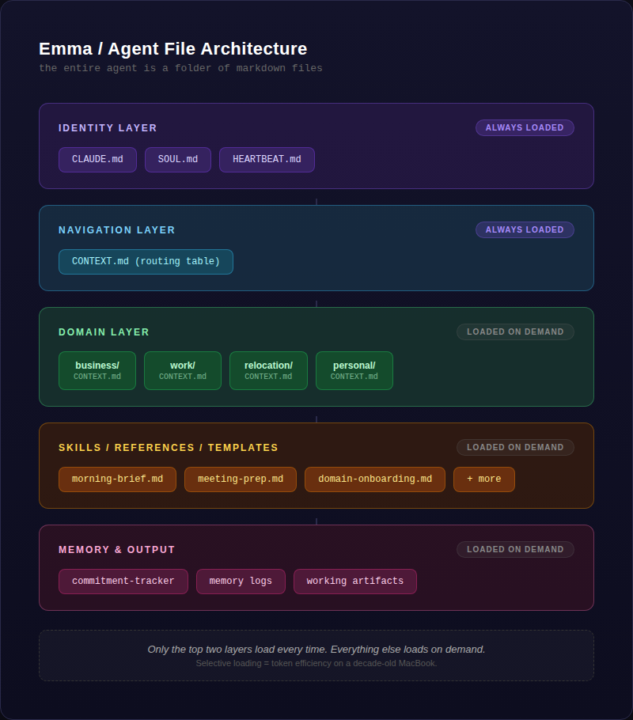
Built an always-on AI Chief of Staff that texts me.
I've been in this community for about a month now and wanted to share where things stand with one of my builds. This isn't polished by any stretch. I do have a few other workflows like content-creator, document-creator, but I needed something to help me navigate my day-to-day as I begin a couple side quests outside my normal 9-5. The goal was simple: I didn't want another chat window I have to remember to open. I wanted something that knows my priorities, reads my calendar, checks my email, and texts me when I need a nudge. Not a chatbot, more like a Chief of Staff. And the goal is to operate within the bounds of the subscription with no extra costs, while also maximizing token efficiency. The other thing I didn't want to do is implement an orchestrating harness yet (OpenClaw, Hermes, etc). The challenge for myself was to keep this as simple as possible without inflating scope. Someone in this community said once: 'constraints are just as, if not more, important than your requirements. What do you NOT want your build to do?' I've definitely taken this to heart in my workflows. ## Planning I've made a few posts about this in comments, but I cannot stress the importance of planning before you build. My method was simple: - First I brain dumped context via voice dictation and transcribed this. Simple tools: VoiceMemos, copy, paste. - Next, I worked through the planning phase with the chat function of Claude in Opus 4.6. I wanted pushback, challenge, and for the model to force me to think deeper and keep me honest. This produced the product requirement document, or PRD. This was a multi-day process (a week?) in my free-time. - For the architecture build, I used Cowork. Handed it the PRD, answered a few basic questions, and then it went on it's way. Got it uploaded to a private git repo. - Currently, I'm working thru further debugging and walking thru the checklist within the PRD in a phased approach. As you'll see below, I have setup a remote screenshare so I can also let Cowork see what I'm doing. This was the most essential because we work TOGETHER to make things happen. it's like working side-by-side with my developer and engineer.
1 like • 20h
@Justin Solomon Do the work for you - once I realised how capable it was with me at the helm, that was a real aha moment. Curious what mechanisms you have in place to capture changes and errors?
1 like • 14h
@Justin Solomon If it fixes itself, don’t fix it. Which model handled the error tracking setup and was that in the PRD or figured out as you went?
1-10 of 46

@andrew-carter-8893
Ideas to execution with AI 'factories'. Turning theory into practice with build, iterate, refine, learn.
Active 3m ago
Joined Apr 20, 2026
Powered by