Activity
Mon
Wed
Fri
Sun
Aug
Sep
Oct
Nov
Dec
Jan
Feb
Mar
Apr
May
Jun
Jul
What is this?
Less
More
Memberships
Rebel Economist (Free)
1.4k members • Free
Goto: academy.cxotransform.com
1.4k members • $10,000
21 contributions to Rebel Economist (Free)

Sep '25 •
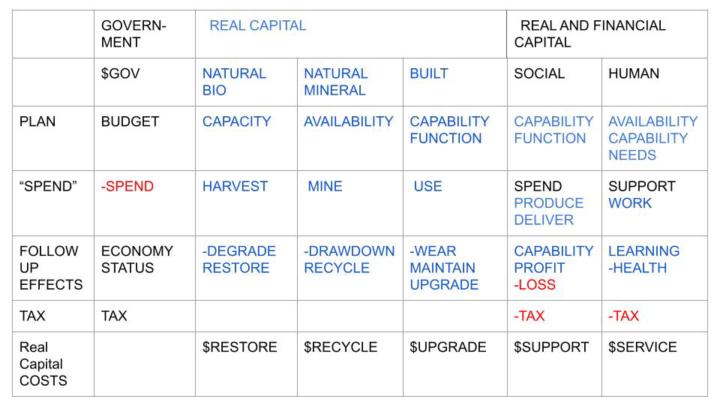
Combining MMT and Real Capital thinking in one table
I'm going to run through my thinking here and it will be rough, so please excuse that. I have a hunch (Nordhaus) that this may be a productive edge to explore, and welcome your thoughts. If follows on from @Steve Keen s presentation to Jeremy Corbyn, where it opens up for spending on that which is important and needed, this gives a framework to do it (rough I know but small beginnings). The table runs left to right. Black is money, Red is liability, blue is real capital, increasing or decreasing (with a - sign). It represents the government budget. You will need to know the basics of real or multi-capital to get this. https://stephenhinton.org/2024/01/28/real-capital-an-explainer/ The first column is the national budget, planning to spend first and then get back all or some via tax (MMT), The last two are mixed real and financial - social capital is organisations, and these all have financial identities that pay tax on their operations, as well as get gov, benefits/contracts, Human capital is people with social identity numbers who get benefits and pay tax and are employed in social organisations. So we have represented the money side of things. However, the national budget expects a use of real capital - biological like wood, food etc and mineral. This is processed in the built capital. You can see already that national accounts do not take into the real capital capacity available, or the drawing down effects of the operations of the social capital, the organisations. At the end of the year (effects) there will be an economic status of the government account, but also the social capital (GDP). However, there will also be status of real capital - soils and forests degraded by harvesting, mineral reserves down, by mining, and of importance, the effects of economic stress on the human capital. This is where MMT comes in. It would be better to, when producing national budgets, to include a real capital focus. You could demand of firms that they declare their real capital impacts per dollar of operation. You could factor in economic stress and budget to minimise it. There are a lot of things you can do if you see it this way,

2 likes • Sep '25
This is really getting there. Feels as though it is close to being a practical tool for decision making. Have you tried putting dynamics behind the table?
Aug '25 •
Now Richard Murphy goes Multi-Capital
Highly recommended I comment his efforts on my Patreon Blog. Too much of policy is steered by economics thinking, which is glaringly not fit for purpose. I realised this whilst on Steve Keen’s Rebels course (highly recommended). The problem is, the way economists talk and act, it sounds like they are the best equipped to advise policy. Scientists have a way of presenting things in a non-actionable way. It seems I am not alone. Bringing Real Capital into accounting and the narrative, I hope a new breed of advisors emerges to provide better decision and policy bases. For my part I have worked out ways of valuing and quantifying real capital (I call it the Real Capital Framework). I am collecting all info I can on the multi-capitals, and adding my view. Some comments from my research on his video: a) A pile of money should never be called capital. Calling it financial capital is a misnomer. True capital is as said in the video: something used but not used up (like resources) but worn down without a flow of maintenance and spare parts. b) He did not mention metals (or stone) – I call them Natural Capital, and like the atoms used as the basis of life (C,H,N,P,Ca,O etc) they could be recycled if our production system was set up that way. They are finite too. c) social capital includes our institutions, and this is where accounting could come in more. We need our institutions to be financially stable and capable of delivering.. (Caring for our institutions). And we need them to possess the built capital that has the capability to be circular (that is caring for the Earth). d) I am really sensing a productive overlap between caring for people, planet and the concrete, measurable, rational demand for the minimum state of the capitals for that to be the case. e) When national budgets are made, there is an expectation expenditure will be balanced via taxes etc returning. There is an implied claim on the multi-capitals – often a drawing down of natural, social and human – to make that budget work. That is the link to MMT
1 like • Aug '25
The definition is really helpful with respect to your work. "Something I have now that when it flows (in the future) will increase my well-being." (My summary rather than word for word). Also key must be depreciation. There are some types of capital (e.g. machines) whose ability to generate flows in the future erodes with use. Also producing the beneficial flows may erode other kinds of (natural) capital (e.g. through emissions or other kinds of waste). But really useful contribution.
1 like • Aug '25
Found this... From https://www.ons.gov.uk/economy/environmentalaccounts/methodologies/principlesofnaturalcapitalaccounting
Jul '25 •
Economists are so stupid they ignore economic stress.
This is my latest article going out on a limb about MMT, national budgets, Human Capital and economic stress. And how to fit them to make policy advice better. @Alwyn Lewis @Demetrios Gizelis @David Madigan @Steve Keen https://www.patreon.com/posts/economic-stress-132303988?utm_medium=clipboard_copy&utm_source=copyLink&utm_campaign=postshare_creator&utm_content=join_link
0 likes • Jul '25
@Stephen Hinton it might be interesting to try to add a line for profit making companies and see how they contribute to the human and financial capital as well - e.g. participation on profit making provides income and well being (self-worth etc). You might need to include B Corp or Community Interest Companies versus exploitative profit making companies to show the differences in the impact on human capital of the different approaches.
Jun '25 •
How MMT, Sustainability and Economic Maturity fit together
Sometimes a simple explanation comes along.... A mature economy is one that, in its budget, it expects to deliver adequate services without drawing down natural capital (deforestation, ecosystem degradation, climate system degradation) or human capital (economic stress) or built capital (poor maintenance). MMT could facilitate this as the money should be there if the resources are. Please rebels check out this short video and let me know if I am hallucinating or not.https://youtu.be/fdZi1nbYPYU
1 like • Jun '25
@Stephen Hinton agreed...let me come back with some thoughts. In the meantime I would direct you to Half Earth Socialism (book) and Stafford Beer and Chile. Modelling across the different types of budget and linear programming to balance goals plus bottom up democracy... Budgets come down, decisions on trade offs go back up and everything done at the most local level possible
1 like • Jun '25
Plus balancing between plans at each level

Dec '24 •
Commodity and non-commodity money - is it just the same?
I write this to suugest that a few new words and notions might perhaps encourage a better and broader grasp on the limits and opportunities that seem to be inside money’s real nature. Between them, Graeber and Hudson surely have described the history of money comprehensively, in its many different forms. Yet I’d say there’s still widespread misunderstanding and confusion about the nature of modern money among politicians, the public and especially (quite strangely, I feel) within finance journalism. The flexibility of money, and its enduringly-universal use, seem to discourage any awareness that something fundamental and highly consequential has changed. Unlike earlier times, modern money is neither based upon nor backed by any concrete or physical commodity at all. Doesn’t that sound like a chalk-and-cheese kind of difference - something that ought to have rapidly revised and reset popular understanding? But no. It seems this dramatic shift has passed largely unnoticed. The old fashioned implications and consequences of money-as-commodity nor only linger but seem to dominate, except within a relatively small MMT-aware community. Of course in everyday transactions the behaviour of money is unchanged for the typical money user. But I think it has changed a lot for the money creators inside governments with their own currency. Therefore, politicians and finance journalists ought to be the most up to date and in the know about this transformation, I feel. Yet the opposite situation seems to be the case. Those folk are the ones who seem deepest in ignorance, firmly attached to ideas and mechanisms long gone by. Admittedly, several features of the modern money system appear to cloud the difference, since they occur in both schemes. For example, tokenisation in the form of cash and the use of ledger-money, as a third-party promise or liability of a bank, can both function independently of whether money is backed by something or (seemingly) by nothing. I think it might be useful, rather than talk of commodity-based money, to think instead of a money system that possess positive total financial equity. That’s one ’new notion’. (Oddly, the acronym for that expression is PTFE, which is why I doubt it will stick). The total of all financial instruments, both assets and liabilities, in such a money system surely equals the financial value of the total quantity of the money commodity in the system - typically precious metal held in secure vaults. In this way, money is a proxy for the value of one specific physical and non-financial asset. This kind of money behaves as an intermediate barter good., In a PTFE money system the public, the banks and the government can potentially all be in positive financial equity simultaneously. All that needs to happen is for everyone to own enough of that special non-financial asset over which money is a mere veil. This seems to be world of the orthodox-economics textbook, in which the money supply is largely fixed, banks lend out of their reserves and the money multiplier works It also looks like the happy, sunlit world of positive financial equity for almost all, a world that luminaries like a recent Fed chairman and the current Chancellor of the UK Exchequer seem firmly to believe is within reach using today’s money.
1 like • Dec '24
I need to re-read "Full employment in a Free Society" by William Beveridge. He suggested that a government has the obligation to maintain money supply sufficient for society to have full employment at a wage level that would remove poverty. He also pointed out how difficult this would be to achieve in a world of global capital movements and balance of payments that weren't maintained close to zero.
1 like • Dec '24
@Demetrios Gizelis non sure who "his" refers to
1-10 of 21
@david-madigan-2029
Engineering , IT guy and program manager. Political and passionate.
Active 52d ago
Joined Mar 26, 2023
Powered by