Activity
Mon
Wed
Fri
Sun
Jun
Jul
Aug
Sep
Oct
Nov
Dec
Jan
Feb
Mar
Apr
What is this?
Less
More
Owned by Roberto
Transforma tu negocio con IA. Descubre cómo la inteligencia artificial puede revolucionar tu empresa.
Comunidad en español para managers y directivos que usan agentes de IA para recuperar 5-10h/semana. Sin código. Acceso gratis limitado.
Memberships
InvestCEO with Kyle Henris
44.1k members • Free
The AI Advantage
120.9k members • Free
Brendan's AI Community
24.4k members • Free
AI Money Lab
71.5k members • Free
Clief Notes
26.1k members • Free
AI Operators Club
11k members • Free
The AI MBA
1.7k members • Free
AI MBA (Free Course)
412 members • Free
Inicia en Skool
2.4k members • Free
5 contributions to Clief Notes

🚀
⭐
3d •
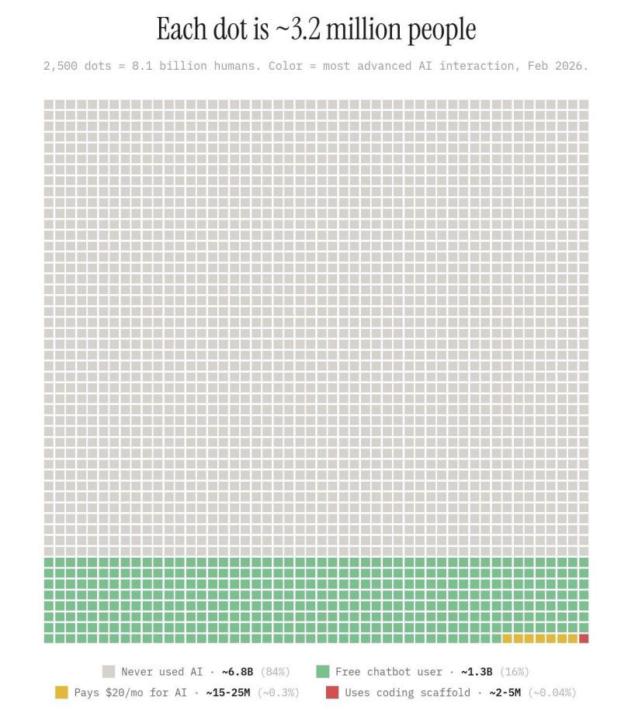
Each dot is 3.2 million people.
📊 You've probably seen this chart floating around LinkedIn and Twitter Each dot is 3.2 million people. ⬜ Grey is the 84% of humans who have never used AI 🟩 Green is the 16% who have used a free chatbot 🟨 Yellow is the 0.3% who pay for one 🟥 Red is the tiny sliver who use AI coding tools Most of the people sharing it have not actually said what it means. So here it is. 🔁 We live inside an algorithm. Mine shows me AI all day. Yours probably does too. Every reel, every post, every podcast clip, every ad. The feed makes it feel like the whole world has moved on without you and you are sprinting to keep up. Inside Clief Notes that feeling gets louder. You log in and see people building agents, shipping side projects, automating their inbox, talking about Claude Code and MCP servers like it is normal. In this room, it is. Step outside and almost nobody is doing any of it. 6.8 billion people have never opened a chatbot. Plenty of the ones who did opened it once, asked it something dumb, got a dumb answer, and decided the whole thing sucked. They are not coming back this year. Maybe not next year either. 🪖 When I was in the Marine Corps I never felt like I was doing anything special. I was surrounded by other Marines. Everyone around me could do what I could do. The standard was the standard. It was not until I left and stood next to people who had never served that I understood. The thing I thought was ordinary was rare. I just could not see it because I was inside it. That is what is happening to you in here. If you feel behind in this community, that is the right feeling to have. It means you are standing next to the people pushing the edge. Step outside this room and the thing you are calling behind is so far ahead of where most of the world is sitting that they cannot see you from where they are. And do not forget. The thing you built last week, the workflow you set up this morning, the conversation you just had with Claude. A version of you from two years ago would have paid good money to do any of it.

0 likes • 2d
The reframe at the end is the part most people in this community need to hear weekly. Solid post. Quick question on the data itself: do you have a source for the 84% / 16% / 0.3% breakdown? I've seen the chart circulating but couldn't trace the original methodology. The 3.2M-per-dot framing makes it feel rigorous, and I'd love to know who actually measured "has used a free chatbot" vs "pays for one" globally. Those are notoriously hard numbers to nail down at country-by-country level. If the data holds up, the Marine Corps analogy is even stronger than people are giving it credit for.

11d •
LEAKED: The Anthropic Team's Internal Prompting Framework
An ex Anthropic researcher just leaked 10 prompts to help you optimize your prompting. ## Prompt 1: Context Brief (The Map Claude Actually Needs) Never jump straight into a question. Start with rich context: ``` You are helping me with [specific goal]. My background: [your role + company/project + constraints]. I've already tried [X and Y]. I'm stuck on [Z]. First, confirm you understand the full context before suggesting anything. ``` Internal tests showed this single change boosts output quality by 41%. Claude isn't psychic — give it the full map. ## Prompt 2: Force Visible Reasoning (Chain-of-Thought on Steroids) Don't ask for answers. Demand the process: ``` Before giving any final recommendation: - show your full step-by-step reasoning - explicitly list every assumption - flag uncertainties and confidence levels (low/medium/high) - only then deliver the polished answer. ``` This pulls out Claude's hidden reasoning layers. You don't just get an answer — you get an auditable thought process you can actually trust. ## AND MORE - see attached files. From @kyronis_talks on X
0 likes • 3d
Useful round-up. The framework itself buries the most important insight though: 80% of the value lives inside Prompt 1 (Context Brief). The other 9 are tactical sharpening on top. Why most managers and operators fail at prompting isn't that they haven't seen the framework, it's that they've never had to brief another human with this level of precision. They delegate to a teammate with 'figure it out' and call it management. AI removes that affordance. Suddenly you have to spell out role, constraints, prior attempts, and stuck point in writing. People who can do that instinctively were already running tight teams. People who can't are getting exposed by a tool, not failed by it. The real intervention isn't a better prompt template, it's the same skill written into how someone runs their week, briefs their reports, and decides what 'done' looks like before the work starts.
1 like • 2d
@David Vogel That’s why it’s so important to stay increasingly up to date with AI harnessing and harness engineering.

12d •
I went to bed with two briefs. I woke up to two shipped products.
Last night I briefed two things. A plugin for a professional video editor. A Mac app for a dashboard I'd been sketching for weeks. Both real. Both specced. Neither had a single line of code written. I wrote the briefs. I kicked off the dispatch layer. I went to sleep. This morning there were two working products. The math on it: - 5 Opus sessions acting as executor advisors - 5 Sonnet sessions doing the mechanical build work - 0 extra spend on top of my Anthropic subscription - 0 new chat windows opened by me The orchestrator session I use as my advisor seat handed each spec to its own background worker. Each worker got its own branch, its own clean context, its own budget line. The Opus workers held the judgment. The Sonnet workers did the keystrokes. They handed off to each other. I slept. The lever people keep missing Most people think "power" in AI means a bigger model or a longer context window. The real lever is distribution. One tight brief can be executed by ten workers in parallel. Ten workers, each with a clean low-token budget, outperform one conversation carrying a bloated context every time. It is not close. The brief is the compression. The brief is the intelligence. Why it costs nothing extra The workers ran on Claude. Claude is covered by my subscription plan. Opus and Sonnet are both on the same plan. No metered API spend. No per-call billing. No "agentic loop surcharge". Ten workers in parallel cost exactly the same amount as sitting in one chat window and typing all day. Same bill. Ten times the output. The system around the AI is what did the work. The principle Stop prompting. Start briefing. A brief is a contract. It has acceptance criteria, files in scope, the one condition that makes the worker stop and surface to you, and the exact thing you want to be sitting on top of in the morning. Every worker starts cold. Every worker reads that same doc. The doc is the system. Prompts fight your context window. Briefs replace it.
1 like • 3d
This is the right framing. 'The brief is the compression. The brief is the intelligence' is the same thing executive teams have been getting wrong about delegation for 30 years. Companies don't fail to scale because they lack capable people. They fail because nobody has written down what 'done' actually looks like, what the acceptance criteria are, and which one condition makes the work pause and surface. So every project becomes a chat window, context bloats, and the executive becomes the bottleneck. What you described isn't really an AI agent pattern. It's a management pattern that happens to work with agents because they're the first 'employees' that genuinely refuse to act without a brief. Humans tolerate ambiguity, agents expose it. The org charts that survive the next 3 years won't be the ones with more headcount, they'll be the ones whose operating layer is briefed instead of meeting'd. You're already there.

16d •
From 2 Hours to 10 Minutes: First Major Automation Win
This is my first major win applying what @Jake Van Clief ef teaches. Since subscribing to Claude Code on March 19th, I’ve been able to show so much progress that my company has now upgraded me to the Max 5x subscription. Looking forward to pushing the boundaries of what’s possible and continuing to improve our processes! As a Finance Manager responsible for month-end closing, I wanted to see what Claude Code could actually achieve—and it delivered! Even without Azure or backend access to our ERP system (D365 F&O), I didn't let that stop me from being "efficiently lazy." Claude Code showed me how to use the Playwright MCP to control Chrome and handle the heavy lifting for me. The script now automatically downloads the monthly trial balance, populates an Excel template, identifies discrepancies via color-coding, and even takes screenshots to document numbers from various reports. I’m already tackling my next big automation project—a task that is notoriously tedious when done manually. Stay tuned for that post, as well as more month-end automation updates in the near future! I had Claude code describe the workflow: Common Reconciliation — Monthly Close Automation with Claude Code + Playwright MCP Every month-end I run a single slash command (/mec-common) and pass it a month number. Claude then drives the entire reconciliation process end-to-end, touching both a live D365 ERP system and a multi-sheet Excel workbook — no manual steps. The workflow in three phases: Phase 1 — Trial Balance Claude navigates to the D365 Trial Balance page, clears any stale filters, sets the correct date range, triggers a recalculation, and downloads the export. The Excel file is placed in the right folder, and the data is pasted (values only) into the reconciliation workbook's Trial bal D365 sheet. A full workbook recalculation is then forced before anything is read. Phase 2 — Revaluation Check Claude loops through ~50 reconciliation sheets. On each sheet it finds the last row where column C says "Revaluation" (there are two — the second one holds the actual diff) and reads the value in column G. If the diff is outside ±1, the sheet tab is colored red. One sheet (150070) is always flagged red and requires manual review regardless.
1 like • 3d
This is the right kind of first win. As a Finance Manager you've found exactly the workflow where the multiplier shows up: deterministic, repetitive, verifiable against a source of truth. One thing to bake in before you scale to the next 5 automations: month-end is regulated ritual. The bot is doing real GL work in D365 that auditors and your CFO will eventually question. The next failure mode isn't accuracy, it's traceability. When the flag on sheet 150070 turns out to be wrong six months from now, your defense is the artifact pack: signed log of every cell touched, screenshots versioned by run, prompt + response snapshot. Treat each /mec-common run as a non-repudiable record from day one. Finance teams that scale agentic ops past phase 1 aren't the ones with cleaner code. They're the ones whose CFO can answer 'what did the AI do this month' without opening Claude.

17d •
Big Win, Launched my Ai Agency!
Hey community!! yesterday I Launched MinAITaur, my Human Tech consulting agency!! We dedicate to mitigate your bureaucracy and uplift your job!! I decided to start on a clean slate, everything from 0. I am so happy, everything has been possible thanks to Jake's teachings and ways. The Agency is a mix of organizational psychology consulting and IT automations using Claude! We help you redesign your Northstar giving your human capital the proper space and the repetitive tasks an architectural system which helps you mitigate it to stay more human than ever before!!! Here is my brands branding proposition. Everything is still in Launch state, happy to help anyone who resonates with this message and if you guys would like to follow I would be thankful to have you there as well. Socials: ig & fb: @minaitaur, www.minaitaur.io. (PD: webpage is not launched yet)

0 likes • 4d
¡Felicidades Juan Eduardo! El positioning “organizational psychology + IT automation” es de las pocas tesis que tienen sentido real para LATAM enterprise. El cuello de botella en la mayoría de las empresas que conozco no es la herramienta, es el cambio de comportamiento. Vas por el carril correcto. Una observación de quien ha vendido agentes a ejecutivos LATAM: la palabra “consultoría” a veces juega en contra cuando el comprador ya tuvo malas experiencias con consultoras tradicionales. “HumanTech” es buen frame, pero en pitch yo aterrizaría rápido en outcome concreto: “reducimos X horas de trabajo administrativo en 60 días” o similar. Los CEO/COO chilenos tienden a comprar resultados medibles antes que metodologías por ahora. El nombre MinAITaur tiene mucha personalidad. No la pierdas en el copy técnico. Mucha suerte con el lanzamiento.
1-5 of 5
@roberto-aguirre-5183
I am an Executive Manager specializing in digital transformation. My passion lies in using technology to drive business growth and improve processes.
Active 15h ago
Joined Apr 27, 2026
Powered by