Jun 9 • Conversation ✨
Courage, Strength, Beauty in Life
Last week, I sat in my neurologist’s office for what I expected to be another appointment.
Another discussion about symptoms.
Another conversation about cerebellar ataxia.
Another reminder of what had happened to me over twenty years ago when a stroke changed the trajectory of my life.
Instead, I heard words I never imagined I would hear.
My neurologist looked at me and said:
“You’re going to be around for a long time.”
And I started sobbing.
Not graceful tears.
Not polite tears.
The kind of tears that come from somewhere so deep inside of you that they surprise even you.
Because for years — if I am honest — I never thought I would hear those words.
At 23 years old, after addiction, trauma, and the devastating loss of my father to suicide, I had a cerebellar stroke.
My life changed overnight.
One day I had independence.
The next, I had paralysis.
I had to learn how to walk again.
How to speak clearly again.
How to navigate a body and brain that no longer moved the way they once had.
For a long time, life became about survival.
And survival is a strange place to live.
You are alive, but not fully living.
You are breathing, but carrying fear.
Fear about what comes next.
Fear about what has been lost.
Fear about how much time you have.
Somewhere deep inside me, I think a part of me quietly wondered for years if my body would continue to decline.
If I would ever truly feel strong again.
If I would ever feel fully alive again.
But somewhere along the way, something shifted.
I got serious about recovery.
Not just from substances.
Not just from an eating disorder.
But recovery in the deepest sense of the word.
Recovery of mind.
Recovery of body.
Recovery of spirit.
I have now been sober for 12 years.
I fought my way through an eating disorder that once consumed my life.
I stopped merely surviving and began prioritizing my mental, emotional, and physical wellbeing.
I started treating my body less like an enemy and more like something sacred.
Something worth fighting for.
Something worth rebuilding.
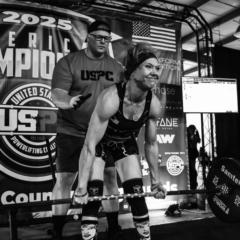
I became an adaptive athlete.
I started powerlifting.
And powerlifting changed something in me.
Not because lifting weights magically erased hardship.
Not because life suddenly became easier.
But because strength changes the way you see yourself.
For the first time in years, I stopped focusing solely on what had been taken from me and started focusing on what I was still capable of building.
Strength.
Confidence.
Capability.
Hope.
And one thing struck me deeply after this recent neurology appointment:
I haven’t even had an MRI since I truly got serious about healing.
Since I committed fully to sobriety.
Since I prioritized recovery from an eating disorder.
Since I began powerlifting.
Since I began intentionally caring for my mental and physical wellbeing.
No, I’m not pretending life became perfect.
I still live with cerebellar ataxia.
There are frustrating days.
Hard days.
Painful days.
Days when courage feels harder to access.
But recovery taught me something profound:
Courage is often quiet.
Sometimes courage looks like rehab.
Sometimes courage looks like showing up to the gym when your body feels uncertain.
Sometimes courage is choosing recovery one more day.
Choosing nourishment.
Choosing hope.
Choosing to believe that your life still matters.
And during my appointment, my neurologist and I talked about something that means so much to me now:
Helping others understand how breathtakingly beautiful life can be.
Not perfect.
Not untouched by suffering.
But beautiful.
The best way I know how to describe it is through the movie Pleasantville.
In the beginning, everything is muted.
Gray.
Predictable.
Flat.
Life feels mundane.
Bleak.
Disconnected from possibility.
And when you are living through trauma, grief, addiction, disability, hopelessness, illness, or survival mode, life can begin to feel like that.
You stop noticing beauty.
You stop expecting joy.
You forget what hope feels like.
You survive.
But little by little, healing begins.
Strength grows.
Courage returns.
And somehow, life slowly begins changing color again.
Joy feels brighter.
Love feels deeper.
Laughter feels fuller.
Ordinary moments become extraordinary.
And suddenly, the things that once felt mundane become sacred.
The first time I carried my own trash after my stroke.
The first time I swept my own floor.
Most people see those things as annoying chores.
I saw freedom.
I saw possibility.
I saw proof that healing was happening.
Because when independence is taken away, even briefly, gratitude changes.
The smallest moments become the most memorable.
The most beautiful.
The most miraculous.
You stop overlooking ordinary things.
You realize life itself is extraordinary.
I am 45 years old now.
I am an adaptive athlete.
A heavy equipment mechanic.
A woman in recovery.
A wife to an incredible adaptive athlete with cerebral palsy.
A survivor of trauma, grief, addiction, disability, and rebuilding.
And after everything, I can say this with my whole heart:
Life is breathtakingly beautiful.
Not because it is easy.
But because it is precious.
Because there is strength here.
Courage here.
Joy here.
Love here.
And if you are struggling right now — if life feels muted, gray, hopeless, or unbearably hard — please hear me:
Healing is possible.
Life can change.
The colors can come back.
Sometimes slowly.
Sometimes quietly.
But they come back.
And sometimes, after years of fighting for yourself, you hear words you never imagined you would hear.
“You’re going to be around for a long time.”
For the first time in a very long time, I allowed myself to believe it.
And what an unbelievably beautiful thing that is.
4
2 comments
Courage, Strength, Beauty in Life
powered by
skool.com/the-orion-collective-8700
The FREE Community for Impossible Performance, where we Build the Individual who Builds the Outcome.
Suggested communities
Powered by