
Jan 26 (edited) • Tools
Using a Flail Mower in the Meditteranean - Revolutionary
Guys, sell your backyard woodchippers - they are useless and expensive. Watch the video before reading.
Here's Pedro the man cutting through the branches like a knife through hot butter !
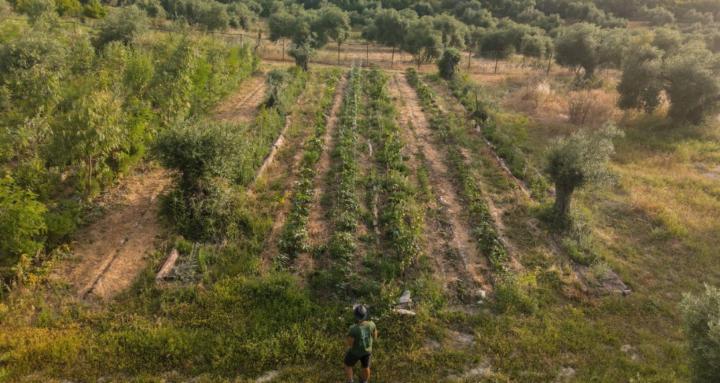
About a year ago, my colleague and I hit a wall. We needed mulch for new syntropic plantings, but first we had to deal with 1.5 km of agroforestry lines planted with carob and bridal broom - Retama monosperma - our main service species.
We prune these lines every couple of years. Until then, we’d just leave the biomass on the ground — but in this climate it decomposes painfully slowly. On top of that, we have to strim the lines once a year, and strimming around woody branches is a nightmare.
So last year we thought: let’s woodchip it.
Spanish broom is insanely fibrous. After one hour of chipping, the machine had already clogged five times. We’d advanced maybe 20 metres. At that pace, finishing the job would’ve taken 100+ hours.
Let’s do the math:
- ~120 litres of petrol
- ~150 € in fuel
- 2 people × 100 hours × 10 €/h = 2000 € in labour
That’s ~2200 €…👉 just to make mulch.
And that’s only the beginning. Then you need to gather it up and mulch the lines.
So we went with the obvious solution instead: we called a guy with a hammer flail mower.
We lined all the branches along the row, and in about one hour the job was done.
Cost? 40 € per hour, plus a bit of fuel and his commute - let’s say 60-80 € tops.
That alone would have justified half a day of woodchipping, easily.
So yes - there’s no point in backyard woodchippers.
Ours cost 3,500 €, and in hindsight it’s just money thrown away. Even on small systems, the economics don’t work:
- constant repairs
- bolts loosening from vibrations
- frequent clogging
- painfully slow
- awkward, impractical designs when they jam
- gulps up fuel
For agroforestry and syntropic systems, they’re simply the wrong tool. We're selling it now.
Here’s how we do it this year to maximize efficiency and save money:
We prune everything we need - olive trees, bridal brooms, pines, carobs - and line up all the prunings. Then we chainsaw out the bigger trunks that won’t fit through the flail mower. Once all the pruning is ready, we call in the flail mower guy.
The video here is from 5 days ago. This machine is powerful: it can handle up to 10 cm diameter softwood and 5–6 cm hardwood with ease.
And we were only talking cost and efficiency above but there's one added benefit that in and of itself justifies a flail-mower over the woodchipper all of the time, especially in a dry climate.
Big branches left on the ground can take years to decompose. In Mediterranean summers, decomposition stops entirely and can start oxidizing, which leads to nutrient loss. On top of that, weeds can sprout between the branches over the autumn, and they’re impossible to remove. Not ideal.
Fine woodchips aren’t great either. They decompose too quickly - a 10 cm layer can disappear in a single season. Coarse woodchip, by contrast, gives you more coverage for less material: a 10 cm layer of fine chips is roughly equivalent to 20 cm of coarse chips.
Coarse, rough woodchips - what a flail mower produces - are slower to decompose, offering longer-lasting protection. After a year, a 20 cm layer is only halfway gone. They also:
- Retain moisture better
- Don’t form a dry crust
- Prone to less oxidation
- Favor fungal activity
- Have lower surface area - exactly what you need for longevity over speed
So here’s the plan: in the first years of managing our syntropic lines, a simple chop-and-drop works fine - the branches aren’t too thick. But by year 5, we’ll be dealing with larger material from species like acacias. The idea is to line up the prunings, call in the tractor guy with the flail mower, and rake the woodchips back onto the lines we’ve pruned - It is only truly worth it with enough branches larger than 3 cm.
In the meantime, I’m exploring whether woodchip windrowing attachments - not the usual silage/hay windrowers - actually exist for tractors. Any suggestions ? Mechanization like this would make the work faster, cheaper, and in this case better ecologically speaking, speeding up succession.
9
6 comments
Using a Flail Mower in the Meditteranean - Revolutionary
powered by
skool.com/syntropic-agroforestry-w-milan-3000
Mediterranean Syntropic Agroforestry made practical.
Efficient design, minimal water, low inputs — maximum impact.
Suggested communities
Powered by