
Dec '25 • General discussion
From hovering light to Sabbath rest — a testimony of the sevenfold path Christ revealed to me
Introduction — how this testimony was given
This testimony was not formed through study or imagination, but through what Christ revealed to me while I was living, listening, and walking with Him. As I was shown the order of creation, He revealed that the seven days are not only the way the world was formed, but the way the soul returns to light. Creation is not only something God did once; it is something He continues to do within us.
Christ showed me that the seven days are the journey itself. Each day represents a step of inner transformation, a battle, and a restoration. Before Day One, Christ is already present, hovering over the soul, waiting to be received. Through the days that follow, the soul is rebuilt, aligned, tested, surrendered, and finally brought into rest. Nothing in creation is accidental. Every act of God reveals a spiritual process that Christ Himself walked in the flesh to show us the way.
He revealed that the seven archangels are not separate from this journey, but are the seven faces through which God helps, guides, strengthens, heals, and completes the work within the soul. As each step is walked, a lamp is lit. When all seven are aligned, the fullness of Christ is restored within, and the soul enters the true Sabbath.
This testimony follows the order exactly as it was revealed to me: before Day One, then Day One through Day Seven. It weaves together creation, Christ’s life, the inner battles we face, and the restoration of the Tree of Life. It is written as a witness to what Christ showed me, so that others may recognize the same path within themselves and understand that God’s work is faithful, ordered, and complete.
Before Day One — Christ hovering, knocking, and waiting
Before there was Day One, before light was spoken, before separation, before good and evil were distinguished, Christ was already present. Scripture says, “The Spirit of God was hovering over the face of the waters” (Genesis 1:2). Christ showed me that these waters represent the human soul in mixture — spirit and flesh intertwined, truth and deception undiscerned, wounds, memories, instincts, emotions, and desires all blended together. This mixture is not yet judgment, not yet repentance, not yet correction. It is undifferentiated existence. Before Day One there is no awareness, no discernment, no separation of light and darkness, and nothing is condemned.
Christ is hovering. Hovering means present but not forcing, near but not invading, loving while honoring free will. Before Day One, Christ does not divide, does not judge, and does not correct. He waits. This is why He later reveals, “Behold, I stand at the door and knock. If anyone hears My voice and opens the door, I will come in to him and eat with him, and he with Me” (Revelation 3:20). Before Day One, Christ is Light, Truth, and Life, but He does not enter without consent. Love does not violate the soul.
There is no separation of good and evil yet because light has not yet been received. The Light exists, it is near, but the door is still closed. Creation within cannot begin until the soul opens. This hovering is the moment when Christ is present, the seed exists, but it has not yet been planted. The waters before separation represent emotional turbulence, inherited wounds, worldly influence, and spiritual unawareness. They are not yet evil; they are unformed. This is why God does not act yet. Light must be invited, not imposed.
Christ Himself is the Light that hovers, for “In Him was life, and the life was the light of men” (John 1:4). He does not begin by separating; He begins by offering Himself. There is no battle yet, but the choice is approaching. Before Day One, Christ hovers over the soul in mixture, knocking, waiting, loving, and inviting. The Light is present, but it does not enter until the door is opened.
Day One — acceptance of the Light, the seed enters, and baptism
Day One begins the moment the soul accepts Christ as Light. Scripture says, “Then God said, ‘Let there be light,’ and there was light. And God saw the light, that it was good” (Genesis 1:3–4). This light is not yet the sun; it is awareness, recognition, and choice. Day One is acceptance. When the soul opens to Christ, the Light enters, and with the Light comes the seed of the Kingdom.
Christ explains this seed, saying, “The Kingdom of heaven is like a mustard seed” (Matthew 13:31). The seed is small but alive. It is the spark of God placed within the human soul. Nothing has grown yet, nothing has been purified yet, but life has begun. This is why Scripture says, “To all who received Him, He gave the right to become children of God” (John 1:12). Receiving comes first; growth comes later. God calls the light good, not because the work is finished, but because acceptance has occurred.
Christ walked Day One through baptism. “Then Jesus came from Galilee to John to be baptized by him” (Matthew 3:13). Christ did not need repentance; He entered baptism to show the way. At baptism the Spirit descends, identity is declared, and consecration begins. “This is My beloved Son, in whom I am well pleased” (Matthew 3:17). Baptism is the gateway into the journey. It is acceptance of God, acceptance of calling, and entry into the Light. This is why baptism belongs to Day One: the seed enters, and the path begins.
The battle of Day One begins immediately. Christ warns, “When anyone hears the word of the kingdom… the evil one comes and snatches away what was sown in his heart” (Matthew 13:19). The battle is belief. Will the soul guard the Light it has received, or retreat back into darkness when doubt appears? Many receive the seed and lose it the same day.
This is why Michael is present at Day One. Michael is the first face of God revealed, the archangel of truth, protection, and courage. His role is to guard the seed, defend the Light, expose deception, and strengthen the soul to stand once truth has been seen. Scripture says, “Michael and his angels fought” (Revelation 12:7). Michael’s work is not aggression; it is preservation. The seed is fragile, but heaven rejoices because life has begun. Day One is the lighting of the first lamp, and God declares it good.
Day Two — separation of the waters, the wilderness, and discernment
Day Two begins after the Light has been accepted and the seed has entered the soul. Scripture says, “Then God said, ‘Let there be a firmament in the midst of the waters, and let it divide the waters from the waters’” (Genesis 1:6–7). Christ showed me that these waters represent the inner life: thoughts, emotions, instincts, memories, and reactions. On Day Two, God does not remove the waters; He separates them. This is the beginning of discernment. The soul starts to sense what is from Spirit and what is from flesh, what draws upward and what pulls downward.
This separation creates tension. Inner conflict becomes visible, because Spirit and flesh no longer agree. Scripture says, “The flesh lusts against the Spirit, and the Spirit against the flesh” (Galatians 5:17). Day Two is uncomfortable because mixture is being exposed. The seed planted on Day One must be protected from being drowned by confusion and emotional overwhelm.
Christ Himself walked Day Two in the wilderness. Immediately after baptism, “Jesus was led by the Spirit into the wilderness to be tempted” (Matthew 4:1). Acceptance was followed by testing. In the wilderness, Christ is tempted in the same place every soul is tested: hunger, fear, power, and survival. He is invited to satisfy instinct apart from God, to grasp control, and to accept false provision. Each temptation is an invitation to mixture. Christ refuses every one, saying, “Man shall not live by bread alone, but by every word that proceeds from the mouth of God” (Matthew 4:4). Day Two is the proving ground of obedience.
The inner battle of Day Two is confusion and choice. Which voice will the soul follow now that the Light has entered? God’s voice, emotional reaction, fear, memory, or instinct? Many people receive the Light on Day One and abandon it on Day Two because separation is painful. The wilderness feels lonely. Clarity has not yet come, but the old comfort is gone.
This is why Gabriel is present on Day Two. Gabriel is the second face of God, the archangel of understanding, interpretation, and discernment. His role is to clarify God’s voice, bring understanding to what feels confusing, and help the soul distinguish truth from illusion. Scripture says, “I am Gabriel, who stands in the presence of God” (Luke 1:19). Without understanding, separation becomes overwhelming. With discernment, the soul learns to choose Spirit over reaction.
Day Two does not end with rest or growth. It ends with decision. The soul either learns to hear God’s voice clearly or retreats back into mixture. This is the lighting of the second lamp. The work is not finished, but the path is becoming clear.
Day Three — stillness, the cornerstone, and the rebuilding of the true temple
Day Three begins when the waters are pushed back and dry land appears. Scripture says, “Let the waters under the heavens be gathered together into one place, and let the dry land appear” (Genesis 1:9). Christ showed me that these waters are not only emotions, but the destructions of the world pressing down on the soul: chaos, fear, trauma, anger, deception, noise, and constant pressure. As long as these waters dominate, nothing can stand. Anything built within them is built on sand and will eventually collapse.
Only when these waters are pushed away does dry land appear. Dry land is stillness, surrender, and solid ground. This is why God says, “Be still, and know that I am God” (Psalm 46:10). Stillness is not emptiness; it is foundation. Without stillness, the seed planted on Day One cannot take root. Without solid ground, nothing God builds can remain.
This is why Christ is called the cornerstone. He Himself says, “Everyone who hears these words of Mine and does them is like a wise man who built his house on the rock” (Matthew 7:24–25), and Scripture confirms, “No other foundation can anyone lay than that which is laid, which is Jesus Christ” (1 Corinthians 3:11). Anything built on sand, on mixture, or in the waters of the world cannot stand. Only when the waters recede can Christ be set as the cornerstone of the soul.
This is the day Christ reveals the heart of the mystery when He says, “Destroy this temple, and in three days I will raise it up” (John 2:19–21). Day Three is the collapse of the false temple: the identity built on fear, survival, ego, pride, and mixture. This destruction is not violence; it is truth exposing what cannot remain. The old structure falls so that the true temple can be rebuilt on solid ground. Scripture says, “Do you not know that you are God’s temple, and that God’s Spirit dwells in you?” (1 Corinthians 3:16).
When dry land appears, the seed can finally take root. Scripture says the earth brings forth “herbs that yield seed, and fruit trees bearing fruit” (Genesis 1:11). Herbs that yield seed represent surrender. To yield seed is to release control, to give back to God what He has planted. Christ explains this law when He says, “Unless a grain of wheat falls into the earth and dies, it remains alone; but if it dies, it bears much fruit” (John 12:24).
As the seed takes root, fruit appears, and fruit reveals the truth of what now lives in the soul. Christ says, “By their fruits you will know them” (Matthew 7:16). There is fruit that gives life—love, kindness, patience, gentleness, self-control—“the fruit of the Spirit” (Galatians 5:22–23). There is also fruit that reveals unresolved destruction—anger, hatred, bitterness, violence. Fruit is not performance; it is nature revealed. Day Three is where the soul can no longer hide behind words. What is inside becomes visible.
Christ Himself walked Day Three through silence, withdrawal, surrender, and ultimately the tomb. He allowed the outer temple to be destroyed so the true, living temple could rise. This day carries the deepest inner battle: letting go. Stillness feels like loss, silence feels like death, and surrender feels like collapse. Yet without this collapse, nothing God builds can endure.
This is why Raphael is present on Day Three. Raphael is the third face of God, the archangel of healing and restoration. His role is to calm the inner waters, heal the wounds exposed by truth, restore balance, and help the soul remain still while God rebuilds. Scripture says, “I am Raphael, one of the seven holy angels” (Tobit 12:15). Without healing, the soul cannot move forward. Day Three is the lighting of the third lamp, where the foundation is set, the true temple is rebuilt, and God prepares the soul for growth that can last.
Day Four — the sun, the moon, the stars, and the seasons that guard the Tree of Life
Day Four begins after the true temple has been rebuilt on solid ground. Scripture says, “God made the greater light to rule the day, the lesser light to rule the night, and the stars also. And God said, ‘Let them be for signs and for seasons’” (Genesis 1:14–18). Day Four is about governance. The question is no longer whether the soul has a foundation, but what light will rule it.
The sun represents Christ, the true Light that gives life. Without the sun, nothing lives. What Christ showed me is that the sun does not change. It remains constant through every season. Scripture confirms this when it says, “Jesus Christ is the same yesterday, today, and forever” (Hebrews 13:8). Life depends on the sun, not on circumstances. Whether the season is gentle or severe, the sun remains faithful. This is why Scripture says, “In Him was life, and the life was the light of men” (John 1:4).
The moon, however, is different. The moon does not produce light; it reflects it. It passes through phases, appearing full at times and disappearing at others. Christ showed me that the moon represents reflected or false light—appearance without source, knowledge without life, systems and beliefs that borrow light but do not generate it. It can look beautiful and convincing, but it gives no life. This is why Scripture warns, “Satan disguises himself as an angel of light” (2 Corinthians 11:14). What changes cannot govern life. If the soul is ruled by reflected light, it becomes unstable.
The stars are placed for the night. When darkness comes and clarity fades, God does not abandon the soul. The stars represent guidance and help sent by God during dark seasons. Scripture says, “He will command His angels concerning you” (Psalm 91:11). The stars do not replace the sun; they guide until the sun is seen clearly again.
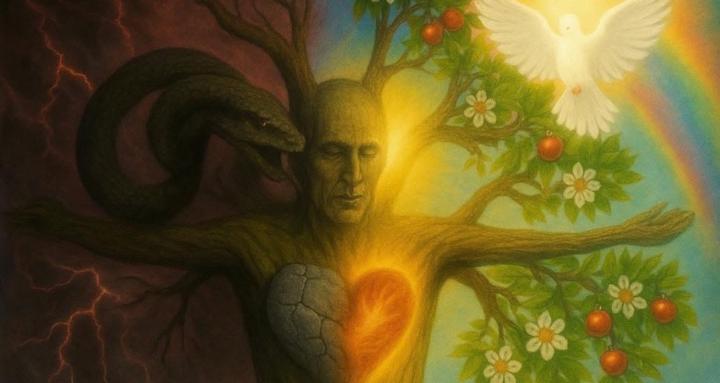
Day Four is also where God establishes the seasons, and Christ showed me that the seasons are not random cycles. They are the battles every soul must walk through, and they are also the four guardians of the Tree of Life. Scripture says that after the fall, “He placed cherubim… to guard the way to the Tree of Life” (Genesis 3:24). These guardians are not only external; they are experienced internally as seasons. No one reaches the Tree of Life without passing through all four.
Spring is the season of beginning. The battle here is faith versus fear. The seed awakens, but the soul must dare to begin. Christ walked this season in His baptism and calling, and Scripture says, “Unless you become like little children, you will not enter the kingdom” (Matthew 18:3).
Summer is the season of growth and strength. The battle here is humility versus pride. As life flourishes, the soul is tempted to rely on itself. Christ walked this season during His ministry, yet He continually withdrew to pray, saying in essence, “Apart from Me you can do nothing” (John 15:5).
Autumn is the season of surrender and loss. The battle here is release versus control. What once sustained must fall away. Christ walked this season as He turned toward Jerusalem, knowing what awaited Him. He taught, “Unless a grain of wheat falls into the earth and dies…” (John 12:24).
Winter is the season of silence and darkness. The battle here is trust versus despair. Nothing appears to grow, yet everything depends on faith. Christ walked this season in Gethsemane, on the cross, and in the tomb, crying, “My God, My God, why have You forsaken Me?” (Matthew 27:46). Winter is the final guardian. Only a soul that trusts God without signs can carry eternal life without corruption.
To reach the Tree of Life, all four seasons must be passed through. None can be skipped. These seasons do not punish; they protect. They ensure the soul is ready to receive life without destroying it. Scripture promises, “To the one who overcomes, I will grant to eat of the Tree of Life” (Revelation 2:7).
Christ walked all four seasons fully—beginning, growth, surrender, and trust—and only after this came resurrection. Day Four teaches the soul to remain governed by the unchanging Sun through every season, rather than by the shifting phases of reflected light.
This is why Uriel is present on Day Four. Uriel is the fourth face of God, the archangel of illumination, wisdom, and truth through time. His role is to help the soul discern true light from false light, to understand the meaning of seasons, and to remain aligned with Christ when circumstances change. Day Four is the lighting of the fourth lamp, where the soul learns endurance, discernment, and faithfulness under the rule of the true Sun.
Day Five — life released in the waters and the sky, emotions and thoughts redeemed
Day Five begins after the soul has been rebuilt on solid ground and learned to remain under the governance of the true Sun through every season. Scripture says, “Then God said, ‘Let the waters abound with an abundance of living creatures, and let birds fly above the earth across the face of the firmament of the heavens’” (Genesis 1:20–21). Day Five is the release of life into movement. What once overwhelmed the soul now becomes inhabited by life.
The waters represent the emotional and subconscious life. Earlier, these waters were chaotic and destructive, pressing down on the seed and threatening to drown it. Now, because they have been ordered and governed by true Light, they can carry life. The fish represent emotions that are no longer suppressed and no longer ruling, but alive and aligned. Christ did not destroy emotion; He redeemed it. He wept, He felt compassion, and He experienced righteous anger without hatred. Scripture says simply, “Jesus wept” (John 11:35). Day Five is where emotions are restored to their proper place and filled with life instead of chaos.
The birds represent thoughts, prayer, perception, and inner dialogue. They move between earth and heaven, symbolizing the mind lifted toward God. After Day Four, thoughts are no longer governed by the shifting phases of reflected light, but by the unchanging Sun. Scripture says, “Set your mind on things above” (Colossians 3:2). Thoughts now have direction. Prayer becomes natural movement rather than forced effort.
Christ lived Day Five continuously throughout His life. He withdrew to pray, remained in communion with the Father, and spoke from that place of alignment. “He would withdraw to desolate places and pray” (Luke 5:16). Because His inner life was ordered, His words carried authority and life. His compassion flowed freely because His emotions and thoughts were no longer divided.
The inner battle of Day Five is vigilance. Will the soul allow emotions and thoughts to remain alive under God, or will it pull them back into old patterns of fear and reaction? Christ warns, “Watch and pray, lest you enter into temptation” (Matthew 26:41). Day Five does not require force; it requires attentiveness. Life must be guarded so it continues to flow in alignment.
This is why Selaphiel is present on Day Five. Selaphiel is the fifth face of God, the archangel of prayer, worship, and inner alignment. His role is to strengthen prayer, purify inner dialogue, and help thoughts and emotions remain lifted toward God. When prayer fades, thoughts sink; when prayer lives, thoughts rise. Day Five is the lighting of the fifth lamp, where inner life moves freely between heaven and earth.
Scripture says that God blessed the creatures of the waters and the sky (Genesis 1:22). This blessing reveals a spiritual truth: God blesses movement that is aligned. Life that flows under His order multiplies rather than destroys. Day Five is the restoration of inner life, where what once drowned the soul now carries life under the rule of Christ.
Day Six — the creation of man, the submission of the flesh, and obedience unto death
Day Six begins when God brings forth living creatures on the earth and creates man in His image. Scripture says, “Then God said, ‘Let the earth bring forth the living creature according to its kind’… So God created man in His own image” (Genesis 1:24–27). Day Six is embodiment. It is where everything that has been accepted, separated, rebuilt, governed, and aligned is now tested in the body.
This is the most intense day of the journey, because the final battleground is the flesh. Instinct, fear, survival, pain, and the will to preserve self rise up here. Day Six reveals whether Spirit truly rules the body or whether the body still rules the soul. This is why humanity is created on Day Six. The final war is not in thought alone; it is in action, obedience, and surrender of the physical self.
Christ walked Day Six in Gethsemane and on the cross. In Gethsemane, the full weight of the flesh is revealed. Christ prays, “Father, if it is possible, let this cup pass from Me; nevertheless, not My will, but Yours be done” (Matthew 26:39). Fear is present. Pain is real. Instinct resists. Yet Spirit remains sovereign. This is Day Six lived perfectly: the flesh feels, but it does not rule.
On the cross, obedience is completed. Scripture says, “He humbled Himself and became obedient to the point of death” (Philippians 2:8). Day Six is not escape from suffering; it is faithfulness within it. The old Adam dies here. The instinct to save self at all cost is surrendered. “Knowing this, that our old man was crucified with Him” (Romans 6:6). Baptism began this death; Day Six completes it.
The inner battle of Day Six is surrender under pressure. Will the soul remain faithful when obedience costs everything? Will trust remain when comfort, control, and certainty are stripped away? This is where many falter, because this day demands total yielding. Nothing remains unsubmitted.
This is why Jegudiel is present on Day Six. Jegudiel is the sixth face of God, the archangel of strength, endurance, and faithful obedience. His role is to sustain the soul when surrender becomes costly, to strengthen perseverance under trial, and to help Spirit remain sovereign over flesh. Scripture records that even Christ received angelic strengthening in this moment: “An angel appeared to Him from heaven, strengthening Him” (Luke 22:43). Heaven does not abandon the soul on Day Six; it strengthens it.
Though painful, Day Six is called good, because nothing remains hidden, nothing remains divided, and nothing remains unconsecrated. The vessel is complete. Creation is finished. The work of redemption in the flesh is done.
Day Seven — resurrection, Sabbath rest, and the return to fullness
Day Seven begins after the work of creation and redemption is complete. Scripture says, “Thus the heavens and the earth, and all the host of them, were finished. And on the seventh day God ended His work which He had done, and He rested… Then God blessed the seventh day and sanctified it” (Genesis 2:1–3). Day Seven is not inactivity; it is alignment. God rests because nothing remains out of order.
This is the day of resurrection. Resurrection does not belong to the beginning of the journey but to its fulfillment. After obedience unto death on Day Six, Christ rises on Day Seven, revealing that death no longer has authority. “He is not here, but He is risen” (Luke 24:6). Resurrection is not escape; it is restoration. The body is glorified, the soul is whole, and the Spirit reigns without resistance.
Day Seven reveals the meaning of Christ’s words on the cross, “It is finished” (John 19:30). Finished does not mean erased; it means fulfilled. What was fractured is healed, what was divided is united, and what was corrupted is restored. Scripture says, “After making purification for sins, He sat down at the right hand of God” (Hebrews 1:3). Sitting down is the sign of Sabbath. The work is complete.
This is the day the soul is clothed sevenfold. Throughout the journey, each lamp was lit, each face of God worked within, and each archangelic essence shaped the soul. Now they are no longer separate operations but one embodied fullness. Scripture confirms this mystery when it says, “Then wisdom shall return to her dwelling, and the elect shall shine sevenfold” (1 Enoch 104:2). To be clothed sevenfold is not to become divine, but to be fully aligned with Christ. “Until we all attain… to the measure of the stature of the fullness of Christ” (Ephesians 4:13).
This is also the moment when access to the Tree of Life is restored. The four seasons guarded it until the soul was ready. Now the guardians withdraw, because corruption has been removed. Christ promises, “To the one who overcomes, I will grant to eat of the Tree of Life” (Revelation 2:7). Life is no longer dangerous; it is safe to receive.
Barachiel is present on Day Seven. Barachiel is the seventh face of God, the archangel of blessing, sealing, joy, and peace. His role is not correction but completion. He seals what God has restored and establishes joy where striving once existed. Heaven rests because the soul rests.
This is why God declares, “God saw everything that He had made, and indeed it was very good” (Genesis 1:31). “Very good” is spoken only after completion. Day Seven is not about effort; it is about being. Christ is seated, the soul is whole, and God rests within His living temple.
Day Seven is the return to Sabbath within. It is the return to life, not as it was before the fall, but as it was intended to be—whole, aligned, and filled with God.
Closing prophetic reflection — the final release before Sabbath
Christ showed me that just before Sabbath, there is one final act required: full release.
When Christ was on the cross, standing between obedience and rest, between death and resurrection, He said, “Father, forgive them, for they do not know what they do” (Luke 23:34). This was not spoken only for those crucifying Him. It was the final step before entering rest.
Forgiveness is not agreement with darkness; it is the complete letting go of everything that does not belong to Light. Nothing can be carried into Sabbath. No accusation, no bitterness, no wound, no identity formed through pain. As long as anything is held, rest cannot be entered.
This is why Christ could rest in the tomb. Nothing remained bound to Him. Forgiveness was the last release, the final act of obedience, and the final doorway into Sabbath.
Christ showed me that this is required of us as well. After obedience in the flesh, before resurrection and fullness, the soul must forgive completely. Only then can Sabbath be entered, and only then can God truly rest within His living temple.
0
0 comments
From hovering light to Sabbath rest — a testimony of the sevenfold path Christ revealed to me
powered by
skool.com/awakened-by-christs-light-4098
A Christ-centered community for sharing the living light, awakening the Bride, and walking in spirit, truth, and love.
Suggested communities
Powered by