

58m •
Google Advertising
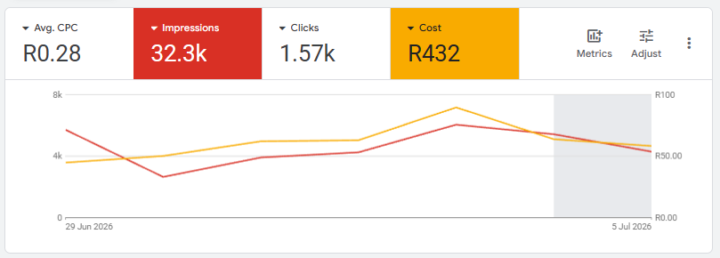
I've been spending quite a bit of time inside Google's new Performance Max campaigns lately, and I think a lot of people are missing the biggest change. Everyone talks about AI. I don't think AI is the interesting part. The interesting part is that Google is finally moving away from just matching keywords and towards finding people who actually buy. That's a massive difference. Traditional Search campaigns are incredible when someone already knows exactly what they're looking for. Performance Max goes looking for people who don't know your business exists yet, but who behave like your existing customers. Google uses all the data it has across Search, YouTube, Gmail, Discover, Maps and Display to find more people that are likely to convert. That's where the magic happens. This week I put around R500 behind a simple LeadLabs campaign. The result? • Nearly 400 enquiries • R0.84 cost per conversion • CTR sitting at 4.51% The lesson isn't "Performance Max is amazing." The lesson is that AI is only as good as the system you build around it. If you feed Google poor signals, it'll find more poor prospects. If you feed it high-quality conversion data, it'll go and find more people that look exactly like your buyers. That's what AI Ops is about. Stop obsessing over prompts. Start building systems that teach AI how your business actually works. That's where the leverage is. No genius required.
0
0
7h •
WELCOME TO AI OPS 👋
Welcome. If you're here to generate another 100 ChatGPT prompts... You're in the wrong place. If you're here to build AI systems that save businesses thousands of hours, land real clients, and create unfair leverage... You're exactly where you need to be. What is AI OPS? AI OPS is a community for operators. Not prompt collectors. Not AI influencers. Not people chasing the latest shiny tool. We build systems that solve real business problems. Inside this community you'll learn how to: - Build AI employees that automate repetitive work - Create production-ready AI agents - Sell AI systems to real businesses - Use tools like Claude Code, Codex, Google Flow, n8n, MCPs and whatever comes next - Think like an operator instead of a prompt engineer The tools will change. The principles won't. What this community is NOT This isn't another AI news feed. You won't find endless "Top 10 AI Tools" posts. You won't find recycled LinkedIn content. You won't find people farming engagement. Everything shared here should make you a better builder. The Rules 1. Build more than you consume. 2. Share real work, not AI-generated fluff. 3. Help people. The fastest way to learn is to teach. 4. Respect everyone's time. Low-effort posts disappear. 5. Leave the community better than you found it. Where to Start 1. Introduce yourself in the comments. 2. Tell us: - What you're building. - Your biggest bottleneck. - What skill you bring to the community. - Complete your profile. - Explore the Classroom. - Build your first system this week. Don't wait until you "know enough." What You'll Get As this community grows, I'll be sharing: - Production-ready AI systems - Complete business automations - Client acquisition playbooks - Prompt libraries - Claude Code workflows - Google Flow builds - Automation templates - SOPs - Sales systems - Real client case studies - Behind-the-scenes breakdowns of the systems I use every day No theory.
1
0
3d •
AI Ads? It's Completely Possible.
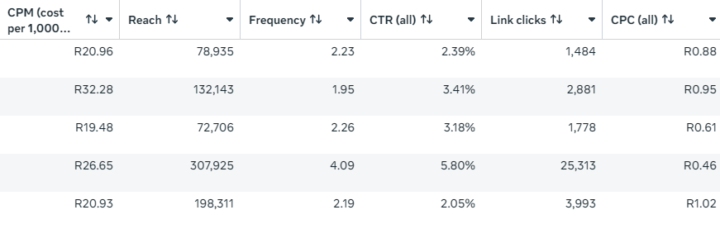
Everyone keeps saying the same thing. "Ads are just getting more expensive." I don't buy it. Yes, there are more advertisers. Yes, auctions are more competitive. But "competition" has become the excuse of choice for lazy marketing. Think about how Meta actually makes money. It doesn't wake up asking how to charge you more. It wants people to stay on the platform. When your ad gets ignored, skipped or hidden, Meta has to serve more impressions to earn the same revenue. So you pay for that. In cold, hard CPM. I've run campaigns where we changed one thing: the messaging. Same audience. Same budget. Same placements. Same objective. Same account. CPM dropped hard. Competition didn't disappear overnight. The ad simply became something people wanted to engage with. Which is why I cringe every time someone says "high CPM means the niche is saturated." No. Sometimes your hook sucks. Sometimes your headline is generic. Sometimes your creative looks like every other Canva template in the feed. Sometimes your offer isn't clear. Meta is asking one question on every auction: will people care about this? If the honest answer is "probably not," you pay a premium to force it in front of them anyway. The biggest unlock for me this year hasn't been another AI tool. It's been shortening the feedback loop. My current stack: • Claude • Meta MCP • Higgsfield MCP • ElevenLabs • FFmpeg Idea to live campaign in minutes instead of days. I test more hooks, I learn faster, and better messaging compounds week after week. If you're spending hours hunting for the perfect audience before you've tested ten different hooks, you're optimising the wrong variable. The market stopped rewarding the best targeting a while ago. It rewards the best communication. That's the edge. Not cheaper traffic. Becoming the advertiser the algorithm actually wants to show.
4d •
30 minutes on Fable 5, a whole Week's Credits gone. You're Welcome 😁
Thirty minutes on Fable 5, a whole week's credits gone. You're welcome. Because what came out the other side is attached, and it's the thing most of you actually need. Here's the shift nobody's pricing in properly. The jump from a cheap model to a frontier "upgrade" model isn't a 20% better autocomplete. On the hard stuff it's a different category of machine. The longer and more complex the job, the bigger the gap, and it grows the deeper you go. Quick task? Barely notice. Whole-project, hold-it-all-at-once, multi-file reasoning? Not close. And if you vibe coded your base, this is aimed squarely at you. Think about how that base got built. A weaker model with a small context window, working through a keyhole, one file or one session at a time. It made a hundred locally sensible decisions that are globally broken, and by design it could never see the breakage. Duplicated logic in two files. A rename done in some places and not others. An endpoint that quietly forgot the auth its nine siblings got. Frontend validation with nothing behind it. None of that is your fault. It's the signature of the tool that built it. Now point an upgrade model at the whole thing at once. That's the unlock. It can hold the entire project in its head where the builder never could. It uses persistent memory like nothing before it, compounding as it works instead of relearning from zero. And it reasons at senior level, root cause, trade-offs, expected value, not pattern-match-and-stop. Here's the part I want to hammer, because it's the highest-leverage move available to you right now: two dead-simple skills have a 20x impact on a vibe-coded base. A /insights skill. Point it at your project and ask what's actually going on. Where's the risk, what contradicts what, what's going to break at scale, what did the weaker model miss. You go from "it works, I think" to a map of exactly where the bodies are buried. A /code-review skill. Not style nitpicks. Whole-system coherence, the semantic seams no linter can see, ranked by what will actually hurt in production, with the fix scoped tightly enough that it doesn't open three new holes while closing one.
5d •
Fable 5? Mythos!
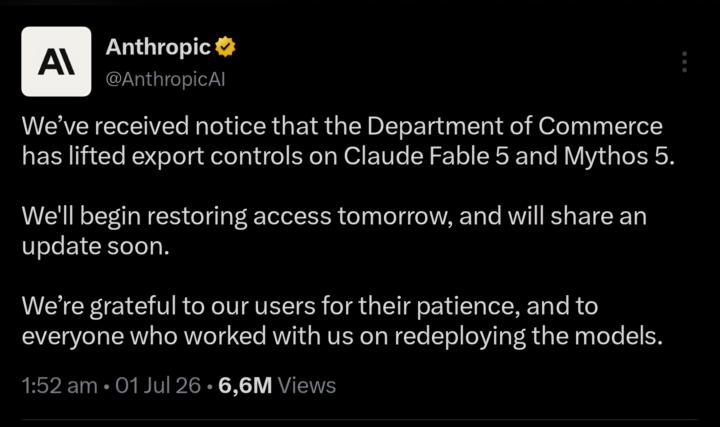
Over the past few days we've watched something fascinating happen. Anthropic announced that Claude Fable 5 and Claude Mythos were temporarily unavailable in many regions after the U.S. government imposed export restrictions on certain frontier AI models. Whether you agree with the policy or not isn't actually the interesting part. The interesting part is this: The United States clearly believes these models are now strategic assets. Think about that for a second. For decades the world's most valuable exports were things like: • Oil • Aircraft • Semiconductors • Military technology Now... Large Language Models are entering that same category. Governments don't restrict technologies that aren't powerful. They restrict technologies they believe could shift economic, military and geopolitical power. Why this matters for us? As builders, entrepreneurs and operators... We don't get to influence export policy. But we do get to decide how prepared we are. Every major technological shift creates two groups of people. The first group waits until the technology becomes mainstream. The second group learns while everyone else is debating whether it matters. History has generally rewarded the second group. The temporary restrictions actually made me more bullish on AI. If governments are willing to intervene... If companies are spending billions training these models... If nations see them as strategic assets... Then we're probably still incredibly early. The conversation has moved beyond "Can AI write an email?" We're now talking about technology that governments believe is important enough to regulate at the highest level.
2
0
1-10 of 10
skool.com/ai-ops
AI for people who actually build.
Websites. Content. Leads. Systems. Sales.
Tested in production. Stripped of fluff.
Founding Operators: free.
Leaderboard (30-day)
1

+1
Powered by