
Apr 14 • General discussion
Vaisakhi Is Not A Harvest Festival. Here's The Full Picture.
Every April, the world tells you to go celebrate. Eat well, dance, be grateful. And every April, one of the most politically significant dates in Sikh history gets quietly stripped of everything that makes it matter.
This is the breakdown I promised you. No shortcuts.
🔹 Where The Confusion Comes From
Vaisakhi does coincide with the spring harvest in Punjab. That's a fact. But coincidence is not meaning. Christmas coincides with the winter solstice — that doesn't make it a festival of astronomy.
The harvest framing isn't accidental. It's the result of centuries of deliberate cultural flattening — first by Mughal rule, then by British colonial administration, and now by a media landscape that finds it easier to cover bhangra dancers than to explain sovereign declarations.
The Sikh community has, in many cases, internalised this framing without questioning it. That's what this post is about.
🔹 What Actually Happened On Vaisakhi 1699
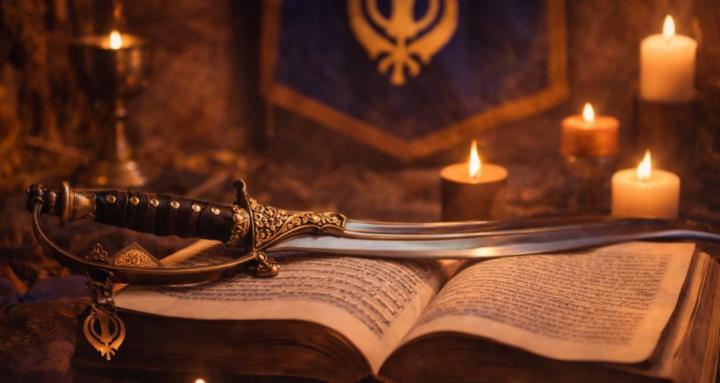
Anandpur Sahib. Roughly 80,000 people gathered. Guru Gobind Singh Ji emerged from a tent holding a drawn sword and asked a single question:
Who here is willing to give their head for the Panth?
Silence. Then one man stood. He was taken inside the tent. The crowd heard what sounded like a strike. Guru Ji emerged again, sword bloodied, and asked again. Five times. Five men. The Panj Pyare — the Five Beloved Ones.
Those five were not chosen to lead a festival. They were chosen to lead a free people.
Guru Gobind Singh Ji then did something no Guru had done before. He asked the Panj Pyare to administer Amrit to him in return. The Guru became the disciple. The hierarchy was dissolved. The Khalsa was born.
🔹 What The Khalsa Actually Meant
The word Khalsa comes from the Arabic khalis — meaning pure, and crucially, belonging directly to the sovereign. In Mughal land administration, Khalsa land meant land under direct royal control — no intermediary, no feudal lord.
Guru Gobind Singh Ji took that word and applied it to people.
Khalsa Sikhs would answer to no earthly authority. No caste. No king. No priest class. Only Waheguru and the Guru Granth Sahib Ji. That is not a religious statement. That is a political one.
The five Kakars — Kesh, Kara, Kanga, Kachera, Kirpan — were not symbolic accessories. They were a uniform. A declaration that you were part of a distinct, sovereign, visible people. You could not be Khalsa and be invisible. That was the point.
🔹 Sarkar-e-Khalsa — The Nation That Followed
What was declared at Anandpur in 1699 found its fullest political expression a century later.
By the early 1800s, under Maharaja Ranjit Singh, the Sikh Empire — Sarkar-e-Khalsa — governed Punjab, Kashmir, and large parts of what is now northwestern Pakistan and Afghanistan. It was one of the most powerful states in Asia. It had a professional army that defeated Afghan forces repeatedly. It maintained diplomatic relations with the British East India Company as an equal.
This was not a feudal chieftainship. It was the institutional expression of what the Khalsa had declared in 1699 — a sovereign people governing their own land.
🔹 1947 And What Was Lost
The Sikh Empire ended with the Anglo-Sikh Wars of the 1840s. Punjab was annexed. Then in 1947, when the British partitioned the subcontinent, Punjab was divided without Sikh consent.
Sikh leaders were promised significant autonomy and protections within India. Those promises were not kept. The Anandpur Sahib Resolution of 1973 — which called for genuine federal autonomy for Punjab — was dismissed as secessionist.
What followed through the 1970s and 80s is a history that most diaspora Sikhs know only in fragments. The point here is this: the trajectory from 1699 to the present is not a story of religious celebration. It is a story of a people who declared sovereignty, built a nation, had it taken, and have never stopped asking for it back.
🔹 What This Means For Diaspora Sikhs Today
Here is the question this community exists to sit with:
If Vaisakhi is your founding moment — your 1776, your Bastille Day — what does it mean that most of us treat it as a cultural occasion rather than a political one?
It means we have accepted someone else's framing of our own history. And you cannot build a future on a history you do not understand.
Knowing this does not mean you stop enjoying the langar or the nagar kirtan. It means you know what you are actually commemorating when you do. It means when someone asks you what Vaisakhi is, you do not say "our harvest festival."
You say: it is the day the Khalsa was declared. A sovereign people. Our founding moment.
🔹 Three Things To Take Away
- Vaisakhi 1699 was a political and spiritual declaration — the birth of the Khalsa as a sovereign people answerable to no earthly authority.
- Sarkar-e-Khalsa was not a concept. It was a state. One of the most powerful in Asia. It was built on the foundation laid at Anandpur Sahib.
- The harvest festival framing is not neutral. It strips political meaning from a people who have every reason to hold onto it. Reject it.
This is what Taking Us Forward is here to do — give you the real picture, not the comfortable one. If this landed, share it with someone who needs it.
☬
2
0 comments
Vaisakhi Is Not A Harvest Festival. Here's The Full Picture.
powered by
skool.com/a-path-forward-2564
Serious discussion on Punjab’s future, institutional reform and personal discipline. Built for thinkers, not spectators.
Suggested communities
Powered by