Activity
Mon
Wed
Fri
Sun
Sep
Oct
Nov
Dec
Jan
Feb
Mar
Apr
May
Jun
Jul
Aug
What is this?
Less
More
Memberships
Cancer Warriors Vault
45 members • $10/month
Cancer Warriors
547 members • Free
171 contributions to Cancer Warriors

24d •
Does Anyone Have Experience Using This Natural Compound?
Dr Paul Marik: Modified Citrus Pectin (MCP) binds to a specific protein called Galectin-3. Galectin-3 is expressed on cancer cells and allows them to bind to the endothelium. It allows the cancer cells to get through the endothelium. It allows the cancer cells to clump together, and so it plays a really important role in the metastatic process. There's really good data, particularly in experimental models. If you give MCP, which binds to Galectin 3 you reduce the risk of metastasis. MCP is taken orally. It's safe and has no side effects. EOM -------------------------------------- If so, please share your experience here. Thank you. The video: https://youtu.be/Al_NPY5AiI8?t=2023

3 likes • 23d
Wow! Yes, I used to take this but then RGCC test said it was 0% for me. But I think testing some things like CTC only in vitro misses upstream signaling that is influenced by the tumour microenvironment which is why my oncologist does organoid work now. I think this data is really promising and I should take it again!
Jul 2 •
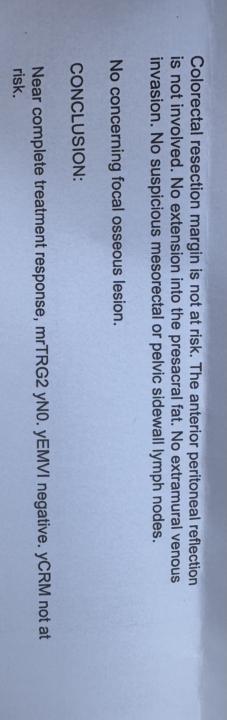
MRI results - near complete response
Hi fellow warriors! ✨ Just a quick update on my journey. I took an integrative approach to my last protocol, combining radiation with fasting, HBOT, repurposed drugs, RLT, and a GKI-friendly meals. I’m happy to share that I’ve achieved a “near complete” treatment response. This result surprised my oncology team, especially since I opted out of standard “Total Neoadjuvant Therapy” (avoiding Oxaliplatin). Because there’s still some scar tissue and inflammation, I’ll need a sigmoidoscopy to see how much of Shrimpy Boy is actually left (if any). My radiation oncologist and I are hoping it’s actually inflammation of surrounding tissues. 🤞 Now I’m moving into a “watch and wait” phase, supported by my oncologist’s knowledge that radiation’s impact can continue to work on tumour cells for months, especially when supported by metabolic therapy. I’m staying patient and vigilant, hoping that this is either a full response or one that will become “complete” very soon. Part of me just wants to fast the shit out anything left, but with knowledge that autophagy can also be weaponised by cancer cells, I’ve decided against this. Best of all I’ve avoided the “near certain” side effects of pelvic radiation—no burns, no bowel issues, and my fertility is intact. I know this might not last forever and I’d be delusionally optimistic to not expect late-onset side side effects. I’m not sure how much longer I’ll stay away from antioxidants due to the “antioxidant paradox”, which ultimately led to my decision to pause some of my supplements and not take Vitamins C, A, E, and CoQ10 during the seven weeks of radiation. Because they act as free-radical scavengers, reintroducing them can risk lowering ROS within the cancer cells, inadvertently shielding Shrimpy Boy from continuous DNA damage over time. I acknowledge that not everyone agrees with pausing antioxidants and that the data remains highly conflicting. Ultimately, this was a decision made strictly for my own peace of mind, rather than an assertion of personal expertise (and is NOT medical advice).
0 likes • 25d
@Marie H. Thank you! Honestly, too many eating disorder relapses from analysis paralysis over what the right diet for cancer is. I’ve had enough of dietary tribalism and dogma. Now I just pay attention to the GKI. Naturally that means low-carb, but I am more flexible. And when things are moving in the wrong direction I just hack it with berberine, metformin, apple cider vinegar, MCTs, etc.
2 likes • 25d
@Marie H. I’m so sorry to hear that. I started practising as a nutritionist late last year and apart from a few older male clients, nearly all the women have had some kind of disordered eating most of their lives. So from day dot, I decided not to be biased and that I would use the term “GKI-friendly” or “ketogenic metabolic therapy” like Dr Duraj and explain it’s a metabolic state - not a diet. If deep therapeutic ketosis has been needed we got to it in creative ways and I also have done a lot of experimenting on myself. Through the fasting window before radiation, I learned that just by finishing a dinner by 6 the day before (low carbish but not “keto”) - by the time I got irradiated at 11 the next day - my GKI was generally 1.5. When you’ve had nearly no carbs for so long, general low carb is SO easy. I hope you find something that is well-balanced for you, so that you benefit from the anti-inflammatory benefits of ketones, differential stress resistance during chemo, but also have mental peace. It took me a lot of trial, error and relapsing, but now I choose consistency over the dogma-fuelled pursuit of perfection every day of the week! 🥰

Jun 30 •
Pray4Isla
Joining this community to feel less alone as we walk through DIPG with our 12-year-old daughter Isla. Please keep her in your prayers. ❤️
0 likes • Jul 2
Welcome Mili and so sorry she has to go through this so young. ❤️

Jun 27 •
Data interpretation by Casey Peavler
Good afternoon. Although Casey Peavler is mentioned here several times, I still want to emphasize that it is worth spending more time studying his materials, because I have not yet seen any other blogger who has analyzed the metabolic pathways of cancer and the drugs or natural compounds that help block these pathways in more detail than he has. His videos are relatively short, detailed, and provide a lot of research-backed facts, numbers, and graphs. Please note that Casey Peavler provides precise dosages of medications and natural compounds in almost all of his videos and compares their final concentrations in the blood. Essentially, he reveals information about the amount of medication and its form that is sufficient to have a significant impact on cancer treatment, as well as the doses that should be avoided due to the lack of further positive effects from increasing the dosage. Regarding hyperbaric and normobaric oxygenation, he provides evidence that normobaric oxygenation is just as effective as hyperbaric oxygenation in treating tumors. Normobaric oxygenation is more natural for humans and does not cause complications. Additionally, if I am not mistaken, normobaric oxygenation is less expensive than hyperbaric oxygenation. There may be some inaccuracies in my data, but studying his interpretation of the data seems to me the most appropriate.
1 like • Jun 27
He is very thorough - love his work! I think it’s his delivery, unpolished content and choppy use of AI in his video shorts that may be contributing to the fact he isn’t given the credit he deserves. The way he unpacks studies, compares subject groups, gives dosing details etc. is extremely valuable. It seems like there is a superficial disconnect on social media between scientific information density and design. It’s frustrating that a content creator with no lived experience or scientific expertise can get lots of attention or praise based on the visual appeal of their posts and click-bait-y BS. It’s like a false trust signal that even I used to fall for.
Jun 16 •
Advice please
My heart is heavy. My friend is going downhill fast with her cancer. She is finding it hard to eat and take all the supplements she has been given. She has Ivermectin Paste and Fenben but wants to wait until she sees an integrative physician this thursday. We have been looking at IVC and Hyperbaric therapy. Is 1.5 pressure enough? I was told that she needs 2 ATA for real progress but then i read 1.5 I have just read on substack from "repurposed oncologist" that now its better to do the 3/4 day metabolic pulse protocol. says the data shows that continuous daily dosing fails and how a structed seventy two hour wave prevents tumor adaptation. Can you advise me. My friend has liver problems as well and has been told that Ivermectin not good? Im sure dying is worse than worrying too much about your liver at this stage? Love your advice. thank you so much
0 likes • Jun 18
@Cheryl Mcduff I have been in this boat many times. This sounds brutal, but don’t expend too much emotional currency if there’s strong evidence she doesn’t want to change. I have tried to help some friends of my parents whose carers wanted metabolic therapy guidance, but they were not open to anything unconventional. And then when some changed their mind it was sadly too late. Even as an integrative cancer coach myself, it’s really hard not to burn yourself out trying to rush people through the change readiness stages. It’s particularly difficult when someone has lost the “will to survive” as you put it.
1 like • Jun 18
@Cheryl Mcduff this is definitely not my area of expertise, but studying to become a nutritionist I did learn a bit about fatty liver and bile issues that can impact liver enzymes. If she’s not into alternative stuff it’s definitely not a herbal overdose. Has she already been on a lot of drugs with high toxicity? Other things I’m wondering about and that may be worth exploring are alcohol, fructose or if something could be obstructing the bile duct, e.g. if not tumours then enlarged nodes, gallstones, cysts, or even pancreatitis. There’s so many possibilities, so maybe it’s worth considering an ultra sound? Sorry these are all what ifs and not very helpful. But my friend was recently diagnosed with metastatic colon cancer because she had liver pain and elevated markers and asked for an ultrasound. Prior to that they just said she had polyps that needed removing. Sometimes you have to advocate for testing that don’t seem extra at all - it seems common sense, but the longer I’ve had cancer the more I’ve realised common sense doesn’t always prevail in our medical systems. 😢
1-10 of 171

@lisa-drake-4174
35 YO 🇦🇺/🇨🇦 who lifts & kicks cancer’s ass with KD, herbs, HBOT & more ReDO drugs than yo neighbourhood dealer!🏋️🥩💊🌿
Instagram: lisamarydrake
Active 5h ago
Joined Aug 10, 2024
Melbourne
Powered by