Activity
Mon
Wed
Fri
Sun
Nov
Dec
Jan
Feb
Mar
Apr
May
Jun
Jul
Aug
Sep
What is this?
Less
More
13 contributions to Deconstructing with Aleeza

Jun 2 •
Anyone still thinking about Natchez?
I am still thinking about it, you? @Sarah Jones @Alexander Skye @Davina Kerrelola @Amy Maez

2 likes • Jul 19
@Alexander Skye I’m still thinking about this documentary and I agree, our language usually doesn’t align with the reality. I think in many situations it’s because there aren’t really words. Your comment made me think of ACT, acceptance and commitment therapy. From my understanding it’s the idea that you practice radical acceptance, accepting that what has happened has happened and then commit to making the changes you can. I think the acceptance requires a great deal of processing grief and other difficult emotions. These can obviously vary depending on positionality. But I think a core reason why so many of my fellow white people seem so stuck in upholding white supremacy is as a whole we’re still trying to hide and deny what we’ve done and continue to do. We can’t move forward without accepting and working to repair our past and current harms. I appreciate your vulnerability and honesty about what’s come up for you and you’re not alone. It’s a lot to look at and process and takes more time to process than I would like. 🥴
Jul 12 •
A post about how we white people don’t have friends
https://www.facebook.com/share/p/18oim4DMXV/?mibextid=wwXIfr
1
0
Jul 11 •
Thoughts on Comfort and the Delusion it Creates
The article from psychology today is great and I think it’s also important that those of us who are white examine how we use our right to comfort to define others’ reality as well as our own. Psychology Today: Get Comfortable With Being Uncomfortable https://www.psychologytoday.com/au/blog/automatic-you/202209/get-comfortable-with-being-uncomfortable?fbclid=IwdGRjcAS_uTlwZG9mAWZkaWQWUKZU4Rrx59eBjL7jehXqQ7qv7JQPfmV4dG4DYWVtAjExAHNydGMGYXBwX2lkCjY2Mjg1NjgzNzkAAR4E390i5lb1HA_1SjsOeqV6JhQb22kcq1AKBT0hFR9GVFR2qY8snUhqKH-M4Q_aem_AwOP-V3F0WLYel7QUV0xbA Facebook Post w/ Commentary https://www.facebook.com/share/1DRFqcDs5z/?mibextid=wwXIfr
1
0
Mar 30 •
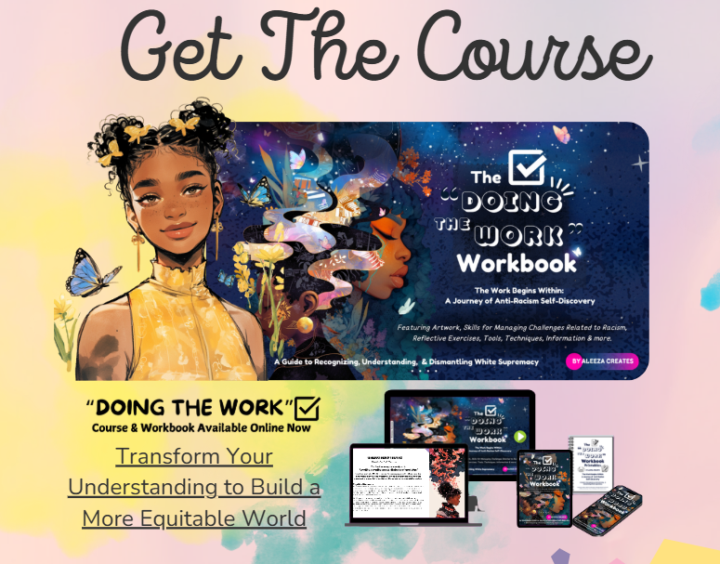
Doing the Work is available in the Classroom tab!
The foundational course designed to help you build real understanding of how race and racism actually function, beyond surface-level conversations, good intentions, or personal anecdotes. This course breaks down key concepts like systemic racism, power, racialization, and harm, while challenging common myths and misunderstandings that keep people stuck. You’ll learn how racism operates not just through individual actions, but through systems, structures, and everyday participation, and how to recognize your role within that without collapsing into defensiveness or avoidance. This course centers impact over intent, and gives you the language, frameworks, and self-awareness needed to engage responsibly in conversations about race. 👉 Doing the Work is the recommended starting point before taking more applied courses like the Allyship Toolbox. Want to learn more about Deconstructing Race, Racism and Theater? Take the course. This isn’t about perfection or being seen as “good.” It’s about building the clarity and capacity to show up differently, consistently, and with accountability. Sliding Scale: Making Learning Accessible for Everyone 💛 Education should be accessible. In this economy, groceries are expensive. Rent is still due. Existing is expensive. We can all use a break. I never want cost or financial barriers to be the reason someone can't access this work. That's why I offer flexible options for my courses: ✨ Pay what you can if that's what works for your budget. ✨ Can't pay right now? That's okay. Reach out and let me know you plan to pay later. ✨ Need a payment plan? Let's work something out together. I'd rather find a solution than turn someone away. ✨ Scholarships are available for those who need them. At the same time, I want to honor that labor has value. Creating courses, research, resources, graphics, and community spaces takes time, energy, and care. If you're able to contribute financially, your support helps make this work sustainable and helps me continue offering scholarships and flexible pricing to others.
1 like • Jun 9
@Sarah Ackerman oof, not the well-spoken. That’s a micro-aggression. It’s historically been because we don’t expect Black people to sound intelligent and well-spoken so we “praise” them when we wouldn’t praise a white person or we would use different language. For example, I might say, this is easy for me to understand or the way you word things helps them click for me. “Articulate” is another one we use a lot with Black people that’s also micro aggressive. Hopefully that makes sense and @Aleeza McCant please correct me if I got anything wrong. Glad you’re here Sarah and willing to grow and change! Welcome!
0 likes • Jun 10
@Aleeza McCant thank you. I struggle with problematic sayings and idioms a lot. My kids call me out on it. It’s things my family has said for generations and I don’t think about it until it’s come out of my mouth. I’m catching things more quickly but often not quick enough. 🤦🏻♀️
Jun 7 •
Chamieka on Privilege
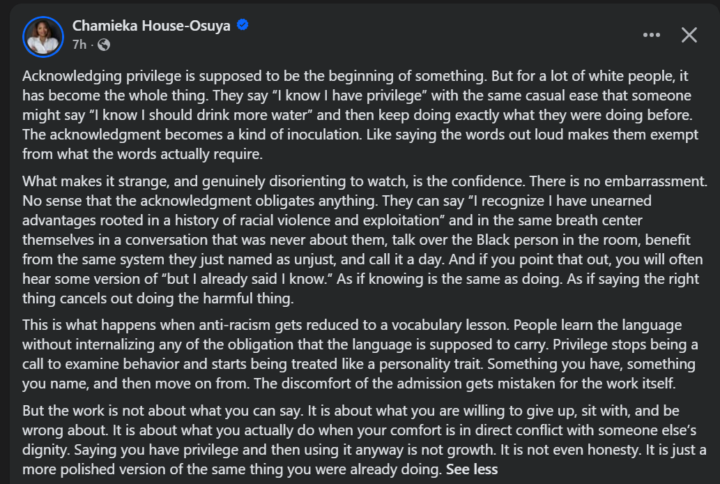
Acknowledging privilege is supposed to be the beginning of something. But for a lot of white people, it has become the whole thing. They say “I know I have privilege” with the same casual ease that someone might say “I know I should drink more water” and then keep doing exactly what they were doing before. The acknowledgment becomes a kind of inoculation. Like saying the words out loud makes them exempt from what the words actually require. What makes it strange, and genuinely disorienting to watch, is the confidence. There is no embarrassment. No sense that the acknowledgment obligates anything. They can say “I recognize I have unearned advantages rooted in a history of racial violence and exploitation” and in the same breath center themselves in a conversation that was never about them, talk over the Black person in the room, benefit from the same system they just named as unjust, and call it a day. And if you point that out, you will often hear some version of “but I already said I know.” As if knowing is the same as doing. As if saying the right thing cancels out doing the harmful thing. This is what happens when anti-racism gets reduced to a vocabulary lesson. People learn the language without internalizing any of the obligation that the language is supposed to carry. Privilege stops being a call to examine behavior and starts being treated like a personality trait. Something you have, something you name, and then move on from. The discomfort of the admission gets mistaken for the work itself. But the work is not about what you can say. It is about what you are willing to give up, sit with, and be wrong about. It is about what you actually do when your comfort is in direct conflict with someone else’s dignity. Saying you have privilege and then using it anyway is not growth. It is not even honesty. It is just a more polished version of the same thing you were already doing. source https://www.facebook.com/share/p/1bAFMyyMoU/
0 likes • Jun 8
“It is about what you actually do when your comfort is in direct conflict with someone else’s dignity.” This line really hit me. It’s powerful.
1-10 of 13