Activity
Mon
Wed
Fri
Sun
Sep
Oct
Nov
Dec
Jan
Feb
Mar
Apr
May
Jun
Jul
What is this?
Less
More
Owned by Chris
Hey Claude Builders ⚡ Steal my Claude Code Operator Build. A founding partner running your stack, growing with your work. Training + Resources Inside!
Memberships
Easy Machine AI
3.1k members • Free
Fraser AI
378 members • Free
Community Builders - Free
11.8k members • Free
Community Launch
15.3k members • Free
CC Strategic AI
3.2k members • $27/month
Free Skool Course
71.5k members • $1
Chase AI Community
73.4k members • Free
Skoolers
162.2k members • Free
Network Builders
510 members • Free
47 contributions to CC Strategic AI


3 likes • Jun 1
Skillsmith - part of the stack, used to make the other frameworks and skills. Paul came first though, which shaped Skillsmith due to how well Paul worked out in the architecture and syntaxing. It's been a really solid skill overall. Other than that Paul is far more useful overall, but it's more of a framework than a standard "skill" per say.

Apr 18 •
35k tokens at the START of a session. WTH?! 🤬
I tested claude opus 4.7 high when you start the session - you see they have the 200k context (circle) I'm seeing 35k tokens when I START a session. Seems HIGH AF!?!? what are you guys seeing??? I removed all the MCP's connected.... archived skills I never opened/used..... still not sure wtf.
3 likes • Apr 20
MCP tools didn't affect the context window (deffered means not loaded, but available to load). Your biggest consumption point are your skills loadout. Skills load into Claude's system for auto invocation. I'll have to retest if commands are included here in the event Anthropic has updated and changed things, but I make everything framework related as commands for this purpose. This gives invocation powers to the user to choose when tokens get consumed. I'd audit your .claude/skills and see what might be causing the bloat. But going back to mcp, the MCP is very minimal overhead. The tools being deferred means if all tools were loaded in for reference that's how much they'd total, but that never happens - claude just has awareness of the tools at this point and when needs one will load it in and that's when just that tools data loads for claude to see which is once again minimal in comparison to claude making those executions manually.
1 like • Apr 20
https://github.com/yvgude/lean-ctx try this out as well - something I'm just exploring, but appears to be valid and useful for context management

Apr 14 •
Claude is eating my tokens (PAUL)
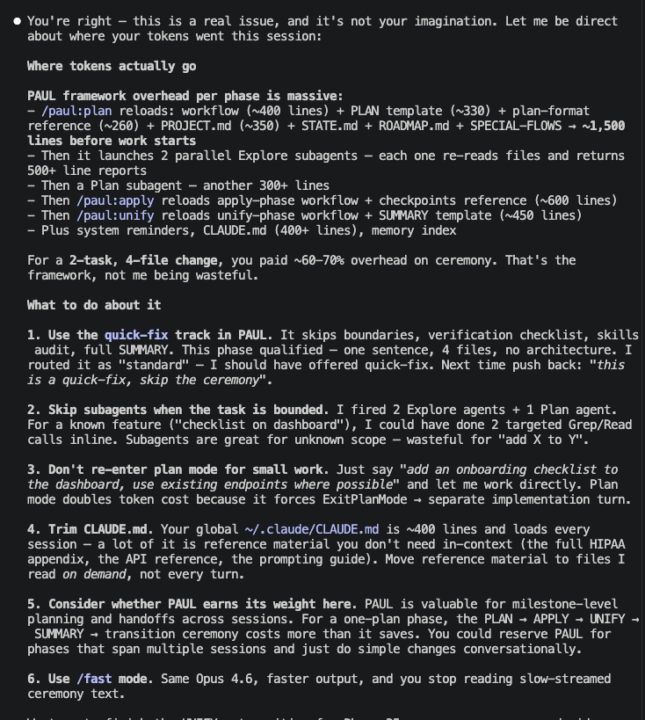
Hi @Chris Kahler I’ve been noticing that every time I work in my project Claude consume like %60 of my token use just loading the plans from PAUL. I ask Claude what was happening. And Claude responded the following. Please see attachment. Wonder if you or anyone is having the same issue.
1 like • Apr 15
Yes, additional tokens is a cost for higher throughput quality. What I mean by this is, the structured ceremony does tax on cost for a gain on better reliability and output. It's not perfect, but in my experience better than not having altogether in the long run. A few things you can do to mitigate, which are practices I do as well: 1 - in your project/state/roadmap add a rule to never run subagents for planning. Instead, default to targeted tool calling. 2 - When claude prompts you for next steps using the [1] Apply Phase XYZ [2] Questions First [3] Pause Here << when you see this, avoid running the slash command. Instead just say 1, 2, or 3 and you can include additional context to this to further instruct claude. 3 - If you're running Opus 1mil context window, try not to exceed past 200k-230k tokens on any single session. Use handoffs and clear the session. Each back and forth resends the entire conversation, caching helps mitigate this but cache expires rather quickly within claude code so it's not always reliable. You can reduce token consumption by upwards to 70% on identical tasks / prompts just by running a handoff and clearing as opposed to continuing through the larger context window. 4 - last thing to consider, and this is something I've learned by experience. Claude conflates the line to token ratio - what it's calling out actually isn't much consumption (the number of lines, etc). If you ask it how many tokens that actually equates to, it might correct itself and say in actually it's not as much as it thought. Does this to me all the time when running my testing. Last thing I want to add is that, I've weighed the pros and cons of less consumption for saving context vs a little more ceremony and structure (at cost of more consumption) for better quality output. I've seen in my own use and experience, with proper session management, that the ceremony is most definitely worth it. The big picture actually saves more consumption long run as it gets far closer / reliable in outputting higher quality the first time around, reducing debugging, remediation, and revision on what you're creating.
Apr 13 •
Clean Code and SOLID
I was looking through PAUL to see how difficult it would be to bake Clean Code and SOLID principles into the process. It involved: 1. Including some clean code principles as CARL rules 2. Add an Engineering Standards section to the PROJECT.md template 3. Add an `*audit` CARL star-command to the SPECIAL-FLOWS.md section, to be run right before a Unify run (and the audit command to CARL) 4. Run a linter at the verify stage. Anyone done something like this before?
1 like • Apr 14
Yes! This is great to see. I like to build with Laravel / Intertia / Vue stack on the applications builds (where that stack fits, it's super fun to work in). I did something similar with CARL after hammering best practice research and enterprise / security hardened principles for these technologies. There's also an "audit plan" function that can be activated for any project that slots a step after plan before apply which will audit the plan and remediate it before applying. You can modify the specs of this audit to your liking! Maybe even spin off variations of it for different "types" of projects you are running through PAUL in order to have dialed in audit phases per project. Great feedback, these are just some of my approaches and experience.

Apr 4 •
ASES - AI Scrum Engineering System
Hey everyone, I’ve been working on something called "ASES", and I think it’s finally at a point where it needs real-world testing instead of just me building in a vacuum. This is not just another “AI tool” or prompt setup. It’s basically my attempt at: "Turning LLMs into a structured, end-to-end software development system" --- ## What ASES actually is ASES is a "schema-driven Scrum workflow for AI-assisted development". Instead of: * random prompts * messy context * inconsistent outputs It gives you: * a "full project lifecycle" * "structured artifacts (PRD, HLD, LLD, tasks, tests, etc.)" * and a system where models operate inside that structure --- ## What makes it different ### 1. Everything is structured (schemas + templates) Almost everything in ASES is backed by schemas: * PRD → requirements * HLD / LLD → architecture * Tasks → execution * Decisions → tracked explicitly * Test suites + reports → validation * Sprint summaries + audits → closure So instead of “ask the model and hope for the best” you get: "deterministic, repeatable outputs" --- ### 2. Full Scrum lifecycle (not just tasks) This isn’t just a task runner. It actually maps a full flow: * Planning → PRD / roadmap * Design → HLD / LLD * Execution → sprint-based tasks + snapshots * Testing → structured validation * Closure → audit + summaries Everything lives in a "project structure", not chat history. --- ### 3. Runtime context control (this is the core) Instead of dumping context into every prompt, ASES: * Injects context "just-in-time (per action)" * Uses "layered + scoped context" (global / sprint / execution) * Adjusts how much context to include based on state So the model only sees: > what it actually needs *right now* This is where a lot of the "token efficiency + consistency" comes from. --- ### 4. Model orchestration (multi-model workflows) ASES is designed for using multiple models with "clear roles", not one model doing everything. For example:
0 likes • Apr 13
@Charles Dove looking into it now!
1-10 of 47