Activity
Mon
Wed
Fri
Sun
Aug
Sep
Oct
Nov
Dec
Jan
Feb
Mar
Apr
May
Jun
What is this?
Less
More
Memberships
Clief Notes
40.7k members • Free
AI Automation Society
417k members • Free
AI Automation Agency Hub
327.6k members • Free
7 contributions to Clief Notes

13d •
It's Happening - The Future is Files
Jake's ICM (March 2026) Google's OKF (June 2026) Now, Vercel's open-source Eve approach, just yesterday. There's an industry-wide convergence around "file-based" AI architectures happening right now. It's happening fast, maybe faster than I thought. Jake published ICM, a Unix-based methodology using folders and files, instead of code-heavy frameworks (AutoGen, LangChain, etc.), to create an architecture that runs sequential, HITL AI workflows. It's light, simple to build, simple to manage, and simple to share. It works well for most assisted work tasks and, while there's merit in other frameworks for handling more asynchronous, always-on, heavy automations, the industry seems to be waking up to the idea that for most jobs, a file-based system does the trick. I guess when Google published OKF, Vercel caught on to the wave and decided to publish Eve. In short, Vercel's Eve focuses on markdown files and TypeScript. An agent is a directory; you define the agent/directory.eve, add instruction.md files and TypeScript files for it to run. Eve compiles it into an app running on Vercel functions. Essentially, this is just Vercel introducing a form of ICM native to its platform. I read Jake's ICM paper (if you haven't, spend some time to do so), it's robust and plainly spells out what everyone else in the industry is starting to realize. For most workflows, simple is better. That isn't to say you can replace all your tools and processes with files. Even Jake himself states that for certain workflows there are better frameworks, but for most of our work now, and until AGI, this just works. What I take away from this: 1. Focus on the fundamentals and think in first principles as much as possible. Everyone is constantly putting out new tools, frameworks, etc. It's easy to become overwhelmed when you weigh everything the same and are constantly "rediscovering" things for the first time. When you understand the underlying principles, hundreds of "new" tools start to look like hundreds of variations of the same 5 things.

1 like • 13d
@Mira Bradshaw full circle moment 😏
1 like • 13d
@Curtis Hays I've watched it, definitely could watch again!
14d •
Let's Talk About It
"In a world full of answers, questions become valuable". I've heard Jake say this and on its face, it makes sense. I really want to understand this concept a bit deeper. For me, I take it as solutions today are a dime a dozen and with AI the speed and accessibility to answers have exploded. Its SO easy to become overwhelmed with all the new tools, updates, tactics, etc, constantly pouring in. I tend to want to ingest it all to always be in the know, always stay ahead and thorough with my approaches but it's exhausting. The focus now is to curate better questions. It's fairly freeing since now I free up all my mental capacity for determine the right questions that will lead me to the correct solution and leave everything else to the tools of today. So, I want to hear from the community. When you hear "In a world full of answers, questions become valuable", what does that mean to you?
1 like • 13d
@Jordan Shaw I'm interested to see that process for my own future builds. That 80% is a major leap for most people and usually results in something good enough but like you said, that intent and specificty with your questions helps build out the rest. Did you templatize that process?
1 like • 13d
@Jordan Shaw thanks for sending that over, I'll take a look. I feel you on the "live in the abstract".
14d •
Congrats — lurker to participant.
That's the leap most people never take. Roughly 90% of our members are still on the other side: scrolling, saving, getting value, never saying a word. Not a knock. Just the math. Lurking isn't failure. It's the default. But you showed up. And that shift compounds fast. The classroom teaches you the tools. The community teaches you how to think with them. When you participate, you get compression — months of grinding folded into a thread someone else already broke so you don't have to. Less friction. Faster outcomes. Personal growth and business growth in the same lane. You don't need a hot take. You need a real question. Give before you extract. Your lurker era wasn't wasted — you were loading context. Welcome to Level 2. A few of you just made the jump, and I want to call it out: • @Vamsi Acharya • @Stacey Lubowa • @Martin Brion • @Mark Benjamin • @Keith Langskov • @Patti Wilcox • @Novus Vella • @Tony Rhodes @Cain Gray If you're still lurking — go check out what they're posting. Real builds. Real questions. No fluff. That's the energy we want in here. And if I missed you — my bad. Drop your name below. We'll get you in the next round. The reward for showing up isn't points. It's speed. You stop duct-taping alone. You stop renting confusion. Your stack starts to click because other people's scars are now in your context. What finally made you break the ice? ───

3 likes • 13d
Thanks for the acknowledgement David! That first leap into community interaction can be a scary one. You're putting yourself, thoughts, opinions, and questions out there for everyone to see, critique, react and engage with. In honesty, I stayed lurking because I was comfortable getting information and having the community in my back pocket without having to expose myself to other. With the many smart people here postings their wins, technical builds, and business insights, I didn't feel I had much to offer of value to the community instead of asking potentially basic questions. It was two realizations that made me leap. First, If I'm going to continue to build my business, I need to learn how to engage with a community and build within. Second, it's almost offensive to have a brilliant community in my back pocket, only taking and not try to give something. So, I made that first post yesterday (thanks for all the replies, I'm planning to reply back!), based on something I was thinking about. I noticed there isnt a lot of posts on that subject so figured I'd let it rip and see what happens. To be frank, I'm not much of a content creator despite my marketing background, so I plan to just use skool as a sort of diary/test moving forward. If it someone finds it valuable, then great, but I'll just be posting what comes to mind or what interests me. To all the lurkers, don't put too much pressure on being some content guru and trying to match all the greatness you see here, just post.
3 likes • 13d
@David Vogel like a nun at a nude beach 🤣 but it's good to share and speak to people I've learned from. 🫵
🔥
May 30 •
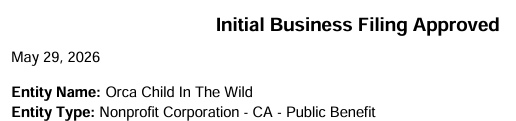
🐋 We Did It. Orca Child In The Wild Is Officially Real.
May 29, 2026. Today the State of California approved our Initial Filing. Orca Child in the Wild is now a recognized Nonprofit Corporation, California Public Benefit. ⚠️ Edit: I need to ask you a favor, if you see this, can you please leave a comment for my daughter, It will mean the world to me! 🐬❤️🔥 Her name is Jordyn I need to take a second to let that sink in. We have been at this for a while now, my daughters dream is to be a marine biologist! 🐬This is not a pet a dolphin passion, although I know she still loves that part. Jordyn is passionate about saving the ocean! 🌊 We have been grateful enough to be able to send her to sea camp a few years in a row and we challenge her to be her dream today, not to wait for it to come true tomorrow. We believe that dreams are meant to be lived! And straight out, So should you! 🔥🌟❤️🔥 What started as a kid who loves the ocean and a family who believed her is now an official organization, recognized by the state, built to protect the waters we all share. From the Los Angeles coast down to San Diego. The tide pools, the kelp forests, the rivers, the lakes, the ponds, and every creature that calls them home. This is a legal status on paper, yes. But here is what it really means: - We can apply for grants and bigger partnerships, so our impact reaches further. - Donations to our mission carry real weight now, backed by a recognized public benefit nonprofit. - The work we have been pouring our hearts into has a permanent home. This was a family effort and a major win and milestone. We are on our way to cleaning up and protecting 120 miles of California coastline. 🏖️ We are now officially the Orca Child in the Wild Family https://www.orcachildinthewild.com (Jordyn created this site, with a little help from dad and Claude Code.)
2 likes • May 30
It's awesome to hear someone so young getting into something so important. No matter the age, you can always push to make an impact, that's inspirational. Best of luck to you!
2 likes • May 30
@Bas Rosario and i just learned something new today, the mission's working already😁

May 21 •
New Building in Public approach
In this season of life, it's challenging to find time to do full coding stretches and manage new products/businesses, so I've started to build and release concepts, ideas and prototypes in a new public repo. I've taken the ICM workflows to heart and built my own variants. I'm also using and building workflows as public projects that others can use as a starter for painful problems I've researched in the marketplace. Love to get feedback from this community - both on the idea of building and sharing this publicly, and the projects that are shared, if they're genuinely useful. The primary thought is I can build and share these in the open rather than hold on to them and do nothing with them. And at the same time, I could build an email newsletter list for the future when I do re-enter the marketplace. I've included some links in the comments below.👇
1 like • May 26
This is very interesting, I'll be keeping tabs on your methods.
1-7 of 7

@mark-benjamin-5293
8 years in customer success with a 5 year focus on marketing. Bring operational efficiency to CX with AI & automation
Active 4d ago
Joined Mar 12, 2026
INTP
Powered by