Activity
Mon
Wed
Fri
Sun
Aug
Sep
Oct
Nov
Dec
Jan
Feb
Mar
Apr
May
Jun
What is this?
Less
More
Memberships
The AI Advantage
126.1k members • Free
13194 contributions to The AI Advantage

7h •
Claude Usage
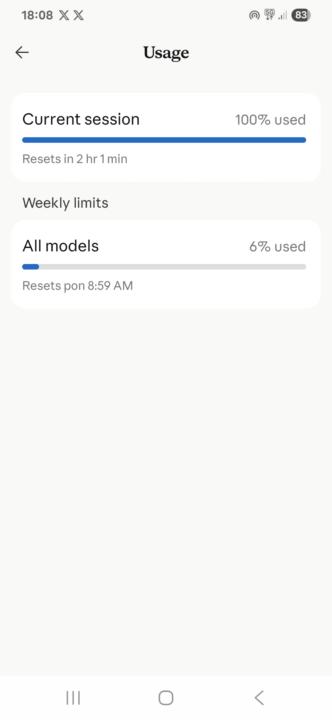
Hello everyone. I have a question about usage. Has anyone else noticed that the usage is increased? I literally put a picture and asked, "I'm connecting supabase, guide me," and I had 79% used. After that question it took 21%, like 21%. I put it on Sonnet 4.6, low effort, and I didn't enable thinking. What is happening with Claude? What are they doing? They have increased usage. Does anyone else have similar issues? It's the same as they do with electric cars, candies and what dealers do with drugs: 1. They first give it for free. 2. You get yourself on it. 3. You cannot live without it. 4. You pay. Same with cars: first electricity was free, now you have to pay more than gas. The same with AI: what are they doing? They will first give it cheaper and then, when you are not going to be able to live without it, they will increase the price while everyone got used to it. People will pay because they cannot function properly without that. That's a fantastic junky addiction marketing trick.

0 likes • 3h
Yeah I get why that’s frustrating, @Mihael Lakus. 🙏 21% for one image + prompt isn’t impossible, but it’s definitely on the heavier side. Images use way more than text, and adding a technical question on top can spike it. Best thing to do is check your usage breakdown in Claude settings (claude.ai/settings/usage.), that’ll show you exactly where it’s going. If something looks off, it’s worth reaching out to their support since that’s all on their side. And honestly, you’re not the only one feeling this. A lot of people are trying to figure out how these limits work right now. It's definitely worth keeping an eye on the usage page so you can see exactly where it's going. -Larissa | AIA Team

3h •
Beginner AI how to:
If ChatGPT gives you an answer that’s too complicated, don’t start over. Simply reply: “Can you explain that in plain English?” or “Pretend you’re teaching a complete beginner.” AI gets better when you keep the conversation going.
1 like • 3h
Great tip, @Roy Shirley! Most people think they need to ask the “perfect” question… but the real power is in continuing the conversation. AI gets better the more you guide it. 💯 That’s how you go from confusion to clarity fast. By the way, Roy, what’s something you asked AI recently that felt too complicated? -Larissa | AIA Team

11h •
🏋️ The Professionals Falling Behind Are the Ones Using AI Too Much
There's a counterintuitive pattern starting to emerge in the communities and conversations we follow closely. It doesn't fit the dominant narrative about AI and professional development, so it tends to get dismissed. But it's consistent enough and specific enough that it's worth looking at directly. The pattern: a growing number of professionals who use AI heavily are reporting, often with some embarrassment, that their ability to think through problems independently, to recall information from memory, to write fluently without AI assistance, feels like it has degraded. Not dramatically. But noticeably. The capability was there before. It's less reliably there now. This is the cognitive atrophy problem. It's real, it's specific, and it's something that smart AI adoption can work against. ------------- Context ------------- Cognitive capabilities are use-it-or-lose-it in a way that's well established in the research. Memory, reasoning, writing fluency, the ability to hold a complex problem in your head and work it through: these capabilities are maintained and developed through exercise and they degrade through disuse. For most of professional history, the nature of knowledge work required these capabilities regularly. Writing required sustained original composition. Research required holding a developing understanding in working memory as new information was integrated. Problem-solving required independent reasoning before any external validation was sought. The work itself was the exercise. AI tools are changing the exercise load. When AI drafts the writing, the composition muscle doesn't engage. When AI does the initial research synthesis, the information integration work doesn't happen. When AI suggests the analysis framework, the independent problem framing doesn't get practiced. Each of these is individually a small reduction in cognitive exercise. Across a day of heavily AI-assisted work, the aggregate reduction is significant. The capability doesn't disappear immediately. It degrades gradually, in a way that's invisible until a situation arises that requires it without AI assistance: a meeting where you need to think on your feet, a client situation where you need to produce analysis quickly without time to brief an AI, a creative challenge where your own perspective needs to show up rather than an AI-assisted version of it. These situations surface the gap.

0 likes • 6h
@Elizabeth LeBlanc that moment of catching yourself mid-redirect is exactly the kind of self-awareness the post is pointing at. The fact that you noticed it and named it means the independent capability is still there. It just needs the reps to stay sharp. What did you end up doing, did you answer your son yourself or go to Chat? 😄 ~ Luke - The AIA Team

11h •
day2 learning claude code
https://digidar-nine.vercel.app/,I'm on my day2 learnin claude code and i just built this AI agency demo website,also i deploy it.it looks powerful for me,so what's your opinion? also i need your advice guys,please.
0 likes • 10h
@Anouar Kort What specifically are you looking for feedback on?

11h •
Decisions can be awakenings
It was not in my budget to get a new IMAC but frustrated over took me when I couldn’t get CoWork and what an amazing experience to have my loyal assistant Amber work with me. Amber is special to me because I never had a mother’s love till I had my mother in law Amber. I have a question I have a couple weeks written out to post on Facebook & instagram but can I do it all in Claude or another platform about helping to realize an alternative to drugs because God made our bodies to heal. I’m 80+ so I think I can help people with all my challenges through the years. I have a product that has given me abundant energy and I have no health problems.
0 likes • 10h
@Carol Egger the moment frustration pushed you to find a way through rather than give up is exactly the kind of decision the title is pointing at. And having someone like Amber in your corner makes all the difference. On your question, yes, Claude can absolutely help you plan, write, and schedule out weeks of social content in one session. You can give it your ideas, your voice, your key messages, and ask it to write out a full posting calendar with captions ready to copy across to Facebook and Instagram. Many people in the community do exactly this. You do not need any other platform to get started, just start a conversation in Claude and tell it what you want to say and who you are saying it to. What would be most helpful, writing the posts themselves, or figuring out how to structure the calendar first? 💡 ~ Luke - The AIA Team
1-10 of 13,194